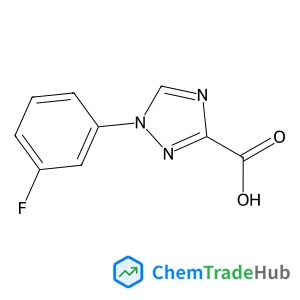
1-(3-Fluorophenyl)-1H-1,2,4-triazole-3-carboxylic acid
CAS Number:
1292369-51-7
Molecular Formula:
C9H6FN3O2
T. Bazaru Rujoiu, A. Petris, V. I. Vlad, I. Rau, A.-M. Manea, F. Kajzar
The light emission properties of the complex formed from deoxyribonucleic acid (DNA)–cetyltrimethylammonium chloride (CTMA) surfactant doped with different concentrations of Rhodamine 610 (Rh610) dye and dissolved in butanol are investigated and discussed. The results are compared to those obtained when only the Rh610 dye is dissolved in butanol, at the same concentrations. The light emission is excited in the investigated samples by the nanosecond pulses of a frequency-doubled Nd:YAG laser, at a wavelength of 532 nm. We have demonstrated the lasing effect in the investigated complex and we have studied its efficiency and coherence properties. The lasing properties of the Rh610 dye are favourably influenced by the presence of the DNA–CTMA complex in the investigated compound. It leads to an increase in the lasing efficiency and in the slope efficiency. Also the temporal coherence of the emitted light is larger and the emission can be tuned to shorter wavelengths.
Rongcai Huang, Kevin H. Shaughnessy
DOI: 10.1039/B509406B
Patrik Västilä, Jenny Wettergren, Hans Adolfsson
DOI: 10.1039/B505516D
Liangru Yang, Alex von Zelewsky, Helen Stoeckli-Evans
DOI: 10.1039/B507769A
Jinxing Ye, Darren J. Dixon, Peter S. Hynes
DOI: 10.1039/B508833J
Victorio Cadierno, Sergio E. García-Garrido, José Gimeno, Noel Nebra
DOI: 10.1039/B506788J
Chunling Fu, Jing Li
DOI: 10.1039/B508069J
Maurilio Galletta, Sebastiano Campagna, Manuel Quesada, Gilles Ulrich, Raymond Ziessel
DOI: 10.1039/B507196H
Edel M. Minogue, Tammy P. Taylor, Anthony K. Burrell, George J. Havrilla, Benjamin P. Warner, Michael T. Janicke
DOI: 10.1039/B506044C
Tim Phillips, Chatna Rajput, Lance Twyman, Ihtshamul Haq, Jim A. Thomas
DOI: 10.1039/B506946G
Sally Dixon, George J. Gordon, Richard J. Whitby
DOI: 10.1039/B508524A
Waste containing N-Methoxy-N-methyl-1,3-thiazole-5-carboxamide (CAS: 898825-89-3...
N-(4-Biphenylyl)dibenzo[b,d]furan-4-amine should be stored in a tightly sealed c...
The market for 3-Acetamido-5-amino-2,4,6-triiodobenzoic acid (CAS: 1713-07-1) is...
Benzyl 2-O-acetyl-3,4,6-tri-O-benzyl-beta-D-galactopyranoside (CAS: 61820-03-9) ...
2-Ethylpiperazine dihydrochloride (CAS: 438050-52-3) is regulated under the Glob...
1,1'-[1,3-Phenylenebis(methylene)]bis(3-methyl-1H-pyrrole-2,5-dione) (CAS: 11946...
Several alternatives can be used in the synthesis of 5-Fluoro-2-(1-pyrrolidinyl)...
Proper personal protective equipment (PPE) must be worn when handling this compo...
When handling 6-Bromoimidazo[1,2-a]pyridin-8-amine, it is important to wear appr...
Alternatives to (2S,4R)-4-(4-Nitrobenzyl)pyrrolidine-2-carboxylic acid hydrochlo...

Physical Chemistry Chemical Physics (PCCP) is an international journal co-owned by 19 physical chemistry and physics societies from around the world. This journal publishes original, cutting-edge research in physical chemistry, chemical physics and biophysical chemistry. To be suitable for publication in PCCP, articles must include significant innovation and/or insight into physical chemistry; this is the most important criterion that reviewers and Editors will judge against when evaluating submissions. The journal has a broad scope and welcomes contributions spanning experiment, theory, computation and data science. Topical coverage includes spectroscopy, dynamics, kinetics, statistical mechanics, thermodynamics, electrochemistry, catalysis, surface science, quantum mechanics, quantum computing and machine learning. Interdisciplinary research areas such as polymers and soft matter, materials, nanoscience, energy, surfaces/interfaces, and biophysical chemistry are welcomed if they demonstrate significant innovation and/or insight into physical chemistry. Joined experimental/theoretical studies are particularly appreciated when complementary and based on up-to-date approaches.