












Origins of optical absorption characteristics of Cu2+ complexes in aqueous solutions
Literature Information
Publication Date
2015-06-01
DOI
10.1039/C5CP01688F
Impact Factor
3.676
Authors
S. Roger Qiu, Brandon C. Wood, Paul R. Ehrmann, Stavros G. Demos, Philip E. Miller, Kathleen I. Schaffers, Tayyab I. Suratwala, Richard K. Brow
View Original
Abstract
Many transition metal complexes exhibit infrared or visible optical absorption arising from d–d transitions that are the key to functionality in technological applications and biological processes. The observed spectral characteristics of the absorption spectra depend on several underlying physical parameters whose relative contributions are still not fully understood. Although conventional arguments based on ligand-field theory can be invoked to rationalize the peak absorption energy, they cannot describe the detailed features of the observed spectral profile such as the spectral width and shape, or unexpected correlations between the oscillator strength and absorption peak position. Here, we combine experimental observations with first-principles simulations to investigate origins of the absorption spectral profile in model systems of aqueous Cu2+ ions with Cl−, Br−, NO2− and CH3CO2− ligands. The ligand identity and concentration, fine structure in the electronic d-orbitals of Cu2+, complex geometry, and solvation environment are all found to play key roles in determining the spectral profile. Moreover, similar physiochemical origins of these factors lead to interesting and unexpected correlations in spectral features. The results provide important insights into the underlying mechanisms of the observed spectral features and offer a framework for advancing the ability of theoretical models to predict and interpret the behavior of such systems.
Related Literature
Hierarchical TiO2–SnO2–graphene aerogels for enhanced lithium storage
Sheng Han, Jianzhong Jiang, Yanshan Huang, Yanping Tang, Jing Cao, Dongqing Wu
2014-11-27
Communication
DOI: 10.1039/C4CP04887C
Understanding the conformation transition in the activation pathway of β2 adrenergic receptor via a targeted molecular dynamics simulation
Xiuchan Xiao, Xiaojun Zeng, Yuan Yuan, Nan Gao, Yanzhi Guo, Xuemei Pu, Menglong Li
2014-11-21
Paper
DOI: 10.1039/C4CP04528A
Go natural and smarter: fenugreek as a hydration designer of collagen based biomaterials
Ivy Kanungo, Nishter Nishad Fathima, Raghava Rao Jonnalagadda, Balachandran Unni Nair
2014-12-11
Paper
DOI: 10.1039/C4CP04363D
Retarded dopant diffusion by moderated dopant–dopant interactions in Si nanowires
Jongseob Kim, Ki-Ha Hong
2014-11-21
Communication
DOI: 10.1039/C4CP04513K
A high-temperature dielectric process as a probe of large-scale silica filler structure in simplified industrial nanocomposites
Angel Alegria, Marc Couty
2014-11-20
Paper
DOI: 10.1039/C4CP04597A
Covalency in resonance-assisted halogen bonds demonstrated with cooperativity in N-halo-guanine quartets
Lando P. Wolters, Nicole W. G. Smits, Célia Fonseca Guerra
2014-11-12
Paper
DOI: 10.1039/C4CP03740E
Detecting free hemoglobin in blood plasma and serum with luminescent terbium complexes
Frank Morgner, Alexandre Lecointre, Loïc J. Charbonnière, Hans-Gerd Löhmannsröben
2014-11-24
Paper
DOI: 10.1039/C4CP04206A
A multinuclear solid state NMR spectroscopic study of the structural evolution of disordered calcium silicate sol–gel biomaterials
Zhongjie Lin, Julian R. Jones, John V. Hanna
2014-12-02
Paper
DOI: 10.1039/C4CP04492D
Cyclic voltammetry using silver as cathode material: a simple method for determining electro and chemical features and solubility values of CO2 in ionic liquids
Irene Reche, Iluminada Gallardo, Gonzalo Guirado
2014-11-27
Communication
DOI: 10.1039/C4CP05409A
Analysis of computational models for an accurate study of electronic excitations in GFP
Tobias Schwabe, Maarten T. P. Beerepoot, Jacob Kongsted
2014-12-03
Paper
DOI: 10.1039/C4CP04524F
You might also like
Compound Q&A
What are the main uses of (5-Sulfamoyl-3-pyridinyl)boronic acid (CAS: 951233-61-7)?
(5-Sulfamoyl-3-pyridinyl)boronic acid is primarily used in chemical synthesis, p...
951233-61-7(5-Sulfamoyl-3-pyrid...
Compound Q&A
How is Benzyl 2-methyl-2-(methylsulfonyl)-4-pentenoate (CAS: 1942858-50-5) typically synthesized?
Benzyl 2-methyl-2-(methylsulfonyl)-4-pentenoate is typically synthesized via est...
1942858-50-5Benzyl 2-methyl-2-(m...
Compound Q&A
What precautions should be taken when handling 8-Fluoroquinolin-6-ol (CAS: 209353-22-0)?
When handling 8-Fluoroquinolin-6-ol (CAS: 209353-22-0), it is important to use p...
209353-22-08-Fluoroquinolin-6-o...
Compound Q&A
What are the physical and chemical properties of 1,3-Dibromo-5-(2-methyl-2-propanyl)benzene (CAS: 129316-09-2)?
1,3-Dibromo-5-(2-methyl-2-propanyl)benzene (CAS: 129316-09-2) is a crystalline c...
129316-09-21,3-Dibromo-5-(2-met...
Compound Q&A
What industries use Ethyl 7-chloro-4-oxo-1-(1,3-thiazol-2-yl)-1,4-dihydro-1,8-naphthyridine-3-carboxylate (CAS: 174726-87-5)?
Ethyl 7-chloro-4-oxo-1-(1,3-thiazol-2-yl)-1,4-dihydro-1,8-naphthyridine-3-carbox...
174726-87-5Ethyl 7-chloro-4-oxo...
Compound Q&A
What precautions should be taken when handling Delta-7-Avenasterol (CAS: 23290-26-8)?
When handling Delta-7-Avenasterol (CAS: 23290-26-8), it is important to wear app...
23290-26-8Delta-7-Avenasterol
Compound Q&A
What precautions should be taken when handling N-({(5R)-3-[3-Fluoro-4-(4-morpholinyl)phenyl]-2-oxo-1,3-oxazolidin-5-yl}methyl)acetamide (CAS: 872992-20-6)?
Proper handling involves the use of personal protective equipment such as gloves...
872992-20-6N-({(5R)-3-[3-Fluoro...
Compound Q&A
What precautions should be taken when handling 2-Methyl-2-proanyl 4-[(2-aminophenyl)amino]-1-piperidinecarboxylate (CAS: 79099-00-6)?
When handling 2-Methyl-2-proanyl 4-[(2-aminophenyl)amino]-1-piperidinecarboxylat...
79099-00-62-Methyl-2-propanyl ...
Compound Q&A
What is N-Methyl-4-chlorobenzylamine hydrochloride (CAS: 65542-24-7)?
N-Methyl-4-chlorobenzylamine hydrochloride (CAS: 65542-24-7) is a organic compou...
65542-24-7N-Methyl-4-chloroben...
Compound Q&A
Is [2-(Dodecyloxy)ethoxy]acetic acid (CAS: 27306-90-7) safe?
[2-(Dodecyloxy)ethoxy]acetic acid (CAS: 27306-90-7) is generally considered safe...
27306-90-7[2-(Dodecyloxy)ethox...
Source Journal
Physical Chemistry Chemical Physics

CiteScore:
5.5
Self-citation Rate:
10.3%
Articles per Year:
3036
Physical Chemistry Chemical Physics (PCCP) is an international journal co-owned by 19 physical chemistry and physics societies from around the world. This journal publishes original, cutting-edge research in physical chemistry, chemical physics and biophysical chemistry. To be suitable for publication in PCCP, articles must include significant innovation and/or insight into physical chemistry; this is the most important criterion that reviewers and Editors will judge against when evaluating submissions. The journal has a broad scope and welcomes contributions spanning experiment, theory, computation and data science. Topical coverage includes spectroscopy, dynamics, kinetics, statistical mechanics, thermodynamics, electrochemistry, catalysis, surface science, quantum mechanics, quantum computing and machine learning. Interdisciplinary research areas such as polymers and soft matter, materials, nanoscience, energy, surfaces/interfaces, and biophysical chemistry are welcomed if they demonstrate significant innovation and/or insight into physical chemistry. Joined experimental/theoretical studies are particularly appreciated when complementary and based on up-to-date approaches.
Recommended Compounds
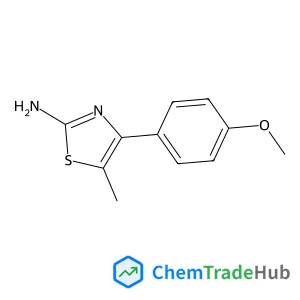
4-(4-Methoxyphenyl)-5-methyl-1,3-thiazol-2-amine
CAS Number:
105512-88-7
Molecular Formula:
C11H12N2OS
![4,10-Dihydroxy-3H-pyrano[3,4,5-kl]xanthen-3-one structure](https://static.chemtradehub.com/structs/125/1259330-61-4-de48.webp "4,10-Dihydroxy-3H-pyrano[3,4,5-kl]xanthen-3-one structure")
Recommended Suppliers





Disclaimer
This page provides academic journal information for reference and research purposes only. We are not affiliated with any journal publishers and do not handle publication submissions. For publication-related inquiries, please contact the respective journal publishers directly.
If you notice any inaccuracies in the information displayed, please contact us at support@chemtradehub.com. We will promptly review and address your concerns.