













Influence of hydration on ion–biomolecule interactions: M+(indole)(H2O)n (M = Na, K; n = 3–6)
Literature Information
Publication Date
2015-09-04
DOI
10.1039/C5CP01565K
Impact Factor
3.676
Authors
Haochen Ke, James M. Lisy
View Original
Abstract
The indole functional group can be found in many biologically relevant molecules, such as neurotransmitters, pineal hormones and medicines. Indole has been used as a tractable model to study the hydration structures of biomolecules as well as the interplay of non-covalent interactions within ion–biomolecule–water complexes, which largely determine their structure and dynamics. With three potential binding sites: above the six- or five-member ring, and the N–H group, the competition between π and hydrogen bond interactions involves multiple locations. Electrostatic interactions from monovalent cations are in direct competition with hydrogen bonding interactions, as structural configurations involving both direct cation–indole interactions and cation–water–indole bridging interactions were observed. The different charge densities of Na+ and K+ give rise to different structural conformers at the same level of hydration. Infrared spectra with parallel hybrid functional-based calculations and Gibbs free energy calculations revealed rich structural insights into the Na+/K+(indole)(H2O)3–6 cluster ion complexes. Isotopic (H/D) analyses were applied to decouple the spectral features originating from the OH and NH stretches. Results showed no evidence of direct interaction between water and the NH group of indole (via a σ-hydrogen bond) at current levels of hydration with the incorporation of cations. Hydrogen bonding to a π-system, however, was ubiquitous at hydration levels between two and five.
Related Literature
Ion–molecule reactions of ammonia clusters with C60 aggregates embedded in helium droplets
Harald Schöbel, Christian Leidlmair, Peter Bartl, Abid Aleem, Michaela Hager, Olof Echt, Tilmann D. Märk, Paul Scheier
2010-11-12
Paper
DOI: 10.1039/C0CP01268H
In vitro hydrogen production—using energy from the sun
Henning Krassen, Sascha Ott, Joachim Heberle
2010-11-23
Perspective
DOI: 10.1039/C0CP01163K
Direct ab initio MD study on the interaction of hydroperoxy radical (HOO) with water molecules
Hiroto Tachikawa, Shigeaki Abe
2010-02-24
Paper
DOI: 10.1039/B923310E
Rotational dynamics of positively and negatively charged solutes in ionic liquid and viscous molecular solvent studied by time-resolved fluorescence anisotropy measurements
Dinesh Chandra Khara, Anunay Samanta
2010-05-29
Paper
DOI: 10.1039/B925099A
On the electron-induced isotope fractionation in low temperature 32O2/36O2 ices—ozone as a case study
B. Sivaraman, A. M. Mebel, N. J. Mason, D. Babikov
2010-11-15
Communication
DOI: 10.1039/C0CP00448K
Negative differential resistance in oxidized zigzag graphene nanoribbons
Min Wang, Chang Ming Li
2010-12-09
Paper
DOI: 10.1039/C0CP00828A
Drainage of the air–water–quartz film: experiments and theory
Rogerio Manica
2010-12-09
Paper
DOI: 10.1039/C0CP00677G
Protein adsorption onto CF3-terminated oligo(ethylene glycol) containing self-assembled monolayers (SAMs): the influence of ionic strength and electrostatic forces
Nelly Bonnet, David O'Hagan, Georg Hähner
2010-02-16
Paper
DOI: 10.1039/B923065N
Supramolecular assembly of a biomineralizing antimicrobial peptide in coarse-grained Monte Carlo simulations
Glenn R. Johnson, Barry L. Farmer, Ras B. Pandey
2010-11-12
Paper
DOI: 10.1039/C0CP01364A
A novel stabilisation model for rutheniumnanoparticles in imidazolium ionic liquids: in situ spectroscopic and labelling evidence
Paul S. Campbell, Catherine C. Santini, Denis Bouchu, Bernard Fenet, Karine Philippot, Bruno Chaudret, Agílio A. H. Pádua, Yves Chauvin
2010-03-10
Paper
DOI: 10.1039/B925329G
You might also like
Compound Q&A
What is 1-(2,4,6-Trifluorophenyl)ethanol (CAS: 1250113-83-7)?
1-(2,4,6-Trifluorophenyl)ethanol is an organic compound with the CAS number 1250...
1250113-83-71-(2,4,6-Trifluoroph...
Compound Q&A
Is 1-(2,4-Dimethoxybenzyl)-4-(hydroxymethyl)-2-pyrrolidinone (CAS: 919111-34-5) safe?
1-(2,4-Dimethoxybenzyl)-4-(hydroxymethyl)-2-pyrrolidinone (CAS: 919111-34-5) is ...
919111-34-51-(2,4-Dimethoxybenz...
Compound Q&A
What are the physical and chemical properties of (7S,15R)-6β,15-Diacetoxy-7α,20-epoxy-7-hydroxykaura-2,16-dien-1-one (CAS: 51419-51-3)?
(7S,15R)-6β,15-Diacetoxy-7α,20-epoxy-7-hydroxykaura-2,16-dien-1-one is a crystal...
51419-51-3(7S,15R)-6β,15-Diace...
Compound Q&A
What regulatory guidelines apply to rac-ethyl (1r,4r)-4-hydroxycyclohexane-1-carboxylate, trans (CAS: 3618-04-0)?
The compound rac-ethyl (1r,4r)-4-hydroxycyclohexane-1-carboxylate, trans (CAS: 3...
3618-04-0rac-ethyl (1r,4r)-4-...
Compound Q&A
What is the market or research trend for 2-(2,4-Difluorophenoxy)-3-nitropyridine (CAS: 175135-62-3)?
The market for 2-(2,4-Difluorophenoxy)-3-nitropyridine (CAS: 175135-62-3) is cur...
175135-62-32-(2,4-Difluoropheno...
Compound Q&A
What are the main uses of 6-Diazo-5-oxo-L-norleucine (CAS: 157-03-9)?
The main uses of 6-Diazo-5-oxo-L-norleucine (CAS: 157-03-9) include research in ...
157-03-96-Diazo-5-oxo-L-norl...
Compound Q&A
What precautions should be taken when handling 2-Aminoethyl-mono-amide-DOTA-tris(tBu ester) (CAS: 173308-19-5)?
When handling 2-Aminoethyl-mono-amide-DOTA-tris(tBu ester) (CAS: 173308-19-5), i...
173308-19-52-Aminoethyl-mono-am...
Compound Q&A
How is 5-Methylimidazo[1,2-a]pyridine-3-carbaldehyde (CAS: 178488-37-4) typically synthesized?
5-Methylimidazo[1,2-a]pyridine-3-carbaldehyde (CAS: 178488-37-4) can be synthesi...
178488-37-45-Methylimidazo[1,2-...
Compound Q&A
Are there alternatives to 2,4,6-Trihydroxyisophthalaldehyde (CAS: 4396-13-8) in synthesis?
There are alternative reagents that can be used in the synthesis of 2,4,6-Trihyd...
4396-13-82,4,6-Trihydroxyisop...
Compound Q&A
What is (2Z)-3-(5-Fluoro-1H-indol-3-yl)-2-sulfanylacrylic acid (CAS: 179461-52-0)?
(2Z)-3-(5-Fluoro-1H-indol-3-yl)-2-sulfanylacrylic acid is a chemical compound wi...
179461-52-0(2Z)-3-(5-Fluoro-1H-...
Source Journal
Physical Chemistry Chemical Physics

CiteScore:
5.5
Self-citation Rate:
10.3%
Articles per Year:
3036
Physical Chemistry Chemical Physics (PCCP) is an international journal co-owned by 19 physical chemistry and physics societies from around the world. This journal publishes original, cutting-edge research in physical chemistry, chemical physics and biophysical chemistry. To be suitable for publication in PCCP, articles must include significant innovation and/or insight into physical chemistry; this is the most important criterion that reviewers and Editors will judge against when evaluating submissions. The journal has a broad scope and welcomes contributions spanning experiment, theory, computation and data science. Topical coverage includes spectroscopy, dynamics, kinetics, statistical mechanics, thermodynamics, electrochemistry, catalysis, surface science, quantum mechanics, quantum computing and machine learning. Interdisciplinary research areas such as polymers and soft matter, materials, nanoscience, energy, surfaces/interfaces, and biophysical chemistry are welcomed if they demonstrate significant innovation and/or insight into physical chemistry. Joined experimental/theoretical studies are particularly appreciated when complementary and based on up-to-date approaches.
Recommended Compounds
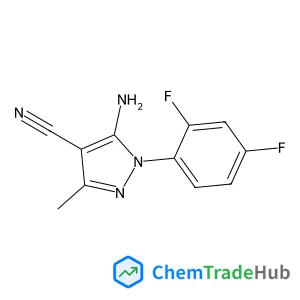
5-Amino-1-(2,4-difluorophenyl)-3-methyl-1H-pyrazole-4-carbonitrile
CAS Number:
1020057-92-4
Molecular Formula:
C11H8F2N4
Recommended Suppliers




Disclaimer
This page provides academic journal information for reference and research purposes only. We are not affiliated with any journal publishers and do not handle publication submissions. For publication-related inquiries, please contact the respective journal publishers directly.
If you notice any inaccuracies in the information displayed, please contact us at support@chemtradehub.com. We will promptly review and address your concerns.