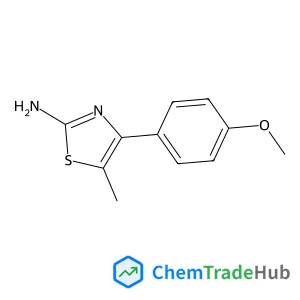
4-(4-Methoxyphenyl)-5-methyl-1,3-thiazol-2-amine
CAS Number:
105512-88-7
Molecular Formula:
C11H12N2OS
Ryan S. Johnson, Hua Guo, Shaun G. Ard, Nicholas S. Shuman
The rates of the reactions Fe+ + N2O → FeO+ + N2 and FeO+ + CO → Fe+ + CO2 are modeled by statistical rate theory accounting for energy- and angular momentum-specific rate constants for formation of the primary and secondary cationic adducts and their backward and forward reactions. The reactions are both suggested to proceed on sextet and quartet potential energy surfaces with efficient, but probably not complete, equilibration by spin-inversion of the populations of the sextet and quartet adducts. The influence of spin-inversion on the overall reaction rate is investigated. The differences of the two reaction rates mostly are due to different numbers of entrance states (atom + linear rotor or linear rotor + linear rotor, respectively). The reaction Fe+ + N2O was studied either with 6Fe+ or with 4Fe+ reactants. Differences in the rate constants of 6Fe+ and 4Fe+ reacting with N2O are attributed to different contributions from electronically excited potential energy surfaces, such as they originate from the open-electronic shell reactants.
DOI: 10.1039/C4CP05094K
Philipp Löper, Soo-Jin Moon, Sílvia Martín de Nicolas, Bjoern Niesen, Sylvain Nicolay, Julien Bailat, Jun-Ho Yum, Stefaan De Wolf
DOI: 10.1039/C4CP03788J
Antonio Abate, Miquel Planells, Derek J. Hollman, Vishal Barthi, Suresh Chand, Henry J. Snaith, Neil Robertson
DOI: 10.1039/C4CP04685D
Yongchang Chen, Miao Huo, Qiang Li, Zhaolin Sun, Lijuan Song
DOI: 10.1039/C4CP04881D
Ahmed Ziani, Ela Nurlaela, Dattatray S. Dhawale, Diego Alves Silva, Erkki Alarousu, Omar F. Mohammed, Kazuhiro Takanabe
DOI: 10.1039/C4CP05616G
Abdenacer Idrissi, B. Marekha, M. Kiselev
DOI: 10.1039/C4CP04839C
Rui Sun, Jiaxu Zhang, William L. Hase
DOI: 10.1039/C4CP03589E
Bo Wang, Shane A. Seabrook, Praveen Nedumpully-Govindan, Pengyu Chen, Hong Yin, Lynne Waddington, V. Chandana Epa, Jason K. Kirby, Feng Ding
DOI: 10.1039/C4CP04996A
Alessandro Erba, Claudio M. Zicovich-Wilson
DOI: 10.1039/C4CP04414B
Lando P. Wolters, Nicole W. G. Smits, Célia Fonseca Guerra
DOI: 10.1039/C4CP03740E
(5-Sulfamoyl-3-pyridinyl)boronic acid is primarily used in chemical synthesis, p...
Benzyl 2-methyl-2-(methylsulfonyl)-4-pentenoate is typically synthesized via est...
When handling 8-Fluoroquinolin-6-ol (CAS: 209353-22-0), it is important to use p...
1,3-Dibromo-5-(2-methyl-2-propanyl)benzene (CAS: 129316-09-2) is a crystalline c...
Ethyl 7-chloro-4-oxo-1-(1,3-thiazol-2-yl)-1,4-dihydro-1,8-naphthyridine-3-carbox...
When handling Delta-7-Avenasterol (CAS: 23290-26-8), it is important to wear app...
Proper handling involves the use of personal protective equipment such as gloves...
When handling 2-Methyl-2-proanyl 4-[(2-aminophenyl)amino]-1-piperidinecarboxylat...
N-Methyl-4-chlorobenzylamine hydrochloride (CAS: 65542-24-7) is a organic compou...
[2-(Dodecyloxy)ethoxy]acetic acid (CAS: 27306-90-7) is generally considered safe...

Physical Chemistry Chemical Physics (PCCP) is an international journal co-owned by 19 physical chemistry and physics societies from around the world. This journal publishes original, cutting-edge research in physical chemistry, chemical physics and biophysical chemistry. To be suitable for publication in PCCP, articles must include significant innovation and/or insight into physical chemistry; this is the most important criterion that reviewers and Editors will judge against when evaluating submissions. The journal has a broad scope and welcomes contributions spanning experiment, theory, computation and data science. Topical coverage includes spectroscopy, dynamics, kinetics, statistical mechanics, thermodynamics, electrochemistry, catalysis, surface science, quantum mechanics, quantum computing and machine learning. Interdisciplinary research areas such as polymers and soft matter, materials, nanoscience, energy, surfaces/interfaces, and biophysical chemistry are welcomed if they demonstrate significant innovation and/or insight into physical chemistry. Joined experimental/theoretical studies are particularly appreciated when complementary and based on up-to-date approaches.
![2-Methyl-2-propanyl 4-oxo-3,9-diazabicyclo[4.2.1]nonane-9-carboxylate structure](https://static.chemtradehub.com/structs/131/1312456-05-5-9a15.webp "2-Methyl-2-propanyl 4-oxo-3,9-diazabicyclo[4.2.1]nonane-9-carboxylate structure")
![4,10-Dihydroxy-3H-pyrano[3,4,5-kl]xanthen-3-one structure](https://static.chemtradehub.com/structs/125/1259330-61-4-de48.webp "4,10-Dihydroxy-3H-pyrano[3,4,5-kl]xanthen-3-one structure")