












Organic–inorganic halide perovskite/crystalline silicon four-terminal tandem solar cells
Literature Information
Publication Date
2014-11-17
DOI
10.1039/C4CP03788J
Impact Factor
3.676
Authors
Philipp Löper, Soo-Jin Moon, Sílvia Martín de Nicolas, Bjoern Niesen, Sylvain Nicolay, Julien Bailat, Jun-Ho Yum, Stefaan De Wolf
View Original
Abstract
Tandem solar cells constructed from a crystalline silicon (c-Si) bottom cell and a low-cost top cell offer a promising way to ensure long-term price reductions of photovoltaic modules. We present a four-terminal tandem solar cell consisting of a methyl ammonium lead triiodide (CH3NH3PbI3) top cell and a c-Si heterojunction bottom cell. The CH3NH3PbI3 top cell exhibits broad-band transparency owing to its design free of metallic components and yields a transmittance of >55% in the near-infrared spectral region. This allows the generation of a short-circuit current density of 13.7 mA cm−2 in the bottom cell. The four-terminal tandem solar cell yields an efficiency of 13.4% (top cell: 6.2%, bottom cell: 7.2%), which is a gain of 1.8%abs with respect to the reference single-junction CH3NH3PbI3 solar cell with metal back contact. We employ the four-terminal tandem solar cell for a detailed investigation of the optical losses and to derive guidelines for further efficiency improvements. Based on a power loss analysis, we estimate that tandem efficiencies of ∼28% are attainable using an optically optimized system based on current technology, whereas a fully optimized, ultimate device with matched current could yield up to 31.6%.
Related Literature
Photophysical, amplified spontaneous emission and charge transport properties of oligofluorene derivatives in thin films
E. Y. Choi, L. Mager, M. Gwon, D. Pitrat, J. C. Mulatier, C. Monnereau, A. Fort, A. J. Attias, K. Dorkenoo, J. E. Kwon, Y. Xiao, K. Matczyszyn, M. Samoc, D.-W. Kim, A. Nakao, B. Heinrich, D. Hashizume, S. Y. Park, F. Mathevet, T. Aoyama, C. Andraud, J. W. Wu, A. Barsella, J. C. Ribierre
2014-07-04
Paper
DOI: 10.1039/C4CP01134A
Poly(vinylidene fluoride)–La0.5Sr0.5CoO3−δ composites: the influence of LSCO particle size on the structure and dielectric properties
K. S. Deepa, P. Shaiju, M. T. Sebastian, E. Bhoje Gowd, J. James
2014-07-02
Paper
DOI: 10.1039/C4CP01924E
Diffusion of finite-size particles in two-dimensional channels with random wall configurations
2014-02-06
Paper
DOI: 10.1039/C3CP55160A
Scaled Brownian motion: a paradoxical process with a time dependent diffusivity for the description of anomalous diffusion
Jae-Hyung Jeon
2014-06-18
Communication
DOI: 10.1039/C4CP02019G
Chemical etching behaviors of semipolar (112) and nonpolar (110) gallium nitride films
Younghun Jung, Kwang Hyeon Baik, Michael A. Mastro, Jennifer K. Hite, Charles R. Eddy, Jr., Jihyun Kim
2014-06-09
Communication
DOI: 10.1039/C4CP02303J
An intriguing pH-triggered FRET-based biosensor emission of a pyrazoline–doxorubicin couple and its application in living cells
Sayaree Dhar, Subhash Chandra Bhattacharya
2014-01-06
Communication
DOI: 10.1039/C3CP54527J
Use of side-chain for rational design of n-type diketopyrrolopyrrole-based conjugated polymers: what did we find out?
Catherine Kanimozhi, Nir Yaacobi-Gross, Edmund K. Burnett, Alejandro L. Briseno, Thomas D. Anthopoulos, Ulrike Salzner, Satish Patil
2014-07-14
Paper
DOI: 10.1039/C4CP02322F
Chirped-pulse millimeter-wave spectroscopy for dynamics and kinetics studies of pyrolysis reactions
G. Barratt Park, Rachel G. Shaver, AnGayle K. Vasiliou, James M. Oldham, Donald E. David, John S. Muenter, John F. Stanton, Arthur G. Suits, G. Barney Ellison, Robert W. Field
2014-03-31
Perspective
DOI: 10.1039/C3CP55352C
You might also like
Compound Q&A
What are the main uses of (5-Sulfamoyl-3-pyridinyl)boronic acid (CAS: 951233-61-7)?
(5-Sulfamoyl-3-pyridinyl)boronic acid is primarily used in chemical synthesis, p...
951233-61-7(5-Sulfamoyl-3-pyrid...
Compound Q&A
How is Benzyl 2-methyl-2-(methylsulfonyl)-4-pentenoate (CAS: 1942858-50-5) typically synthesized?
Benzyl 2-methyl-2-(methylsulfonyl)-4-pentenoate is typically synthesized via est...
1942858-50-5Benzyl 2-methyl-2-(m...
Compound Q&A
What precautions should be taken when handling 8-Fluoroquinolin-6-ol (CAS: 209353-22-0)?
When handling 8-Fluoroquinolin-6-ol (CAS: 209353-22-0), it is important to use p...
209353-22-08-Fluoroquinolin-6-o...
Compound Q&A
What are the physical and chemical properties of 1,3-Dibromo-5-(2-methyl-2-propanyl)benzene (CAS: 129316-09-2)?
1,3-Dibromo-5-(2-methyl-2-propanyl)benzene (CAS: 129316-09-2) is a crystalline c...
129316-09-21,3-Dibromo-5-(2-met...
Compound Q&A
What industries use Ethyl 7-chloro-4-oxo-1-(1,3-thiazol-2-yl)-1,4-dihydro-1,8-naphthyridine-3-carboxylate (CAS: 174726-87-5)?
Ethyl 7-chloro-4-oxo-1-(1,3-thiazol-2-yl)-1,4-dihydro-1,8-naphthyridine-3-carbox...
174726-87-5Ethyl 7-chloro-4-oxo...
Compound Q&A
What precautions should be taken when handling Delta-7-Avenasterol (CAS: 23290-26-8)?
When handling Delta-7-Avenasterol (CAS: 23290-26-8), it is important to wear app...
23290-26-8Delta-7-Avenasterol
Compound Q&A
What precautions should be taken when handling N-({(5R)-3-[3-Fluoro-4-(4-morpholinyl)phenyl]-2-oxo-1,3-oxazolidin-5-yl}methyl)acetamide (CAS: 872992-20-6)?
Proper handling involves the use of personal protective equipment such as gloves...
872992-20-6N-({(5R)-3-[3-Fluoro...
Compound Q&A
What precautions should be taken when handling 2-Methyl-2-proanyl 4-[(2-aminophenyl)amino]-1-piperidinecarboxylate (CAS: 79099-00-6)?
When handling 2-Methyl-2-proanyl 4-[(2-aminophenyl)amino]-1-piperidinecarboxylat...
79099-00-62-Methyl-2-propanyl ...
Compound Q&A
What is N-Methyl-4-chlorobenzylamine hydrochloride (CAS: 65542-24-7)?
N-Methyl-4-chlorobenzylamine hydrochloride (CAS: 65542-24-7) is a organic compou...
65542-24-7N-Methyl-4-chloroben...
Compound Q&A
Is [2-(Dodecyloxy)ethoxy]acetic acid (CAS: 27306-90-7) safe?
[2-(Dodecyloxy)ethoxy]acetic acid (CAS: 27306-90-7) is generally considered safe...
27306-90-7[2-(Dodecyloxy)ethox...
Source Journal
Physical Chemistry Chemical Physics

CiteScore:
5.5
Self-citation Rate:
10.3%
Articles per Year:
3036
Physical Chemistry Chemical Physics (PCCP) is an international journal co-owned by 19 physical chemistry and physics societies from around the world. This journal publishes original, cutting-edge research in physical chemistry, chemical physics and biophysical chemistry. To be suitable for publication in PCCP, articles must include significant innovation and/or insight into physical chemistry; this is the most important criterion that reviewers and Editors will judge against when evaluating submissions. The journal has a broad scope and welcomes contributions spanning experiment, theory, computation and data science. Topical coverage includes spectroscopy, dynamics, kinetics, statistical mechanics, thermodynamics, electrochemistry, catalysis, surface science, quantum mechanics, quantum computing and machine learning. Interdisciplinary research areas such as polymers and soft matter, materials, nanoscience, energy, surfaces/interfaces, and biophysical chemistry are welcomed if they demonstrate significant innovation and/or insight into physical chemistry. Joined experimental/theoretical studies are particularly appreciated when complementary and based on up-to-date approaches.
Recommended Compounds
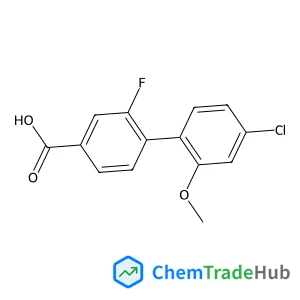
4-(4-Chloro-2-methoxyphenyl)-3-fluorobenzoic acid
CAS Number:
1261970-23-3
Molecular Formula:
C14H10ClFO3
![N-[2,6-Di(9-anthryl)-4-oxido-8,9,10,11,12,13,14,15-octahydrodinaphtho[2,1-d:1',2'-f][1,3,2]dioxaphosphepin-4-yl]-1,1,1-trifluoromethanesulfonamide structure](https://static.chemtradehub.com/structs/122/1227374-64-2-cdb5.webp "N-[2,6-Di(9-anthryl)-4-oxido-8,9,10,11,12,13,14,15-octahydrodinaphtho[2,1-d:1',2'-f][1,3,2]dioxaphosphepin-4-yl]-1,1,1-trifluoromethanesulfonamide structure")
N-[2,6-Di(9-anthryl)-4-oxido-8,9,10,11,12,13,14,15-octahydrodinaphtho[2,1-d:1',2'-f][1,3,2]dioxaphosphepin-4-yl]-1,1,1-trifluoromethanesulfonamide
CAS Number:
1227374-64-2
Molecular Formula:
C49H37F3NO5PS
Recommended Suppliers






Disclaimer
This page provides academic journal information for reference and research purposes only. We are not affiliated with any journal publishers and do not handle publication submissions. For publication-related inquiries, please contact the respective journal publishers directly.
If you notice any inaccuracies in the information displayed, please contact us at support@chemtradehub.com. We will promptly review and address your concerns.