












Comparison of direct dynamics simulations with different electronic structure methods. F− + CH3I with MP2 and DFT/B97-1
Literature Information
Publication Date
2014-10-09
DOI
10.1039/C4CP03589E
Impact Factor
3.676
Authors
Rui Sun, Jiaxu Zhang, William L. Hase
View Original
Abstract
In previous work, ion imaging experiments and direct chemical dynamics simulations with DFT/B97-1 were performed to study the atomic-level dynamics of the F− + CH3I → FCH3 + I− SN2 nucleophilic substitution reaction at different collision energies. Overall, the simulations are in quite good agreement with experiment at the low collision energy of 0.32 eV, however there are differences between experiment and simulation at the high collision energy of 1.53 eV. A recent CCSD(T) study of the potential energy surface for the F− + CH3I → FCH3 + I− SN2 reaction shows that it has both a traditional C3v and a hydrogen-bond entrance channel. They are represented by MP2 but not by B97-1, which has only the latter channel. On the other hand, B97-1 gives a reaction exothermicity in excellent agreement with experiment, while MP2 is in error by 24.3 kJ mol−1. In the work presented here, direct dynamics simulations using MP2/aug-cc-pvdz/ECP/d were performed for the F− + CH3I → FCH3 + I− reaction at a 1.53 eV collision energy. The same direct rebound and stripping and indirect atomistic reaction mechanisms are found in the B97-1 and MP2 simulations. Both the B97-1 and MP2 simulations agree with the experimental fraction of the available product energy partitioned to CH3F internal energy, i.e. fint = 0.59 ± 0.08. However, the MP2 fint distribution is broader and in better agreement with experiment than B97-1. The two simulations methods give the same product energy partitioning for the stripping mechanism, but different partitionings for the rebound and indirect mechanisms. Compared to experiment, the principal difference between the B97-1 and MP2 results is the differential cross section which is nearly isotropic for B97-1. For MP2 backward scattering is more important than forward, as found in the experiments. Though there is no overall barrier for the reaction, B97-1 gives a reaction cross section appreciably larger than that for MP2, i.e. 8.6 ± 2.2 Å2versus 1.8 ± 0.3 Å2. For B97-1 59% of the reaction consists of indirect mechanisms, while for MP2 the indirect mechanisms only comprise 11% of the reaction. The experimental differential cross section is more consistent with the atomistic mechanisms for MP2 than for B97-1.
Related Literature
Effect of electrolyte bleaching on the stability and performance of dye solar cells
Simone Mastroianni, Imran Asghar, Kati Miettunen, Janne Halme, Alessandro Lanuti, Thomas M. Brown, Peter Lund
2014-02-04
Paper
DOI: 10.1039/C3CP55342F
Atmospheric aqueous phase radical chemistry of the isoprene oxidation products methacrolein, methyl vinyl ketone, methacrylic acid and acrylic acid – kinetics and product studies
Luisa Schöne, Janine Schindelka, Edyta Szeremeta, Thomas Schaefer, Dirk Hoffmann, Krzysztof J. Rudzinski, Rafal Szmigielski, Hartmut Herrmann
2014-02-04
Paper
DOI: 10.1039/C3CP54859G
Role of supramolecular synthons in the formation of the supramolecular architecture of molecular crystals revisited from an energetic viewpoint
Roman I. Zubatyuk, Svitlana V. Shishkina, Viktoriya V. Dyakonenko, Volodymyr V. Medviediev
2014-01-22
Paper
DOI: 10.1039/C3CP55390F
Experimental and simulation studies of unusual current blockade induced by translocation of small oxidized PEG through a single nanopore
S. Cabello-Aguilar, A. Abou Chaaya, F. Picaud, M. Bechelany, C. Pochat-Bohatier, S. Yesylevskyy, S. Kraszewski, M. C. Bechelany, F. Rossignol, E. Balanzat, J. M. Janot, P. Miele, P. Dejardin, S. Balme
2014-07-08
Paper
DOI: 10.1039/C4CP01954G
Photophysical evaluation of a new functional terbium complex in FRET-based time-resolved homogenous fluoroassays
Katia Nchimi Nono, Loïc J. Charbonnière, Hans-Gerd Löhmannsröben
2014-01-10
Paper
DOI: 10.1039/C3CP54883J
Thylakoid direct photobioelectrocatalysis: utilizing stroma thylakoids to improve bio-solar cell performance
Michelle Rasmussen, Shelley D. Minteer
2014-07-03
Paper
DOI: 10.1039/C4CP02754J
The interaction of gold and silver nanoparticles with a range of anionic and cationic dyes
H. Kitching, A. J. Kenyon, I. P. Parkin
2014-02-10
Paper
DOI: 10.1039/C3CP55366C
You might also like
Compound Q&A
What are the main uses of (5-Sulfamoyl-3-pyridinyl)boronic acid (CAS: 951233-61-7)?
(5-Sulfamoyl-3-pyridinyl)boronic acid is primarily used in chemical synthesis, p...
951233-61-7(5-Sulfamoyl-3-pyrid...
Compound Q&A
How is Benzyl 2-methyl-2-(methylsulfonyl)-4-pentenoate (CAS: 1942858-50-5) typically synthesized?
Benzyl 2-methyl-2-(methylsulfonyl)-4-pentenoate is typically synthesized via est...
1942858-50-5Benzyl 2-methyl-2-(m...
Compound Q&A
What precautions should be taken when handling 8-Fluoroquinolin-6-ol (CAS: 209353-22-0)?
When handling 8-Fluoroquinolin-6-ol (CAS: 209353-22-0), it is important to use p...
209353-22-08-Fluoroquinolin-6-o...
Compound Q&A
What are the physical and chemical properties of 1,3-Dibromo-5-(2-methyl-2-propanyl)benzene (CAS: 129316-09-2)?
1,3-Dibromo-5-(2-methyl-2-propanyl)benzene (CAS: 129316-09-2) is a crystalline c...
129316-09-21,3-Dibromo-5-(2-met...
Compound Q&A
What industries use Ethyl 7-chloro-4-oxo-1-(1,3-thiazol-2-yl)-1,4-dihydro-1,8-naphthyridine-3-carboxylate (CAS: 174726-87-5)?
Ethyl 7-chloro-4-oxo-1-(1,3-thiazol-2-yl)-1,4-dihydro-1,8-naphthyridine-3-carbox...
174726-87-5Ethyl 7-chloro-4-oxo...
Compound Q&A
What precautions should be taken when handling Delta-7-Avenasterol (CAS: 23290-26-8)?
When handling Delta-7-Avenasterol (CAS: 23290-26-8), it is important to wear app...
23290-26-8Delta-7-Avenasterol
Compound Q&A
What precautions should be taken when handling N-({(5R)-3-[3-Fluoro-4-(4-morpholinyl)phenyl]-2-oxo-1,3-oxazolidin-5-yl}methyl)acetamide (CAS: 872992-20-6)?
Proper handling involves the use of personal protective equipment such as gloves...
872992-20-6N-({(5R)-3-[3-Fluoro...
Compound Q&A
What precautions should be taken when handling 2-Methyl-2-proanyl 4-[(2-aminophenyl)amino]-1-piperidinecarboxylate (CAS: 79099-00-6)?
When handling 2-Methyl-2-proanyl 4-[(2-aminophenyl)amino]-1-piperidinecarboxylat...
79099-00-62-Methyl-2-propanyl ...
Compound Q&A
What is N-Methyl-4-chlorobenzylamine hydrochloride (CAS: 65542-24-7)?
N-Methyl-4-chlorobenzylamine hydrochloride (CAS: 65542-24-7) is a organic compou...
65542-24-7N-Methyl-4-chloroben...
Compound Q&A
Is [2-(Dodecyloxy)ethoxy]acetic acid (CAS: 27306-90-7) safe?
[2-(Dodecyloxy)ethoxy]acetic acid (CAS: 27306-90-7) is generally considered safe...
27306-90-7[2-(Dodecyloxy)ethox...
Source Journal
Physical Chemistry Chemical Physics

CiteScore:
5.5
Self-citation Rate:
10.3%
Articles per Year:
3036
Physical Chemistry Chemical Physics (PCCP) is an international journal co-owned by 19 physical chemistry and physics societies from around the world. This journal publishes original, cutting-edge research in physical chemistry, chemical physics and biophysical chemistry. To be suitable for publication in PCCP, articles must include significant innovation and/or insight into physical chemistry; this is the most important criterion that reviewers and Editors will judge against when evaluating submissions. The journal has a broad scope and welcomes contributions spanning experiment, theory, computation and data science. Topical coverage includes spectroscopy, dynamics, kinetics, statistical mechanics, thermodynamics, electrochemistry, catalysis, surface science, quantum mechanics, quantum computing and machine learning. Interdisciplinary research areas such as polymers and soft matter, materials, nanoscience, energy, surfaces/interfaces, and biophysical chemistry are welcomed if they demonstrate significant innovation and/or insight into physical chemistry. Joined experimental/theoretical studies are particularly appreciated when complementary and based on up-to-date approaches.
Recommended Compounds
![5-Chloropyrrolo[2,1-f][1,2,4]triazin-4(3H)-one structure](https://static.chemtradehub.com/structs/888/888720-60-3-4f7c.webp "5-Chloropyrrolo[2,1-f][1,2,4]triazin-4(3H)-one structure")
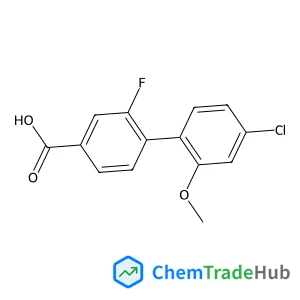
4-(4-Chloro-2-methoxyphenyl)-3-fluorobenzoic acid
CAS Number:
1261970-23-3
Molecular Formula:
C14H10ClFO3
Recommended Suppliers





Disclaimer
This page provides academic journal information for reference and research purposes only. We are not affiliated with any journal publishers and do not handle publication submissions. For publication-related inquiries, please contact the respective journal publishers directly.
If you notice any inaccuracies in the information displayed, please contact us at support@chemtradehub.com. We will promptly review and address your concerns.