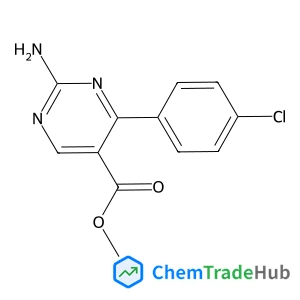
Methyl 2-amino-4-(4-chlorophenyl)-5-pyrimidinecarboxylate
CAS Number:
1133115-56-6
Molecular Formula:
C12H10ClN3O2
Brindaban Modak, Swapan K. Ghosh
A systematic calculation, using hybrid density functional theory, has been carried out to investigate the origin of the enhancement of photo-conversion efficiency of Rh-doped SrTiO3 with codoping of Sb. In the case of Rh-doped SrTiO3, partially unoccupied states are introduced above the valence band, thus lowering the hole oxidation at the valence band (VB) drastically, which explains the poor oxygen evolution activity of Rh-doped SrTiO3. We show that the partially occupied t2g subset of the Rh 4d orbital is completely filled in the presence of Sb due to the transfer of the extra electron to the Rh center. As a result, acceptor states are completely passivated in the case of (Rh, Sb)-codoped SrTiO3 and a continuous band structure with reduced band gap is formed, which is responsible for the observed enhanced photocatalytic activity of (Rh, Sb)-codoped SrTiO3. We have shown that the relative positions of the band edges of (Rh, Sb)-codoped SrTiO3 with respect to the water redox levels are in favor of the spontaneous release of both hydrogen and oxygen during water splitting, which is consistent with the experimental observation. We have also studied the effect of codoping in different proportions (1 : 2 and 2 : 1) of Rh and Sb. Although 1 : 2 (Rh, Sb)-codoping leads to the formation of a clean band structure with the reduction of the band gap by a larger extent, it shows lower photo-conversion efficiency due to its charge non-compensated nature. In addition, the presence of acceptor states above the VB limits the oxygen evolution efficiency of 2 : 1 (Rh, Sb)-codoped SrTiO3. Thus, the present approach successfully reproduces the experimental features of the Rh-monodoped as well as (Rh, Sb)-codoped SrTiO3 and also explains their origin.
DOI: 10.1039/C8CP01395K
D. Bloos, R. Marx, P. Lutz, M. Kern, O. Laguta, C. Dietrich, J. van Slageren
DOI: 10.1039/C7CP07443C
Tatsuki Shinoda
DOI: 10.1039/C8CP04885A
Senbo Xiao, Zhiliang Zhang, Jianying He
DOI: 10.1039/C8CP03256D
Wei-yan Liang, Anita Das, Xue Dong, Zhong-hua Cui
DOI: 10.1039/C8CP01376D
Y. Khabzina, C. Laroche, J. Pérez-Pellitero, D. Farrusseng
DOI: 10.1039/C8CP04042G
Daisuke Matsushita, Hirotaka Uji, Shunsaku Kimura
DOI: 10.1039/C8CP02315H
Pengxiang Xu, Jiaping Lin, Liangshun Zhang
DOI: 10.1039/C8CP02062K
2-Methylbenzene-1,4-diamine dihydrochloride (CAS: 615-45-2) should be stored in ...
(1S,4S)-2,5-Diazabicyclo[2.2.1]heptane dihydrobromide is generally considered sa...
(6-Chloropyridazin-3-YL)methanamine finds applications in the pharmaceutical ind...
2-Fluoro-3-methylphenol is primarily used in the synthesis of pharmaceuticals, p...
When handling 3-Methoxy-4-nitrobenzonitrile, it is important to wear appropriate...
When handling 1,3-Oxazolo[4,5-b]pyridine-2(3H)-thione (CAS: 211949-57-4), it is ...
4-Ethynylbenzamide (CAS: 90347-86-7) falls under various regulatory guidelines i...
3-(2-Ethylphenyl)-2-thioxo-4-imidazolidinone is primarily used as an intermediat...
(2-Fluoro-6-methoxyphenyl)acetic acid, also known as 4-fluoro-3-methoxybenzoic a...
Market trends for 2-[4-(Hydroxymethyl)phenoxy]ethanol (CAS: 102196-18-9) indicat...

Physical Chemistry Chemical Physics (PCCP) is an international journal co-owned by 19 physical chemistry and physics societies from around the world. This journal publishes original, cutting-edge research in physical chemistry, chemical physics and biophysical chemistry. To be suitable for publication in PCCP, articles must include significant innovation and/or insight into physical chemistry; this is the most important criterion that reviewers and Editors will judge against when evaluating submissions. The journal has a broad scope and welcomes contributions spanning experiment, theory, computation and data science. Topical coverage includes spectroscopy, dynamics, kinetics, statistical mechanics, thermodynamics, electrochemistry, catalysis, surface science, quantum mechanics, quantum computing and machine learning. Interdisciplinary research areas such as polymers and soft matter, materials, nanoscience, energy, surfaces/interfaces, and biophysical chemistry are welcomed if they demonstrate significant innovation and/or insight into physical chemistry. Joined experimental/theoretical studies are particularly appreciated when complementary and based on up-to-date approaches.
![5-Bromo-3-isopropyl-1H-pyrrolo[2,3-b]pyridine structure](https://static.chemtradehub.com/structs/125/1256819-54-1-8620.webp "5-Bromo-3-isopropyl-1H-pyrrolo[2,3-b]pyridine structure")