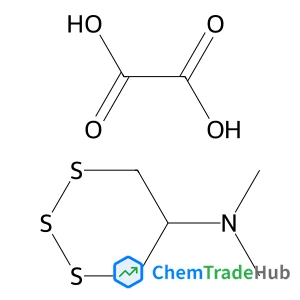
Oxalic acid compound with cyclohexylsulfamothioic O-acid (11)
CAS Number:
31895-22-4
Molecular Formula:
C7H13NO4S3
Malcolm Burns, Gordon Wiseman, Angus Knight, Peter Bramley, Lucy Foster, Sophie Rollinson, Andrew Damant, Sandy Primrose
Following a report on a significant amount of horse DNA being detected in a beef burger product on sale to the public at a UK supermarket in early 2013, the Elliott report was published in 2014 and contained a list of recommendations for helping ensure food integrity. One of the recommendations included improving laboratory testing capacity and capability to ensure a harmonised approach for testing for food authenticity. Molecular biologists have developed exquisitely sensitive methods based on the polymerase chain reaction (PCR) or mass spectrometry for detecting the presence of particular nucleic acid or peptide/protein sequences. These methods have been shown to be specific and sensitive in terms of lower limits of applicability, but they are largely qualitative in nature. Historically, the conversion of these qualitative techniques into reliable quantitative methods has been beset with problems even when used on relatively simple sample matrices. When the methods are applied to complex sample matrices, as found in many foods, the problems are magnified resulting in a high measurement uncertainty associated with the result which may mean that the assay is not fit for purpose. However, recent advances in the technology and the understanding of molecular biology approaches have further given rise to the re-assessment of these methods for their quantitative potential. This review focuses on important issues for consideration when validating a molecular biology assay and the various factors that can impact on the measurement uncertainty of a result associated with molecular biology approaches used in detection of food fraud, with a particular focus on quantitative PCR-based and proteomics assays.
Waste containing (6-Bromo-2-naphthyl)oxy](dimethyl)(2-methyl-2-propanyl)silane (...
7-Fluoro-4-isoquinolinecarboxylic acid can be synthesized via a multi-step proce...
2,3,5,6-Tetrabromothieno[3,2-b]thiophene is a crystalline compound with a high m...
1-[4-(Benzylamino)-7,8-dihydro-5H-pyrano[4,3-d]pyrimidin-2-yl]-2-methyl-1H-indol...
The market for imidazo[5,1-d]-1,2,3,5-tetrazine-8-carboxylic acid, 3,4-dihydro-3...
3-(Triisopropylsilyl)propiolaldehyde is a synthetic organic compound with the CA...
6-Nitro-2H-1,4-benzoxazin-3(4H)-one (CAS: 81721-87-1) is subject to various regu...
Waste containing (3-Fluorophenyl)(4-{[(2-methyl-2-propanyl)oxy]carbonyl}-1-piper...
N,N'-4,4'-Biphenyldiyldiisonicotinamide is a white crystalline solid with a mole...
6-Bromo-8-fluoro-2-quinazolinol is primarily used in the pharmaceutical industry...

Analyst publishes analytical and bioanalytical research that reports premier fundamental discoveries and inventions, and the applications of those discoveries, unconfined by traditional discipline barriers.