












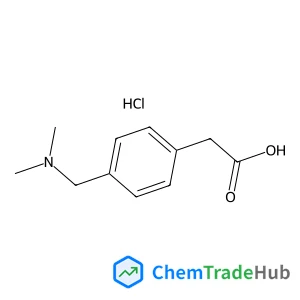
4-(Dimethylaminomethyl)phenylacetic acid hydrochloride
CAS Number:
99985-52-1
Molecular Formula:
C11H16ClNO2
Eunji Jang, Minsu Kim, Won-Gun Koh
We developed a novel protein-based bioassay platform utilizing metal-enhanced fluorescence (MEF), which is a hydrogel microarray entrapping silica-coated silver nanoparticles (Ag@SiO2). As a model system, different concentrations of glucose were detected using a fluorescence method by sequential bienzymatic reaction of hydrogel-entrapped glucose oxidase (GOX) and peroxidase (POD) inside a hydrogel microarray. Microarrays based on poly(ethylene glycol)(PEG) hydrogels were prepared by photopatterning a solution containing PEG diacrylate (PEG-DA), photoinitiator, enzymes, and Ag@SiO2. The resulting hydrogel microarrays were able to entrap both enzymes and Ag@SiO2 without leaching and deactivation problems. The presence of Ag@SiO2 within the hydrogel microarray enhanced the fluorescence signal, and the extent of the enhancement was dependent on the thickness of silica shells and the amount of Ag@SiO2. Optimal MEF effects were achieved when the thickness of the silica shell was 17.5 nm, and 0.5 mg mL−1 of Ag@SiO2 was incorporated into the assay systems. Compared with the standard hydrogel microarray-based assay performed without Ag@SiO2, more than a 4-fold fluorescence enhancement was observed in a glucose concentration range between 10−3 mM and 10.0 mM using hydrogel microarray entrapping Ag@SiO2, which led to significant improvements in the sensitivity and the limit of detection (LOD). The hydrogel microarray system presented in this study could be successfully combined with a microfluidic device as an initial step to create an MEF-based micro-total-analysis-system (μ-TAS).
Jinxing Ye, Darren J. Dixon, Peter S. Hynes
DOI: 10.1039/B508833J
D. Krishna Kumar, D. Amilan Jose, Amitava Das, Parthasarathi Dastidar
DOI: 10.1039/B506941F
Herbert W. Roesky, S. Shravan Kumar
DOI: 10.1039/B505307B
Hiroyuki Miyake, Hideki Sugimoto, Hitoshi Tamiaki, Hiroshi Tsukube
DOI: 10.1039/B506130J
Tsutomu Kimura, Toshiaki Murai
DOI: 10.1039/B507755A
Liang Li, Huifeng Qian, Jicun Ren
DOI: 10.1039/B505791D
Patrick J. Hrdlicka, T. Santhosh Kumar, Jesper Wengel
DOI: 10.1039/B506986F
Martin Schüler, David O'Hagan, Alexandra M. Z. Slawin
DOI: 10.1039/B506010A
Sayam Sen Gupta, Krishnaswami S. Raja, Eiton Kaltgrad, Erica Strable, M. G. Finn
DOI: 10.1039/B502444G
Hanh. V. Ly, Taryn. D. Forster, Darren Maley, Masood Parvez, Roland Roesler
DOI: 10.1039/B508152A
Waste containing N-Methoxy-N-methyl-1,3-thiazole-5-carboxamide (CAS: 898825-89-3...
N-(4-Biphenylyl)dibenzo[b,d]furan-4-amine should be stored in a tightly sealed c...
The market for 3-Acetamido-5-amino-2,4,6-triiodobenzoic acid (CAS: 1713-07-1) is...
Benzyl 2-O-acetyl-3,4,6-tri-O-benzyl-beta-D-galactopyranoside (CAS: 61820-03-9) ...
2-Ethylpiperazine dihydrochloride (CAS: 438050-52-3) is regulated under the Glob...
1,1'-[1,3-Phenylenebis(methylene)]bis(3-methyl-1H-pyrrole-2,5-dione) (CAS: 11946...
Several alternatives can be used in the synthesis of 5-Fluoro-2-(1-pyrrolidinyl)...
Proper personal protective equipment (PPE) must be worn when handling this compo...
When handling 6-Bromoimidazo[1,2-a]pyridin-8-amine, it is important to wear appr...
Alternatives to (2S,4R)-4-(4-Nitrobenzyl)pyrrolidine-2-carboxylic acid hydrochlo...

Analyst publishes analytical and bioanalytical research that reports premier fundamental discoveries and inventions, and the applications of those discoveries, unconfined by traditional discipline barriers.

![[(5-Methyl-1,3,4-thiadiazol-2-yl)sulfanyl]acetic acid structure](https://static.chemtradehub.com/structs/509/50918-26-8-4ce8.webp "[(5-Methyl-1,3,4-thiadiazol-2-yl)sulfanyl]acetic acid structure")



