











A highly selective fluorescent probe for sulfide ions based on aggregation of Cu nanocluster induced emission enhancement
Literature Information
Publication Date
2015-02-05
DOI
10.1039/C5AN00017C
Impact Factor
4.616
Authors
Zenghe Li, Song Guo, Chao Lu
View Original
Abstract
In this study, S2− ions were found to enhance the fluorescence of cysteine-capped Cu nanoclusters (Cu NCs). High resolution transmission electron microscopy (HRTEM), Fourier-transform infrared spectroscopy (FT-IR), scanning electron microscopy-energy dispersive X-ray (SEM-EDX) measurements, zeta potential and X-ray photoelectron spectroscopy (XPS) measurements demonstrated that the S2− ion-induced aggregation of the Cu NCs contributed to the fluorescence enhancement of the dispersed Cu NCs. Based on these findings, a highly selective fluorescent probe was developed for the determination of H2S using the S2− ion-enhanced fluorescence of the as-prepared Cu NCs. The relative fluorescence intensity was proportional to the concentration of S2− in the range from 0.2 to 50 μM. The detection limit (S/N = 3) was 42 nM. The proposed method has been successfully applied to determine H2S produced from toys called “Fart Bomb” with recoveries of 97.6–101.8%. The results of the proposed method were in good agreement with those determined by a standard methylene blue method. This work is not only of importance for a better understanding of the aggregation induced emission (AIE) properties of the Cu NCs but also of great potential to find extensive biological applications for H2S.
Related Literature
High-nuclearity homometallic iron and nickel clusters: Fe22 and Ni24 complexes from the use of N-methyldiethanolamine
Dolos Foguet-Albiol, Khalil A. Abboud, George Christou
2005-08-03
Communication
DOI: 10.1039/B507748F
Electrochemical detection of Arachis hypogaea (peanut) agglutinin binding to monovalent and clustered lactosyl motifs immobilized on a polypyrrole film
Chantal Gondran, Olivier Renaudet, Pascal Dumy, Hugues Driguez, Sébastien Fort, Serge Cosnier
2005-07-14
Communication
DOI: 10.1039/B506699A
PNA C–C+i-motif: superior stability of PNA TC8 tetraplexes compared to DNA TC8 tetraplexes at low pH
Nagendra K. Sharma, Krishna N. Ganesh
2005-07-13
Communication
DOI: 10.1039/B506870C
Highly luminescent water-soluble CdTe nanowires as fluorescent probe to detect copper(ii)
Bo Tang, Jinye Niu, Chengguang Yu, Linhai Zhuo, Jiechao Ge
2005-07-19
Communication
DOI: 10.1039/B502978C
Control of dark current in photoelectrochemical (TiO2/I−–I3−) and dye-sensitized solar cells
Seigo Ito, Paul Liska, Pascal Comte, Raphaël Charvet, Peter Péchy, Udo Bach, Lukas Schmidt-Mende, Shaik Mohammed Zakeeruddin, Andreas Kay, Mohammad K. Nazeeruddin, Michael Grätzel
2005-08-02
Communication
DOI: 10.1039/B505718C
Simple iron-aminecatalysts for the cross-coupling of aryl Grignards with alkyl halides bearing β-hydrogens
Robin B. Bedford, Duncan W. Bruce, Robert M. Frost, Michael Hird
2005-07-22
Communication
DOI: 10.1039/B507133J
Precise synthesis of poly(macromonomer)s containing sugars by repetitive ring-opening metathesis polymerisation
James J. Murphy, Kotohiro Nomura
2005-07-13
Communication
DOI: 10.1039/B506877K
Ru(iv)-catalyzed isomerization of allylamines in water: A highly efficient procedure for the deprotection of N-allylic amines
Victorio Cadierno, Sergio E. García-Garrido, José Gimeno, Noel Nebra
2005-07-13
Communication
DOI: 10.1039/B506788J
Microporous organic crystals: an unusual case for l-leucyl–l-serine
Carl Henrik Görbitz, Mette Nilsen, Kai Szeto, Linda Wibecke Tangen
2005-07-28
Communication
DOI: 10.1039/B504976H
You might also like
Compound Q&A
How should waste containing N-Methoxy-N-methyl-1,3-thiazole-5-carboxamide (CAS: 898825-89-3) be handled?
Waste containing N-Methoxy-N-methyl-1,3-thiazole-5-carboxamide (CAS: 898825-89-3...
898825-89-3N-Methoxy-N-methyl-1...
Compound Q&A
How should N-(4-Biphenylyl)dibenzo[b,d]furan-4-amine (CAS: 1318338-47-4) be stored?
N-(4-Biphenylyl)dibenzo[b,d]furan-4-amine should be stored in a tightly sealed c...
1318338-47-4N-(4-Biphenylyl)dibe...
Compound Q&A
What is the market or research trend for 3-Acetamido-5-amino-2,4,6-triiodobenzoic acid (CAS: 1713-07-1)?
The market for 3-Acetamido-5-amino-2,4,6-triiodobenzoic acid (CAS: 1713-07-1) is...
1713-07-13-Acetamido-5-amino-...
Compound Q&A
How should Benzyl 2-O-acetyl-3,4,6-tri-O-benzyl-beta-D-galactopyranoside (CAS: 61820-03-9) be stored?
Benzyl 2-O-acetyl-3,4,6-tri-O-benzyl-beta-D-galactopyranoside (CAS: 61820-03-9) ...
61820-03-9Benzyl 2-O-acetyl-3,...
Compound Q&A
What regulatory guidelines apply to 2-Ethylpiperazine dihydrochloride (CAS: 438050-52-3)?
2-Ethylpiperazine dihydrochloride (CAS: 438050-52-3) is regulated under the Glob...
438050-52-32-Ethylpiperazine di...
Compound Q&A
What regulatory guidelines apply to 1,1'-[1,3-Phenylenebis(methylene)]bis(3-methyl-1H-pyrrole-2,5-dione) (CAS: 119462-56-5)?
1,1'-[1,3-Phenylenebis(methylene)]bis(3-methyl-1H-pyrrole-2,5-dione) (CAS: 11946...
119462-56-51,1'-[1,3-Phenyleneb...
Compound Q&A
Are there alternatives to 5-Fluoro-2-(1-pyrrolidinyl)pyridine (CAS: 1287217-79-1) in synthesis?
Several alternatives can be used in the synthesis of 5-Fluoro-2-(1-pyrrolidinyl)...
1287217-79-15-Fluoro-2-(1-pyrrol...
Compound Q&A
What precautions should be taken when handling 1-((2R,3R,4R,5R)-5-((bis(4-methoxyphenyl)(phenyl)methoxy)methyl)-4-hydroxy-3-methoxytetrahydrofuran-2-yl)-5-methylpyrimidine-2,4(1H,3H)-dione (CAS: 153631-19-7)?
Proper personal protective equipment (PPE) must be worn when handling this compo...
153631-19-71-((2R,3R,4R,5R)-5-(...
Compound Q&A
What precautions should be taken when handling 6-Bromoimidazo[1,2-a]pyridin-8-amine (CAS: 676371-00-9)?
When handling 6-Bromoimidazo[1,2-a]pyridin-8-amine, it is important to wear appr...
676371-00-96-Bromoimidazo[1,2-a...
Compound Q&A
Are there alternatives to (2S,4R)-4-(4-Nitrobenzyl)pyrrolidine-2-carboxylic acid hydrochloride (CAS: 1049740-22-8) in synthesis?
Alternatives to (2S,4R)-4-(4-Nitrobenzyl)pyrrolidine-2-carboxylic acid hydrochlo...
1049740-22-8(2S,4R)-4-(4-Nitrobe...
Source Journal
Analyst

CiteScore:
7.8
Self-citation Rate:
5.6%
Articles per Year:
653
Analyst publishes analytical and bioanalytical research that reports premier fundamental discoveries and inventions, and the applications of those discoveries, unconfined by traditional discipline barriers.
Recommended Compounds
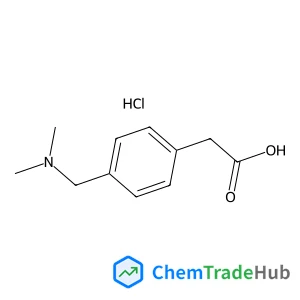
4-(Dimethylaminomethyl)phenylacetic acid hydrochloride
CAS Number:
99985-52-1
Molecular Formula:
C11H16ClNO2

Recommended Suppliers



Disclaimer
This page provides academic journal information for reference and research purposes only. We are not affiliated with any journal publishers and do not handle publication submissions. For publication-related inquiries, please contact the respective journal publishers directly.
If you notice any inaccuracies in the information displayed, please contact us at support@chemtradehub.com. We will promptly review and address your concerns.