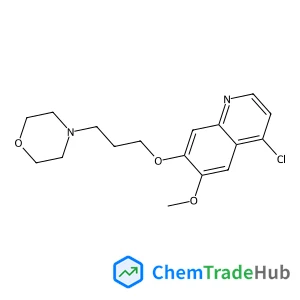
4-(3-((4-Chloro-6-methoxyquinolin-7-yl)oxy)propyl)morpholine
CAS Number:
205448-32-4
Molecular Formula:
C17H21ClN2O3
Hin Chun Yau, Mustafa K. Bayazit, Piers R. J. Gaffney, Andrew G. Livingston, Joachim H. G. Steinke, Milo S. P. Shaffer
Poly(ethylene glycol) [1, PEG∼4(OH)2, Mn ∼ 200], glycerol ethoxylate [2, PEG∼21(OH)3, Mn ∼ 1000] and pentaerythritol ethoxylate [3, PEG∼15(OH)4, Mn ∼ 797] react directly with phenyl-C61-butyric acid methyl ester (PCBM), in the presence of dibutyltinoxide (DBTO) catalyst at 140 °C, to give a mixture of fullerene [C60] end-capped PEGs via transesterification. Among these PEG linkers, only PEG∼4(OPCB)2 (4a) (OPCB: ester oxygen linked phenyl-C61-butyryl group) was successfully isolated from the crude product mixture in the fully end-capped form. Fully acylated PEG∼21(OPCB)3 (5) and PEG∼15(OPCB)4 (6) could not be separated chromatographically from incompletely reacted species due to the polydispersity in branch lengths. This purification challenge was overcome by using a monodisperse branched core, 1,3,5-tris(octagoloxymethyl)benzene [7, PEG24(OH)3] to give a monodisperse tris-fullerene homostar, PEG24(OPCB)3 (8). The structures of the bis- and tris-fullerene products were confirmed by MALDI-TOF mass spectrometry and 1H NMR spectroscopy with supporting FTIR and UV-vis spectroscopic analysis.
Minh Tho Nguyen
DOI: 10.1039/D0CP03154B
Manish Singh, Rei Abe-Yoshizumi, Tatsuya Tsukuda
DOI: 10.1039/C9CP04991F
Nora Lüdtke, Jelena Föller, Christel M. Marian
DOI: 10.1039/D0CP04654J
Jihua Zhang, Xia Chen, MingSen Deng, Hujun Shen, Hang Li, Jianwen Ding
DOI: 10.1039/D0CP01983F
Paulami Ghosh, Debashree Ghosh
DOI: 10.1039/C9CP05166J
Zhiling Liu, Yan Bai, Ya Li, Jing He, Qingyang Lin, Hua Xie, Zichao Tang
DOI: 10.1039/D0CP03883K
Na Yang, Lanlan Peng, Li Li, Jing Li, Zidong Wei
DOI: 10.1039/C9CP04691G
O. Pacherova, N. Nepomniashchaia, V. Vetokhina, S. Cichon, T. Kocourek, A. Dejneka
DOI: 10.1039/D0CP03644G
Ting Jia, Paul Ohodnicki, Benjamin Chorpening, Jonathan Lekse, Gregory Hackett, Yuhua Duan
DOI: 10.1039/C9CP04921E
(5-Sulfamoyl-3-pyridinyl)boronic acid is primarily used in chemical synthesis, p...
Benzyl 2-methyl-2-(methylsulfonyl)-4-pentenoate is typically synthesized via est...
When handling 8-Fluoroquinolin-6-ol (CAS: 209353-22-0), it is important to use p...
1,3-Dibromo-5-(2-methyl-2-propanyl)benzene (CAS: 129316-09-2) is a crystalline c...
Ethyl 7-chloro-4-oxo-1-(1,3-thiazol-2-yl)-1,4-dihydro-1,8-naphthyridine-3-carbox...
When handling Delta-7-Avenasterol (CAS: 23290-26-8), it is important to wear app...
Proper handling involves the use of personal protective equipment such as gloves...
When handling 2-Methyl-2-proanyl 4-[(2-aminophenyl)amino]-1-piperidinecarboxylat...
N-Methyl-4-chlorobenzylamine hydrochloride (CAS: 65542-24-7) is a organic compou...
[2-(Dodecyloxy)ethoxy]acetic acid (CAS: 27306-90-7) is generally considered safe...

Polymer Chemistry welcomes submissions in all areas of polymer science that have a strong focus on macromolecular chemistry. Manuscripts may cover a broad range of fields, yet no direct application focus is required.
![5-Chloropyrrolo[2,1-f][1,2,4]triazin-4(3H)-one structure](https://static.chemtradehub.com/structs/888/888720-60-3-4f7c.webp "5-Chloropyrrolo[2,1-f][1,2,4]triazin-4(3H)-one structure")