


RAFT-derived antimicrobial polymethacrylates: elucidating the impact of end-groups on activity and cytotoxicity
Literature Information
Publication Date
2014-06-16
DOI
10.1039/C4PY00652F
Impact Factor
5.582
Authors
Thomas D. Michl, Katherine E. S. Locock, Natalie Emilia Stevens, John D. Hayball, Krasimir Vasilev, Almar Postma, Yue Qu, Ana Traven, Matthias Haeussler, Laurence Meagher, Hans J. Griesser
View Original
Abstract
Antimicrobial polymers as mimics of natural antimicrobial peptides are emerging as an alternative to classic antibiotics due to their potency, selectivity and lower susceptibility to resistance. The key chemical aspects necessary to confer high activity and selectivity to the polymer chain composition are largely known. However, little attention has been paid to how end-groups affect the overall biological activity. Here we report the use of RAFT polymerization to obtain eight well-defined cationic methacrylate polymers which bear either amine (PA1–4) or guanidine (PG1–4) pendant groups, while systematically varying the R- and Z-RAFT end-groups. These polymers were assessed in haemotoxicity assays as well as antimicrobial testing against clinically relevant pathogens; such as a vigorously biofilm forming strain of Staphylococcus epidermidis (S. epidermidis) and a vancomycin and methicillin resistant strain of Staphylococcus aureus (VISA) as well as the opportunistic fungus Candida albicans (C. albicans). The R-group was found to dominate the measured toxicity of polymers. Replacement of the anionic cyanovaleric acid R-group (PA1) with the neutral isobutyronitrile (PA3) led to over a 20 fold increase in the haemolytic activity of the polymers. The Z-group, however, was found to have more influence on the antimicrobial activity of the polymers against both VISA and C. albicans, whereby polymers with a long, lipophilic dodecylsulfanyl Z-group (PA1) were found to be more potent than those with either an ethylsulfanyl or no ZCS2-group. These results indicate that chemical control over the end-groups is a key element for achieving the desired high biological activity and selectivity, particularly when low molecular weights are required for maximum antibacterial activity.
Recommended Journals

Bioorganic & Medicinal Chemistry

NDT & E International

Journal of Asian Natural Products Research

Acta Metallurgica Sinica-English Letters

Medicinal Chemistry Research

Journal of the Indian Institute of Science

Bioorganic & Medicinal Chemistry Letters

Main Group Chemistry

Colloid Journal

Atomization and Sprays
Related Literature
Dependence of the nascent vibrational distribution of NO(v) on the photolysis wavelength of NO2 in the range λ = 266–327 nm measured by time-resolved Fourier transform infrared emission
C. Brooks, G. Hancock, M. Saunders
2007-08-03
Paper
DOI: 10.1039/B710594K
Kinetic analysis of supported Ni-catalyzed CO2/CH4 reactions using photoacoustic spectroscopy
Ji-Woong Kim, Jae-Au Ha, Hun Jung, Byung-II Ahn, Sung-Han Lee, Joong-Gill Choi
2007-09-25
Paper
DOI: 10.1039/B709102H
Surface electrochemistry of CO as a probe molecule on carbon-supported Se-surface modified Ru nanoparticlesviainfrared reflection absorption spectroscopy
Elena R. Savinova, Francoise Hahn, Nicolas Alonso-Vante
2007-09-20
Paper
DOI: 10.1039/B709436A
Multiphoton dissociation dynamics of BrCl and the BrCl+cation
Olivier P. J. Vieuxmaire, N. Hendrik Nahler, Richard N. Dixon, Michael N. R. Ashfold
2007-08-30
Paper
DOI: 10.1039/B709222A
Second-harmonic generation for studying structural motion of biological molecules in real time and space
2007-09-07
Paper
DOI: 10.1039/B710505C
Chemorheological analysis and model-free kinetics of acid catalysed furfuryl alcohol polymerization
Nathanael Guigo, Alice Mija, Luc Vincent, Nicolas Sbirrazzuoli
2007-08-08
Paper
DOI: 10.1039/B707950H
Protein resistance of (ethylene oxide)n monolayers at the air/water interface: effects of packing density and chain length
Yijian Chen, Guangzhao Zhang, Shihe Yang
2007-10-10
Paper
DOI: 10.1039/B711037E
You might also like
Compound Q&A
What is 1-(2,4,6-Trifluorophenyl)ethanol (CAS: 1250113-83-7)?
1-(2,4,6-Trifluorophenyl)ethanol is an organic compound with the CAS number 1250...
1250113-83-71-(2,4,6-Trifluoroph...
Compound Q&A
Is 1-(2,4-Dimethoxybenzyl)-4-(hydroxymethyl)-2-pyrrolidinone (CAS: 919111-34-5) safe?
1-(2,4-Dimethoxybenzyl)-4-(hydroxymethyl)-2-pyrrolidinone (CAS: 919111-34-5) is ...
919111-34-51-(2,4-Dimethoxybenz...
Compound Q&A
What are the physical and chemical properties of (7S,15R)-6β,15-Diacetoxy-7α,20-epoxy-7-hydroxykaura-2,16-dien-1-one (CAS: 51419-51-3)?
(7S,15R)-6β,15-Diacetoxy-7α,20-epoxy-7-hydroxykaura-2,16-dien-1-one is a crystal...
51419-51-3(7S,15R)-6β,15-Diace...
Compound Q&A
What regulatory guidelines apply to rac-ethyl (1r,4r)-4-hydroxycyclohexane-1-carboxylate, trans (CAS: 3618-04-0)?
The compound rac-ethyl (1r,4r)-4-hydroxycyclohexane-1-carboxylate, trans (CAS: 3...
3618-04-0rac-ethyl (1r,4r)-4-...
Compound Q&A
What is the market or research trend for 2-(2,4-Difluorophenoxy)-3-nitropyridine (CAS: 175135-62-3)?
The market for 2-(2,4-Difluorophenoxy)-3-nitropyridine (CAS: 175135-62-3) is cur...
175135-62-32-(2,4-Difluoropheno...
Compound Q&A
What are the main uses of 6-Diazo-5-oxo-L-norleucine (CAS: 157-03-9)?
The main uses of 6-Diazo-5-oxo-L-norleucine (CAS: 157-03-9) include research in ...
157-03-96-Diazo-5-oxo-L-norl...
Compound Q&A
What precautions should be taken when handling 2-Aminoethyl-mono-amide-DOTA-tris(tBu ester) (CAS: 173308-19-5)?
When handling 2-Aminoethyl-mono-amide-DOTA-tris(tBu ester) (CAS: 173308-19-5), i...
173308-19-52-Aminoethyl-mono-am...
Compound Q&A
How is 5-Methylimidazo[1,2-a]pyridine-3-carbaldehyde (CAS: 178488-37-4) typically synthesized?
5-Methylimidazo[1,2-a]pyridine-3-carbaldehyde (CAS: 178488-37-4) can be synthesi...
178488-37-45-Methylimidazo[1,2-...
Compound Q&A
Are there alternatives to 2,4,6-Trihydroxyisophthalaldehyde (CAS: 4396-13-8) in synthesis?
There are alternative reagents that can be used in the synthesis of 2,4,6-Trihyd...
4396-13-82,4,6-Trihydroxyisop...
Compound Q&A
What is (2Z)-3-(5-Fluoro-1H-indol-3-yl)-2-sulfanylacrylic acid (CAS: 179461-52-0)?
(2Z)-3-(5-Fluoro-1H-indol-3-yl)-2-sulfanylacrylic acid is a chemical compound wi...
179461-52-0(2Z)-3-(5-Fluoro-1H-...
Source Journal
Polymer Chemistry

CiteScore:
8.6
Self-citation Rate:
7.3%
Articles per Year:
457
Polymer Chemistry welcomes submissions in all areas of polymer science that have a strong focus on macromolecular chemistry. Manuscripts may cover a broad range of fields, yet no direct application focus is required.
Recommended Compounds
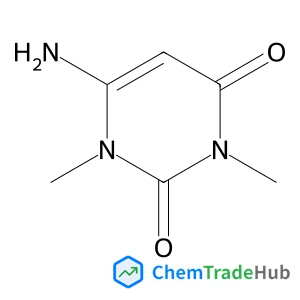
6-amino-1,3-dimethyl-1,2,3,4-tetrahydropyrimidine-2,4-dione
CAS Number:
6642-31-5
Molecular Formula:
C6H9N3O2
Recommended Suppliers





Disclaimer
This page provides academic journal information for reference and research purposes only. We are not affiliated with any journal publishers and do not handle publication submissions. For publication-related inquiries, please contact the respective journal publishers directly.
If you notice any inaccuracies in the information displayed, please contact us at support@chemtradehub.com. We will promptly review and address your concerns.