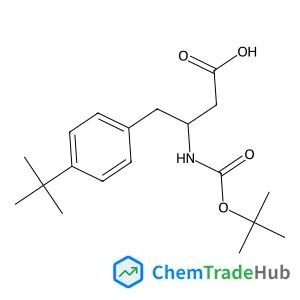
(S)-3-((tert-Butoxycarbonyl)amino)-4-(4-(tert-butyl)phenyl)butanoic acid
CAS Number:
403661-85-8
Molecular Formula:
C19H29NO4
Xiaofu Sun, Yanling Chi, Tiancheng Mu
An efficient method to precipitate and refine cellulose from ionic liquids (ILs) using compressed CO2 as a gas anti-solvent was proposed. 1-Butyl-3-methylimidazolium acetate ([Bmim]OAc) was used as the solvent of microcrystalline cellulose (MCC). The yield and degree of polymerization (DP) value of the regenerated cellulose can be finely tuned by controlling the temperature, pressure, reaction time and addition of aprotic polar solvents. For gaining a better understanding of the possible cellulose precipitation mechanism, the possible carboxylation reaction, volume expansion and solvatochromic parameters of the solution caused by compressed CO2 were investigated. The solvent strength of the system can be adjusted by the pressure and temperature of CO2. The regenerated cellulose samples from [Bmim]OAc by addition of different anti-solvents were characterized by solid-state cross-polarization/magic angle spinning (CP/MAS) 13C NMR, X-ray diffraction (XRD) and atomic force microscopy (AFM). In addition, the energy consumption analysis during the anti-solvent process was discussed. The precipitation and staged bio-refining of cellulose from IL is easy, sustainable and cost-efficient.
Kentaro Ito, Kumi Y. Inoue, Kosuke Ino, Tomokazu Matsue, Hitoshi Shiku
DOI: 10.1039/C9AN00478E
DOI: 10.1039/C9AN00025A
Shuzhen Lv, Kangyao Zhang, Dianping Tang
DOI: 10.1039/C9AN00724E
Jiahong Guo, Zhiwei Bai, Yonglei Lyu, Jikui Wang, Qiang Wang
DOI: 10.1039/C8AN00388B
Gyaninder Pal Singh, Richa Nigam, Gaurav Singh Tomar, Mohan Monisha, Sanjeev Kumar Bhoi, Arulselvi S, Kangana Sengar, Deepa Akula, Prashanth Panta, Roy Anindya
DOI: 10.1039/C8AN00533H
Xinglin Wang, Xiaoyi Gao, Jiale He, Xiaochen Hu, Yunchao Li, Xiaohong Li, Louzhen Fan, Hua-Zhong Yu
DOI: 10.1039/C9AN00624A
Qianqian Fang, Yingying Li, Xinxing Miao, Yiqiu Zhang, Jun Yan, Tainrong Yu, Jian Liu
DOI: 10.1039/C9AN00190E
When handling 4-Methyl-6-(trifluoromethyl)quinoline (CAS: 40716-16-3), safety go...
4-(3,5-Difluorophenyl)aniline is an aromatic organic compound with the CAS numbe...
5-{[4-(Trifluoromethyl)phenyl]sulfanyl}-1,2,3-thiadiazole-4-carboxylic acid can ...
The market for 4-Benzylaniline hydrochloride (CAS: 6317-57-3) is steadily growin...
[3-(Diethylsulfamoyl)phenyl]boronic acid is generally considered safe when handl...
3-Bromo-2,5-dimethoxyaniline is mainly used in the pharmaceutical and chemical i...
N-Methyl-1-(5-methyl-1H-indol-3-yl)methanamine (CAS: 915922-67-7) is subject to ...
This compound is primarily used in the pharmaceutical industry for the synthesis...
2-Methyl-2-propanyl [(1S,3R)-3-aminocyclohexyl]carbamate (CAS: 1298101-47-9) sho...
Ethyl 2-bromo-4,4,4-trifluorobutanoate (CAS: 367-33-9) is utilized in the pharma...

Green Chemistry provides a unique forum for the publication of innovative research on the development of alternative green and sustainable technologies. The scope of Green Chemistry is based on, but not limited to, the definition proposed by Anastas and Warner (Green Chemistry: Theory and Practice, P T Anastas and J C Warner, Oxford University Press, Oxford, 1998). Green chemistry is the utilisation of a set of principles that reduces or eliminates the use or generation of hazardous substances in the design, manufacture and application of chemical products. Green Chemistry is at the frontiers of this continuously-evolving interdisciplinary science and publishes research that attempts to reduce the environmental impact of the chemical enterprise by developing a technology base that is inherently non-toxic to living things and the environment. Submissions on all aspects of research relating to the endeavour are welcome. The journal publishes original and significant cutting-edge research that is likely to be of wide general appeal. To be published, work must present a significant advance in green chemistry. Papers must contain a comparison with existing methods and demonstrate advantages over those methods before publication can be considered. For more information please see this Editorial. Coverage includes the following, but is not limited to: Design (e.g. biomimicry, design for degradation/recycling/reduced toxicity…) Reagents & Feedstocks (e.g. renewables, CO2, solvents, auxiliary agents, waste utilization…) Synthesis (e.g. organic, inorganic, synthetic biology…) Catalysis (e.g. homogeneous, heterogeneous, enzyme, whole cell…) Process (e.g. process design, intensification, separations, recycling, efficiency…) Energy (e.g. renewable energy, fuels, photovoltaics, fuel cells, energy storage, energy carriers…) Applications (e.g. electronics, dyes, consumer products, coatings, pharmaceuticals, preservatives, building materials, chemicals for industry/agriculture/mining…) Impact (e.g. safety, metrics, LCA, sustainability, (eco)toxicology…) Green chemistry is, by definition, a continuously-evolving frontier. Therefore, the inclusion of a particular material or technology does not, of itself, guarantee that a paper is suitable for the journal. To be suitable, the novel advance should have the potential for reduced environmental impact relative to the state of the art. Green Chemistry does not normally deal with research associated with 'end-of-pipe' or remediation issues.