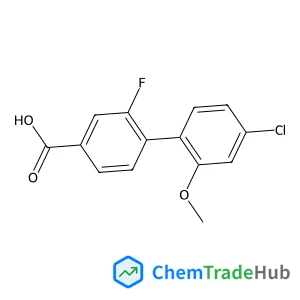
4-(4-Chloro-2-methoxyphenyl)-3-fluorobenzoic acid
CAS Number:
1261970-23-3
Molecular Formula:
C14H10ClFO3
The first page of this article is displayed as the abstract.
Mandeep K. Chahal, Muniappan Sankar, Ray J. Butcher
DOI: 10.1039/C6CP08396J
Katharine Moore Tibbetts, Xiao-Jiang Feng, Herschel Rabitz
DOI: 10.1039/C6CP06187G
P. Modak, Ashok K. Verma
DOI: 10.1039/C6CP07805B
Elham Ashori, Francesc Illas
DOI: 10.1039/C6CP07898B
Chao Wu, Qingxun Guo, Wujun Ma, Xiaoping Li, Panlong Qiu, Jianyong Hu, Qiang Wang
DOI: 10.1039/C6CP08334J
Christel Gervais, Christian Brouder, Nicolas Trcera, Amélie Bordage, Cristina Coelho-Diogo, Pierre Florian, Aydar Rakhmatullin, Lorenzo Paulatto, Michele Lazzeri, Delphine Cabaret
DOI: 10.1039/C6CP08393E
Jennifer Wilcox, David W. Ball
DOI: 10.1039/C6CP07116C
Stanley Udochukwu Ofoegbu, Tiago L. P. Galvão, José R. B. Gomes, João Tedim, Helena I. S. Nogueira, M. G. S. Ferreira
DOI: 10.1039/C7CP00241F
Denis S. Grebenkov, Gleb Oshanin
DOI: 10.1039/C6CP06102H
(5-Sulfamoyl-3-pyridinyl)boronic acid is primarily used in chemical synthesis, p...
Benzyl 2-methyl-2-(methylsulfonyl)-4-pentenoate is typically synthesized via est...
When handling 8-Fluoroquinolin-6-ol (CAS: 209353-22-0), it is important to use p...
1,3-Dibromo-5-(2-methyl-2-propanyl)benzene (CAS: 129316-09-2) is a crystalline c...
Ethyl 7-chloro-4-oxo-1-(1,3-thiazol-2-yl)-1,4-dihydro-1,8-naphthyridine-3-carbox...
When handling Delta-7-Avenasterol (CAS: 23290-26-8), it is important to wear app...
Proper handling involves the use of personal protective equipment such as gloves...
When handling 2-Methyl-2-proanyl 4-[(2-aminophenyl)amino]-1-piperidinecarboxylat...
N-Methyl-4-chlorobenzylamine hydrochloride (CAS: 65542-24-7) is a organic compou...
[2-(Dodecyloxy)ethoxy]acetic acid (CAS: 27306-90-7) is generally considered safe...

Physical Chemistry Chemical Physics (PCCP) is an international journal co-owned by 19 physical chemistry and physics societies from around the world. This journal publishes original, cutting-edge research in physical chemistry, chemical physics and biophysical chemistry. To be suitable for publication in PCCP, articles must include significant innovation and/or insight into physical chemistry; this is the most important criterion that reviewers and Editors will judge against when evaluating submissions. The journal has a broad scope and welcomes contributions spanning experiment, theory, computation and data science. Topical coverage includes spectroscopy, dynamics, kinetics, statistical mechanics, thermodynamics, electrochemistry, catalysis, surface science, quantum mechanics, quantum computing and machine learning. Interdisciplinary research areas such as polymers and soft matter, materials, nanoscience, energy, surfaces/interfaces, and biophysical chemistry are welcomed if they demonstrate significant innovation and/or insight into physical chemistry. Joined experimental/theoretical studies are particularly appreciated when complementary and based on up-to-date approaches.
![N-[2,6-Di(9-anthryl)-4-oxido-8,9,10,11,12,13,14,15-octahydrodinaphtho[2,1-d:1',2'-f][1,3,2]dioxaphosphepin-4-yl]-1,1,1-trifluoromethanesulfonamide structure](https://static.chemtradehub.com/structs/122/1227374-64-2-cdb5.webp "N-[2,6-Di(9-anthryl)-4-oxido-8,9,10,11,12,13,14,15-octahydrodinaphtho[2,1-d:1',2'-f][1,3,2]dioxaphosphepin-4-yl]-1,1,1-trifluoromethanesulfonamide structure")