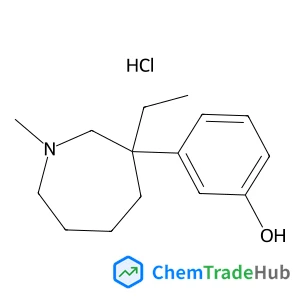
3-(3-Ethyl-1-methyl-3-azepanyl)phenol hydrochloride (1:1)
CAS Number:
59263-76-2
Molecular Formula:
C15H24ClNO
Shaun T. Mutter, François Zielinski, James R. Cheeseman, Christian Johannessen, Paul L. A. Popelier, Ewan W. Blanch
As two biologically and medically relevant monosaccharides, the constituents of hyaluronic acid, D-glucuronic acid and N-acetyl-D-glucosamine, constitute perfect test cases for the development of carbohydrate-specific structural methods. These two molecules have been analysed by Raman optical activity (ROA), a spectroscopic technique exhibiting exquisite sensitivity to stereochemistry. We show that it is possible to support the experiment with a simulation approach combining density functional theory (DFT) and molecular dynamics (MD), both using explicit solvation. Thus, we have gained new insight into the crucial hydration effects that contribute to the conformational dynamics of carbohydrates and managed to characterize in detail the poorly understood vibrational nature of this class of biomolecules. Experimental and calculated ROA spectra of these two molecules are reported and excellent agreement has been found. More specifically, comparison has been made with the more commonly used gas phase and implicitly solvated calculation approaches, which offer poor or zero modelling of solvent interactions. The calculated spectra have been used to resolve the structural origins of the observed bands, a current challenge in the study of carbohydrates due to a lack of definitive vibrational assignments. We report and analyse major features in the fingerprint region of the ROA spectra, with recurrent structural and spectral features between the two monosaccharides observed.
Bendu Pan, Jia-Sheng Ouyang, Yaqi Zhang, Hao Liang, Qiang Ni, Bin Chen, Xiaoyun Pu, Long Jiang, Rihui Cao, Liqin Qiu
DOI: 10.1039/D1QO00566A
Tiao-Zhen Zhu, Pan-Lin Shao, Xumu Zhang
DOI: 10.1039/D1QO00368B
Radhakrishna Gattu, Suchandra Bhattacharjee, Karuna Mahato, Abu T. Khan
DOI: 10.1039/C8OB00736E
Sandeep Kumar, Tharmalingam Punniyamurthy
DOI: 10.1039/D0QO01369B
Piera M. Marchetti, Van Kelly, Joanna P. Simpson, Mairi Ward, Dominic J. Campopiano
DOI: 10.1039/C8OB00441B
Jiajun Zhang, Tian-Hui Xu, Zhengkai Chen
DOI: 10.1039/D1QO00790D
Irena Nekola, Aleksandar Višnjevac, Renata Kobetić, Irena Martin-Kleiner
DOI: 10.1039/C8OB00253C
Shanshan Ma, Aimin Yu, Xiangtai Meng
DOI: 10.1039/C8OB00004B
Ming Bao, Wei Lu, Han Su, Lihua Qiu
DOI: 10.1039/C8OB00735G
Yuan-Yuan Ren, Shou-Fei Zhu
DOI: 10.1039/C8OB00473K
Waste containing N-Methoxy-N-methyl-1,3-thiazole-5-carboxamide (CAS: 898825-89-3...
N-(4-Biphenylyl)dibenzo[b,d]furan-4-amine should be stored in a tightly sealed c...
The market for 3-Acetamido-5-amino-2,4,6-triiodobenzoic acid (CAS: 1713-07-1) is...
Benzyl 2-O-acetyl-3,4,6-tri-O-benzyl-beta-D-galactopyranoside (CAS: 61820-03-9) ...
2-Ethylpiperazine dihydrochloride (CAS: 438050-52-3) is regulated under the Glob...
1,1'-[1,3-Phenylenebis(methylene)]bis(3-methyl-1H-pyrrole-2,5-dione) (CAS: 11946...
Several alternatives can be used in the synthesis of 5-Fluoro-2-(1-pyrrolidinyl)...
Proper personal protective equipment (PPE) must be worn when handling this compo...
When handling 6-Bromoimidazo[1,2-a]pyridin-8-amine, it is important to wear appr...
Alternatives to (2S,4R)-4-(4-Nitrobenzyl)pyrrolidine-2-carboxylic acid hydrochlo...

Physical Chemistry Chemical Physics (PCCP) is an international journal co-owned by 19 physical chemistry and physics societies from around the world. This journal publishes original, cutting-edge research in physical chemistry, chemical physics and biophysical chemistry. To be suitable for publication in PCCP, articles must include significant innovation and/or insight into physical chemistry; this is the most important criterion that reviewers and Editors will judge against when evaluating submissions. The journal has a broad scope and welcomes contributions spanning experiment, theory, computation and data science. Topical coverage includes spectroscopy, dynamics, kinetics, statistical mechanics, thermodynamics, electrochemistry, catalysis, surface science, quantum mechanics, quantum computing and machine learning. Interdisciplinary research areas such as polymers and soft matter, materials, nanoscience, energy, surfaces/interfaces, and biophysical chemistry are welcomed if they demonstrate significant innovation and/or insight into physical chemistry. Joined experimental/theoretical studies are particularly appreciated when complementary and based on up-to-date approaches.
![[4-(Heptyloxy)phenyl]boronic acid structure](https://static.chemtradehub.com/structs/136/136370-19-9-ad33.webp "[4-(Heptyloxy)phenyl]boronic acid structure")