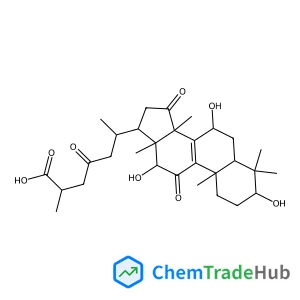
(3beta,7beta,12beta)-3,7,12-Trihydroxy-11,15,23-trioxolanost-8-en-26-oic acid
CAS Number:
98665-22-6
Molecular Formula:
C30H44O8
Shuang Chen, Jun Dai, Xiao Cheng Zeng
Motivated by recent experimental synthesis of a semiconducting metal–organic graphene analogue (J. Am. Chem. Soc., 2014, 136, 8859), i.e., Ni3(2,3,6,7,10,11-hexaiminotriphenylene)2 [Ni3(HITP)2], a new Kagome lattice, Cu3(HITP)2, is designed by substituting the coordination of Ni by Cu. Such substitution results in interesting changes in electronic properties of the M3(HITP)2 bulk and two-dimensional (2D) sheets. In Ni3(HITP)2, each Ni atom adopts the dsp2 hybridization, forming a perfect 2D conjugation, whereas in Cu3(HITP)2, each Cu atom adopts the sp3 hybridization, resulting in a distorted 2D sheet. The M3(HITP)2 bulks, assembled from M3(HITP)2 sheets via both strong π–π interaction and weak metal–metal interaction, are metallic. However, the 2D Ni3(HITP)2 sheet is a semiconductor with a narrow band gap whereas the 2D Cu3(HITP)2 sheet is a metal. Remarkably, both the 2D M3(HITP)2 Kagome lattices possess Dirac bands in the vicinity of the Fermi level. Additional ab initio molecular dynamics simulations show that both sheets exhibit high thermal stability at elevated temperatures. Our theoretical study offers new insights into tunability of electronic properties for the 2D metal–organic frameworks (MOFs).
Sebastian Kraszewski, Céline Boiteux, Christophe Ramseyer, Claude Girardet
DOI: 10.1039/B905991A
Gus Hancock, Marc Morrison, Mark Saunders
DOI: 10.1039/B909195E
Jaane Seehusen, Dirk Schwarzer, Jörg Lindner, Peter Vöhringer
DOI: 10.1039/B903466H
Arne Dinse, Reinhard Schomäcker, Alexis T. Bell
DOI: 10.1039/B821131K
Niall J. English, Damian A. Mooney
DOI: 10.1039/B910462C
Boris B. Averkiev, Alexander I. Boldyrev
DOI: 10.1039/B908973J
M. E. Suk, N. R. Aluru
DOI: 10.1039/B903541A
Tibor Pasinszki, Gábor Bazsó, Melinda Krebsz, György Tarczay
DOI: 10.1039/B913204J
J. C. Sancho-García, A. J. Pérez-Jiménez, Y. Olivier, J. Cornil
DOI: 10.1039/B925652K
Waste containing N-Methoxy-N-methyl-1,3-thiazole-5-carboxamide (CAS: 898825-89-3...
N-(4-Biphenylyl)dibenzo[b,d]furan-4-amine should be stored in a tightly sealed c...
The market for 3-Acetamido-5-amino-2,4,6-triiodobenzoic acid (CAS: 1713-07-1) is...
Benzyl 2-O-acetyl-3,4,6-tri-O-benzyl-beta-D-galactopyranoside (CAS: 61820-03-9) ...
2-Ethylpiperazine dihydrochloride (CAS: 438050-52-3) is regulated under the Glob...
1,1'-[1,3-Phenylenebis(methylene)]bis(3-methyl-1H-pyrrole-2,5-dione) (CAS: 11946...
Several alternatives can be used in the synthesis of 5-Fluoro-2-(1-pyrrolidinyl)...
Proper personal protective equipment (PPE) must be worn when handling this compo...
When handling 6-Bromoimidazo[1,2-a]pyridin-8-amine, it is important to wear appr...
Alternatives to (2S,4R)-4-(4-Nitrobenzyl)pyrrolidine-2-carboxylic acid hydrochlo...

Physical Chemistry Chemical Physics (PCCP) is an international journal co-owned by 19 physical chemistry and physics societies from around the world. This journal publishes original, cutting-edge research in physical chemistry, chemical physics and biophysical chemistry. To be suitable for publication in PCCP, articles must include significant innovation and/or insight into physical chemistry; this is the most important criterion that reviewers and Editors will judge against when evaluating submissions. The journal has a broad scope and welcomes contributions spanning experiment, theory, computation and data science. Topical coverage includes spectroscopy, dynamics, kinetics, statistical mechanics, thermodynamics, electrochemistry, catalysis, surface science, quantum mechanics, quantum computing and machine learning. Interdisciplinary research areas such as polymers and soft matter, materials, nanoscience, energy, surfaces/interfaces, and biophysical chemistry are welcomed if they demonstrate significant innovation and/or insight into physical chemistry. Joined experimental/theoretical studies are particularly appreciated when complementary and based on up-to-date approaches.