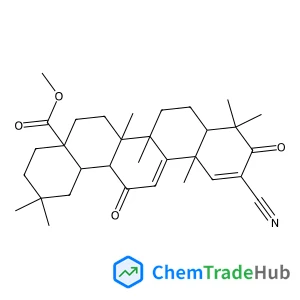
Methyl 2-cyano-3,12-dioxooleana-1,9(11)-dien-28-oate
CAS Number:
218600-53-4
Molecular Formula:
C32H43NO4
Lei Xu, Youyong Li, Dan Li, Peng Xu, Sheng Tian, Huiyong Sun, Hui Liu, Tingjun Hou
Macrophage migration inhibitory factor (MIF) is a multi-functional protein that acts as a cytokine and as an enzyme. Recently, MIF was identified as a non-canonical ligand of G protein-coupled chemokine receptor CXCR2 with low nanomolar affinity in leukocyte arrest and chemotaxis, but the precise knowledge of the molecular determinants of the MIF–CXCR2 interface has remained unknown. Therefore, we employed homology modeling, protein–protein docking, molecular dynamics (MD) simulations, Molecular Mechanics/Generalized Born Surface Area (MM/GBSA) binding free energy calculations and MM/GBSA binding free energy decomposition to obtain insights into the molecular recognition of MIF with CXCR2. The predicted binding pattern of MIF–CXCR2 is in good agreement with the experimental data and sheds light on the functional role of important MIF–CXCR2 interface residues in association with binding and signaling. According to our predictions, the R11A/D44A double mutations of MIF exhibit a pronounced defect in the binding affinity of MIF to CXCR2, resulting in large conformational changes. The potential two-site binding model for the MIF–CXCR2 recognition was proposed: initialized primarily by the non-polar interactions including the van der Waals and hydrophobic interactions, the N-terminal region of CXCR2 contacts the N-like loop and β-sheet of MIF (site 1), and then the ECL2 and ECL3 regions of CXCR2 form strong interactions with the pseudo-(E)LR motif and C-terminus of MIF, which induces the molecular thermodynamic motion of TMs for signal transduction (site 2). This study will extend our understanding to the binding mechanisms of MIF to CXCR2 and provide useful information for the rational design of potent inhibitors selectively targeting the MIF–CXCR2 interactions.
Ignacio Fdez. Galván, Daniel Roca-Sanjuán, Erick L. Bastos, Wilhelm J. Baader, Roland Lindh
DOI: 10.1039/C6CP08154A
Yuri Mikhlin, Vladimir Nasluzov, Alexander Romanchenko, Yevgeny Tomashevich, Alexey Shor, Roberto Félix
DOI: 10.1039/C6CP07598C
Arunkumar Kathiravan, Rajadurai Vijay Solomon
DOI: 10.1039/C6CP07768D
M. Ziatdinov, H. Lim, S. Fujii, K. Kusakabe, M. Kiguchi, T. Enoki, Y. Kim
DOI: 10.1039/C6CP08352H
Claudio L. A. Berli, Magalí Mercuri, Martín G. Bellino
DOI: 10.1039/C6CP06602J
Chao Wu, Qingxun Guo, Wujun Ma, Xiaoping Li, Panlong Qiu, Jianyong Hu, Qiang Wang
DOI: 10.1039/C6CP08334J
Christof Drechsel-Grau, Dominik Marx
DOI: 10.1039/C6CP05679B
When handling 4-(2-Furylmethyl)thiomorpholine 1,1-dioxide (CAS: 79206-94-3), it ...
When handling 4-Chloro-N-[2-(4-morpholinyl)ethyl]benzamide (CAS: 71320-77-9), it...
Waste containing this compound (CAS: 62921-74-8) should be handled according to ...
Waste containing (S)-Methyl 2-amino-3-cyclohexylpropanoate should be collected i...
This compound can be synthesized using a multi-step process involving the conjug...
There are several alternatives to (2E)-3-(3,4-Dichlorophenyl)acrylic acid in syn...
Ethyl 6-(2-nitrophenyl)imidazo[2,1-b][1,3]thiazole-3-carboxylate (CAS: 925437-84...
Waste containing 2-(1,3-Thiazol-2-yl)ethanamine (CAS: 18453-07-1) should be coll...
Methyl 5-iodo-2-methylbenzoate can be synthesized through the iodination of meth...
5-Chloro[1,2,4]triazolo[1,5-a]pyridine is commonly synthesized via the condensat...

Physical Chemistry Chemical Physics (PCCP) is an international journal co-owned by 19 physical chemistry and physics societies from around the world. This journal publishes original, cutting-edge research in physical chemistry, chemical physics and biophysical chemistry. To be suitable for publication in PCCP, articles must include significant innovation and/or insight into physical chemistry; this is the most important criterion that reviewers and Editors will judge against when evaluating submissions. The journal has a broad scope and welcomes contributions spanning experiment, theory, computation and data science. Topical coverage includes spectroscopy, dynamics, kinetics, statistical mechanics, thermodynamics, electrochemistry, catalysis, surface science, quantum mechanics, quantum computing and machine learning. Interdisciplinary research areas such as polymers and soft matter, materials, nanoscience, energy, surfaces/interfaces, and biophysical chemistry are welcomed if they demonstrate significant innovation and/or insight into physical chemistry. Joined experimental/theoretical studies are particularly appreciated when complementary and based on up-to-date approaches.