












Investigation of solvent dynamic effects on the electron self-exchange in two thianthrene couples with large inner reorganization energies
Literature Information
Publication Date
2014-12-11
DOI
10.1039/C4CP04581E
Impact Factor
3.676
Authors
P. Choto, K. Rasmussen, G. Grampp
View Original
Abstract
The large structural difference between thianthrene radical cations and their neutral parent molecules can possibly affect their electron self-exchange reactions. Before this can be investigated experimentally, it is necessary to first understand the influence of the solvent on such electron transfer reactions. To achieve this, the rate constants of the electron self-exchange reactions of the Th˙+/Th and MTh˙+/MTh (Th = thianthrene, MTh = 2,3,7,8-tetramethoxythianthrene) couples were investigated by means of ESR line broadening experiments in different solvents at 293 K. The diffusion corrected rate constants cover a range of 7.2 × 10⁸ ≤ ket ≤ 44 × 108 M−1 s−1 for Th˙+/Th and 2.0 × 10⁸ ≤ ket ≤ 11.6 × 10⁸ M−1 s−1 for MTh˙+/MTh, respectively. The results were analysed within the framework of the Marcus Theory and the characteristic reorganization energy, λ, was determined. Both couples clearly show a solvent dynamic effect controlled by the longitudinal relaxation time τL of the solvents. However, the influence of the structural changes, in terms of λ, was smaller than expected at room temperature.
Recommended Journals
Related Literature
Kinetics, mechanisms and ionic liquids in the uptake of n-butylamine onto low molecular weight dicarboxylic acids
Michelle C. Fairhurst, Michael J. Ezell, Carla Kidd, Pascale S. J. Lakey, Manabu Shiraiwa, Barbara J. Finlayson-Pitts
2017-01-24
Paper
DOI: 10.1039/C6CP08663B
Photoinduced electron transfer in layer-by-layer thin solid films containing cobalt oxide nanosheets, porphyrin, and methyl viologen
R. Sasai, Y. Kato, W. Soontornchaiyakul, H. Usami, A. Masumori, W. Norimatsu
2017-01-17
Paper
DOI: 10.1039/C6CP07250J
Temperature-dependent ESR and computational studies on antiferromagnetic electron transfer in the yeast NADH dehydrogenase Ndi1
Kaiqi Wu, Wenfei Li, Lu Yu, Wei Tong, Yue Feng, Shenglong Ling, Longhua Zhang, Xiao Zheng, Maojun Yang
2017-01-09
Paper
DOI: 10.1039/C6CP08107J
Ligand non-innocence and strong correlation in manganese superoxide dismutase mimics
Alexandra R. McIsaac, David A. Mazziotti
2017-01-26
Paper
DOI: 10.1039/C6CP07563K
Exciton-vibrational resonance and dynamics of charge separation in the photosystem II reaction center
Vladimir I. Novoderezhkin, Elisabet Romero, Javier Prior, Rienk van Grondelle
2017-01-17
Paper
DOI: 10.1039/C6CP07308E
Charge transport in organic donor–acceptor mixed-stack crystals: the role of nonlocal electron–phonon couplings
Lingyun Zhu, Hua Geng, Yuanping Yi, Zhixiang Wei
2017-01-06
Paper
DOI: 10.1039/C6CP07417K
Collective proton transfer in ordinary ice: local environments, temperature dependence and deuteration effects
Christof Drechsel-Grau, Dominik Marx
2016-11-07
Perspective
DOI: 10.1039/C6CP05679B
Influence of Zn on the photoluminescence of colloidal (AgIn)xZn2(1−x)S2 nanocrystals
Dharmendar Kumar Sharma, Shuzo Hirata, Lukasz Bujak, Vasudevanpillai Biju, Tatsuya Kameyama, Marino Kishi, Tsukasa Torimoto, Martin Vacha
2017-01-05
Paper
DOI: 10.1039/C6CP07550A
Modeling the abnormally slow infiltration rate in mesoporous films
Claudio L. A. Berli, Magalí Mercuri, Martín G. Bellino
2016-12-12
Communication
DOI: 10.1039/C6CP06602J
Hybrid host materials for highly efficient electrophosphorescence and thermally activated delayed fluorescence independent of the linkage mode
Chao Wu, Qingxun Guo, Wujun Ma, Xiaoping Li, Panlong Qiu, Jianyong Hu, Qiang Wang
2017-01-18
Paper
DOI: 10.1039/C6CP08334J
You might also like
Compound Q&A
What precautions should be taken when handling 4-(2-Furylmethyl)thiomorpholine 1,1-dioxide (CAS: 79206-94-3)?
When handling 4-(2-Furylmethyl)thiomorpholine 1,1-dioxide (CAS: 79206-94-3), it ...
79206-94-34-(2-Furylmethyl)thi...
Compound Q&A
What precautions should be taken when handling 4-Chloro-N-[2-(4-morpholinyl)ethyl]benzamide (CAS: 71320-77-9)?
When handling 4-Chloro-N-[2-(4-morpholinyl)ethyl]benzamide (CAS: 71320-77-9), it...
71320-77-94-Chloro-N-[2-(4-mor...
Compound Q&A
How should waste containing 2-[2-(2-Methoxyethoxy)ethoxy]ethyl 4-methylbenzenesulfonate (CAS: 62921-74-8) be handled?
Waste containing this compound (CAS: 62921-74-8) should be handled according to ...
62921-74-82-[2-(2-Methoxyethox...
Compound Q&A
How should waste containing (S)-Methyl 2-amino-3-cyclohexylpropanoate be handled?
Waste containing (S)-Methyl 2-amino-3-cyclohexylpropanoate should be collected i...
40056-18-6(S)-Methyl 2-amino-3...
Compound Q&A
How is 5-({4-[(2S,4R)-4-Hydroxy-2-methyltetrahydro-2H-pyran-4-yl]-2-thienyl}sulfanyl)-1-methyl-1,3-dihydro-2H-indol-2-one (CAS: 166882-70-8) typically synthesized?
This compound can be synthesized using a multi-step process involving the conjug...
166882-70-85-({4-[(2S,4R)-4-Hyd...
Compound Q&A
Are there alternatives to (2E)-3-(3,4-Dichlorophenyl)acrylic acid (CAS: 7312-27-8) in synthesis?
There are several alternatives to (2E)-3-(3,4-Dichlorophenyl)acrylic acid in syn...
7312-27-8(2E)-3-(3,4-Dichloro...
Compound Q&A
How should Ethyl 6-(2-nitrophenyl)imidazo[2,1-b][1,3]thiazole-3-carboxylate (CAS: 925437-84-9) be stored?
Ethyl 6-(2-nitrophenyl)imidazo[2,1-b][1,3]thiazole-3-carboxylate (CAS: 925437-84...
925437-84-9Ethyl 6-(2-nitrophen...
Compound Q&A
How should waste containing 2-(1,3-Thiazol-2-yl)ethanamine (CAS: 18453-07-1) be handled?
Waste containing 2-(1,3-Thiazol-2-yl)ethanamine (CAS: 18453-07-1) should be coll...
18453-07-12-(1,3-Thiazol-2-yl)...
Compound Q&A
How is Methyl 5-iodo-2-methylbenzoate (CAS: 103440-54-6) typically synthesized?
Methyl 5-iodo-2-methylbenzoate can be synthesized through the iodination of meth...
103440-54-6Methyl 5-iodo-2-meth...
Compound Q&A
How is 5-Chloro[1,2,4]triazolo[1,5-a]pyridine (CAS: 1427399-34-5) typically synthesized?
5-Chloro[1,2,4]triazolo[1,5-a]pyridine is commonly synthesized via the condensat...
1427399-34-55-Chloro[1,2,4]triaz...
Source Journal
Physical Chemistry Chemical Physics

CiteScore:
5.5
Self-citation Rate:
10.3%
Articles per Year:
3036
Physical Chemistry Chemical Physics (PCCP) is an international journal co-owned by 19 physical chemistry and physics societies from around the world. This journal publishes original, cutting-edge research in physical chemistry, chemical physics and biophysical chemistry. To be suitable for publication in PCCP, articles must include significant innovation and/or insight into physical chemistry; this is the most important criterion that reviewers and Editors will judge against when evaluating submissions. The journal has a broad scope and welcomes contributions spanning experiment, theory, computation and data science. Topical coverage includes spectroscopy, dynamics, kinetics, statistical mechanics, thermodynamics, electrochemistry, catalysis, surface science, quantum mechanics, quantum computing and machine learning. Interdisciplinary research areas such as polymers and soft matter, materials, nanoscience, energy, surfaces/interfaces, and biophysical chemistry are welcomed if they demonstrate significant innovation and/or insight into physical chemistry. Joined experimental/theoretical studies are particularly appreciated when complementary and based on up-to-date approaches.
Recommended Compounds
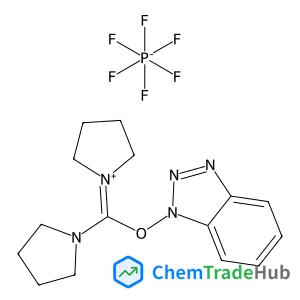
(1H-Benzotriazol-1-yloxy)(di-1-pyrrolidinyl)methylium hexafluorophosphate
CAS Number:
105379-24-6
Molecular Formula:
C15H21F6N5OP
Recommended Suppliers





Disclaimer
This page provides academic journal information for reference and research purposes only. We are not affiliated with any journal publishers and do not handle publication submissions. For publication-related inquiries, please contact the respective journal publishers directly.
If you notice any inaccuracies in the information displayed, please contact us at support@chemtradehub.com. We will promptly review and address your concerns.