












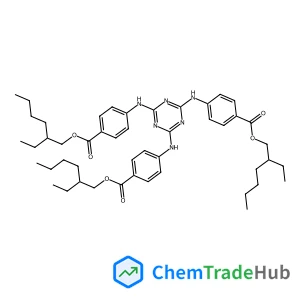
Tris(2-ethylhexyl) 4,4',4''-(1,3,5-triazine-2,4,6-triyltriimino)tribenzoate
CAS Number:
88122-99-0
Molecular Formula:
C48H66N6O6
Arnim Hellweg, Dmitrij Rappoport
We report optimized auxiliary basis sets for use with the Karlsruhe segmented contracted basis sets including moderately diffuse basis functions (Rappoport and Furche, J. Chem. Phys., 2010, 133, 134105) in resolution-of-the-identity (RI) post-self-consistent field (post-SCF) computations for the elements H–Rn (except lanthanides). The errors of the RI approximation using optimized auxiliary basis sets are analyzed on a comprehensive test set of molecules containing the most common oxidation states of each element and do not exceed those of the corresponding unaugmented basis sets. During these studies an unsatisfying performance of the def2-SVP and def2-QZVPP auxiliary basis sets for Barium was found and improved sets are provided. We establish the versatility of the def2-SVPD, def2-TZVPPD, and def2-QZVPPD basis sets for RI-MP2 and RI-CC (coupled-cluster) energy and property calculations. The influence of diffuse basis functions on correlation energy, basis set superposition error, atomic electron affinity, dipole moments, and computational timings is evaluated at different levels of theory using benchmark sets and showcase examples.
N. Hohlbein, A. Shaaban, A. R. Bras, W. Pyckhout-Hintzen, A. M. Schmidt
DOI: 10.1039/C5CP00620A
Zanele P. Nhlabatsi, Priya Bhasi, Sanyasi Sitha
DOI: 10.1039/C5CP07124K
Sijing Yi, Jiao Wang, Xiao Chen
DOI: 10.1039/C5CP03659C
Akira Aiba, Satoshi Kaneko, Shintaro Fujii, Tomoaki Nishino, Manabu Kiguchi
DOI: 10.1039/C6CP03437C
Tristan Koppe, Tanusree Mondal, Christoph Brüsewitz, Kaushal Kumar, Vineet Kumar Rai, Hans Hofsäss, Ulrich Vetter
DOI: 10.1039/C5CP01874A
Bolong Huang, Jianfu Li, Zhenyi Jiang, Bo Wang, Zhigang Wang, Rui-Qin Zhang
DOI: 10.1039/C5CP02598B
Mattanjah S. de Vries
DOI: 10.1039/C6CP90169G
Jiaye Su, Keda Yang, Decai Huang
DOI: 10.1039/C5CP07253K
Yuta Wada, Satoshi Chiba, Sou Kumagai, Hoonseung Lee, Ai Serizawa, Oi Lun Li, Gasidit Panomsuwan
DOI: 10.1039/C6CP03579E
Rajamani Krishna
DOI: 10.1039/C5CP02726H
Ethyl 3-cyclohexylpropanoate is a clear, colorless to light yellow liquid with a...
Waste containing 2-(Hydroxymethyl)-5-(methoxycarbonyl)-6-methyl-4-(2-nitrophenyl...
Waste containing 2,4,6-Tris(pentafluoroethyl)-1,3,5-triazine (CAS: 858-46-8) sho...
When handling Chloroac-nle-oh (CAS: 56787-36-1), it is essential to wear appropr...
Ethyl 6-phenylimidazo[2,1-b][1,3]thiazole-3-carboxylate is primarily used in the...
Alternatives to alpha-(2-Bromophenyl)benzylamine (CAS: 55095-15-3) in synthesis ...
Waste containing 2-Chloro-5-methoxypyridine (CAS: 139585-48-1) should be managed...
1-(4-Methoxyphenyl)-2,5-dimethyl-1H-pyrrole (CAS: 5044-27-9) is used in various ...
There are alternative reagents and compounds that can be used in the synthesis o...
Tungsten(IV) oxide, also known as tungsten dioxide, is a chemical compound with ...

Physical Chemistry Chemical Physics (PCCP) is an international journal co-owned by 19 physical chemistry and physics societies from around the world. This journal publishes original, cutting-edge research in physical chemistry, chemical physics and biophysical chemistry. To be suitable for publication in PCCP, articles must include significant innovation and/or insight into physical chemistry; this is the most important criterion that reviewers and Editors will judge against when evaluating submissions. The journal has a broad scope and welcomes contributions spanning experiment, theory, computation and data science. Topical coverage includes spectroscopy, dynamics, kinetics, statistical mechanics, thermodynamics, electrochemistry, catalysis, surface science, quantum mechanics, quantum computing and machine learning. Interdisciplinary research areas such as polymers and soft matter, materials, nanoscience, energy, surfaces/interfaces, and biophysical chemistry are welcomed if they demonstrate significant innovation and/or insight into physical chemistry. Joined experimental/theoretical studies are particularly appreciated when complementary and based on up-to-date approaches.
![3-[(4-Nitrobenzyl)oxy]-3-oxopropanoic Acid structure](https://static.chemtradehub.com/structs/773/77359-11-6-0d04.webp "3-[(4-Nitrobenzyl)oxy]-3-oxopropanoic Acid structure")








