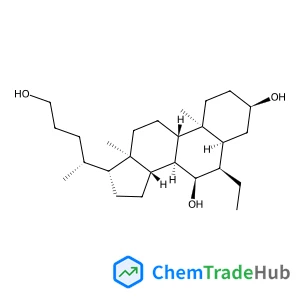
(3alpha,5beta,6alpha,7alpha)-6-Ethylcholane-3,7,24-triol
CAS Number:
1537866-49-1
Molecular Formula:
C26H46O3
Xin Li, Liangliang Zhu, Sai Duan, Yanli Zhao, Hans Ågren
Spontaneously emerged supramolecular chirality and chiral symmetry breaking from achiral/racemic constituents remain poorly understood. We here report that supramolecular chirality may emerge from the structural flexibility of achiral aryl nitrogen centres which provide instantaneous chirality. Employing a naphthalimide–cyanostilbene dyad as a model, we explored the underlying mechanism of aggregation-induced chiral symmetry breaking and found that the conformations of the N-naphthylpiperazine and the N,N-dimethylaniline units facilitate the formation of ordered supramolecular structures and offer opposite handedness. Furthermore, chiral symmetry breaking of the monomers was amplified by the formation of dimers. The microscopic and the macroscopic observations from the theoretical simulations and experimental measurements are thus rationalized by connecting the population of the dihedral angles of the aryl nitrogen centres, the morphology of the self-assemblies, and the observed circular dichroism spectra.
Roger W. Alder, Leila Chaker, François P. V. Paolini
DOI: 10.1039/B409112D
Shin-ichiro Kato, Taisuke Matsumoto, Tsutomu Ishi-i, Thies Thiemann, Motoyuki Shigeiwa, Hideki Gorohmaru, Shuichi Maeda, Yoshiro Yamashita, Shuntaro Mataka
DOI: 10.1039/B410016F
David R. Kelly, Eva Caroff, Robert W. Flood, William Heal, Stanley M. Roberts
DOI: 10.1039/B404389H
Gebhard Haberhauer, Thomas Oeser, Frank Rominger
DOI: 10.1039/B406335J
Prasad V. Ganesan, Cameron J. Kepert
DOI: 10.1039/B409543J
Xile Hu, Ingrid Castro-Rodriguez, Karsten Meyer
DOI: 10.1039/B409241D
S. Bordiga, C. Lamberti, G. Ricchiardi, L. Regli, F. Bonino, A. Damin, K.-P. Lillerud, M. Bjorgen, A. Zecchina
DOI: 10.1039/B407246D
Takayuki Suzuki, Tatsuya Kato, Hiraku Shinozaki
DOI: 10.1039/B407342H
Jiawei Tang, Chengzhong Yu, Xufeng Zhou, Xiaoxia Yan, Dongyuan Zhao
DOI: 10.1039/B408100E
DOI: 10.1039/B410700D
Waste containing 6-Chloro-5-(2'-hydroxy-3'-methoxy-4-biphenylyl)-3-(3-methoxyphe...
(3alpha,5alpha)-3-Hydroxypregnane-11,20-dione is primarily used in the pharmaceu...
The market for 4-Amino-6-chloro-2-pyridinecarboxylic acid (CAS: 546141-56-4) is ...
Alternatives to (2-Benzoylethyl)trimethylammonium chloride (CAS: 24472-88-6) in ...
N-[4-Nitro-3-(trifluoromethyl)phenyl]acetamide (CAS: 393-12-4) is generally safe...
Alternative reagents such as other phosphates or similar functional groups can b...
There are alternatives to N,N'-Bis(3-aminopropyl)-1,3-propanediamine (CAS: 4605-...
When handling Aluminium trihexadecanoate, it is important to use appropriate per...
(1,1-Dioxido-3-oxo-1,2-benzothiazol-2(3H)-yl)acetic acid is a chemical compound ...
Several alternatives to 5,5-dimethyloxolan-2-one (CAS: 3123-97-5) can be used in...

Physical Chemistry Chemical Physics (PCCP) is an international journal co-owned by 19 physical chemistry and physics societies from around the world. This journal publishes original, cutting-edge research in physical chemistry, chemical physics and biophysical chemistry. To be suitable for publication in PCCP, articles must include significant innovation and/or insight into physical chemistry; this is the most important criterion that reviewers and Editors will judge against when evaluating submissions. The journal has a broad scope and welcomes contributions spanning experiment, theory, computation and data science. Topical coverage includes spectroscopy, dynamics, kinetics, statistical mechanics, thermodynamics, electrochemistry, catalysis, surface science, quantum mechanics, quantum computing and machine learning. Interdisciplinary research areas such as polymers and soft matter, materials, nanoscience, energy, surfaces/interfaces, and biophysical chemistry are welcomed if they demonstrate significant innovation and/or insight into physical chemistry. Joined experimental/theoretical studies are particularly appreciated when complementary and based on up-to-date approaches.