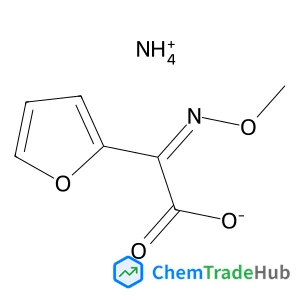
Ammonium (Z)-2-(furan-2-yl)-2-(methoxyimino)acetate
CAS Number:
97148-39-5
Molecular Formula:
C7H10N2O4
D. Durgalakshmi, S. Balakumar
Mimicking three dimensional microstructural scaffolds with their requisite mechanical properties in relation to human bone is highly needed for implant applications. Various biocompatible polymers and bioactive glasses were synthesized to achieve these properties. In the present study, we have fabricated highly porous and bioactive PMMA–Bioglass scaffolds by the phase separation method. Chloroform, acetone and an ethanol–water mixture were used as the different solvent phases in preparing the scaffolds. Large interconnecting pores of sizes ∼100 to 250 μm were observed in the scaffolds and a porosity percentage up to 54% was also achieved by this method. All samples showed a brittle fracture with the highest modulus of 91 MPa for the ethanol–water prepared scaffolds. The bioactivities of the scaffolds were further studied by immersing them in simulated body fluid for 28 days. Scanning electron microscopy, X-ray diffraction and Raman spectra confirmed the formation of bioactive hydroxyl calcium apatite on the surfaces of the scaffolds.
Xi Huang, Huihui Liu, Jiyun Wang, Caiqiao Xiong
DOI: 10.1039/C9SC90270H
DOI: 10.1039/CS9881700269
Stephen R. George-Williams, Dimitri Karis, Angela L. Ziebell, Russell R. A. Kitson, Paolo Coppo, Siegbert Schmid, Christopher D. Thompson, Tina L. Overton
DOI: 10.1039/C8RP90012D
DOI: 10.1039/CS9881700317
Mathieu Mével, Mohammed Bouzelha, Simon Pacouret, Mickael Guilbaud, Magalie Penaud-Budloo, Dimitri Alvarez-Dorta, Laurence Dubreil, Sébastien G. Gouin, Jean Philippe Combal, Mirja Hommel, Véronique Blouin, Philippe Moullier, Oumeya Adjali, David Deniaud, Eduard Ayuso
DOI: 10.1039/C9SC04189C
1H-Indazole-6-carbonitrile finds applications in pharmaceuticals, where it serve...
Waste containing Dioctyl (2E)-2-butenedioate (CAS: 2997-85-5) should be collecte...
Sodium [(1,2-benzoxazol-3-ylmethyl)sulfonyl]azanide is primarily used in pharmac...
Dimethyl 4-(4,4,5,5-tetramethyl-1,3,2-dioxaborolan-2-yl)-2,6-pyridinedicarboxyla...
Waste containing 2-Fluoro-6-hydrazinopyridine (CAS: 80714-39-2) should be manage...
6-Formyl-2-pyridinecarboxylic acid is an organic compound with the molecular for...
Research trends for this compound indicate a focus on its potential applications...
9H-Tribenzo[b,d,f]azepine is typically synthesized via a multi-step process invo...
1-Cyclopropyl-7-ethoxy-6-fluoro-8-methoxy-4-oxo-1,4-dihydro-3-quinolinecarboxyli...
Waste containing Methyl 3-oxo-1,2,3,4-tetrahydro-6-quinoxalinecarboxylate (CAS: ...

Physical Chemistry Chemical Physics (PCCP) is an international journal co-owned by 19 physical chemistry and physics societies from around the world. This journal publishes original, cutting-edge research in physical chemistry, chemical physics and biophysical chemistry. To be suitable for publication in PCCP, articles must include significant innovation and/or insight into physical chemistry; this is the most important criterion that reviewers and Editors will judge against when evaluating submissions. The journal has a broad scope and welcomes contributions spanning experiment, theory, computation and data science. Topical coverage includes spectroscopy, dynamics, kinetics, statistical mechanics, thermodynamics, electrochemistry, catalysis, surface science, quantum mechanics, quantum computing and machine learning. Interdisciplinary research areas such as polymers and soft matter, materials, nanoscience, energy, surfaces/interfaces, and biophysical chemistry are welcomed if they demonstrate significant innovation and/or insight into physical chemistry. Joined experimental/theoretical studies are particularly appreciated when complementary and based on up-to-date approaches.