












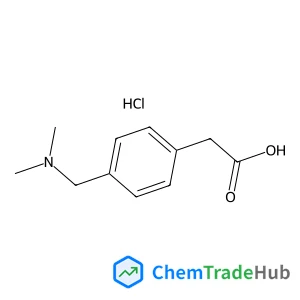
4-(Dimethylaminomethyl)phenylacetic acid hydrochloride
CAS Number:
99985-52-1
Molecular Formula:
C11H16ClNO2
The primary step of the near UV photophysics of a phenylalanine residue is investigated in one- and two-color pump–probe R2PI nanosecond experiments carried out on specific conformers of the Ac-Gly-Phe-NH2 molecule and related neutral compounds isolated in a supersonic expansion. Compared to toluene, whose ππ* state photophysics is dominated by intersystem crossing with a lifetime of ∼80 ns at the origin, the first ππ* state of Phe in the peptide environment is systematically found to be shorter-lived. The lifetime at the origin of transition is found to be significantly shortened in the presence of a primary amide (–CONH2) group (20–60 ns, depending on the conformer considered), demonstrating the existence of an additional non-radiative relaxation channel related to this chemical group. The quenching effect induced by the peptide environment is still more remarkable beyond the origin of the ππ* state, since vibronic bands of one of the 4 conformers observed (the 27-ribbon conformation) become barely detectable in the ns R2PI experiment, suggesting a significant conformer-selective lifetime shortening (below 100 ps). These results on dipeptides, which extend previous investigations on shorter Phe-containing molecules (N-Ac-Phe-NH2 and N-Ac-Phe-NH-Me), confirm the existence of conformer-dependent non-radiative deactivation processes, whose characteristic timescales range from tens of ns down to hundreds of ps or below. This dynamics is assigned to two distinct mechanisms: a first one, consistent with an excitation energy transfer from the optically active ππ* state to low-lying amide nπ* excited states accessed through conical intersections, especially in the presence of a C-terminal primary amide group (–CONH2); a second one, responsible for the short lifetimes in 27 ribbon structures, would be more specifically triggered by phenyl ring vibrational excitations. Implications in terms of spectroscopic probing of Phe in a peptide environment, especially in the presence of a quenching amide group, are discussed.
A. J. (Ton) Dirks, Sander S. van Berkel, Nikos S. Hatzakis, Joost A. Opsteen, Floris L. van Delft, Jeroen J. L. M. Cornelissen, Alan E. Rowan, Jan C. M. van Hest, Floris P. J. T. Rutjes, Roeland J. M. Nolte
DOI: 10.1039/B508428H
Hui Hong, Tim Stinear, Paul Skelton, Jonathan B. Spencer, Peter F. Leadlay
DOI: 10.1039/B506835E
Hanh. V. Ly, Taryn. D. Forster, Darren Maley, Masood Parvez, Roland Roesler
DOI: 10.1039/B508152A
Naoto Hashimoto, Keiko Ninomiya, Takamasa Endo, Masahiko Sisido
DOI: 10.1039/B508194G
Gaku Fukuhara, Tadashi Mori
DOI: 10.1039/B504948B
Liangru Yang, Alex von Zelewsky, Helen Stoeckli-Evans
DOI: 10.1039/B507769A
Robin B. Bedford, Duncan W. Bruce, Robert M. Frost, Michael Hird
DOI: 10.1039/B507133J
Makeba B. Murphy-Jolly, Lesley C. Lewis, Andrew J. M. Caffyn
DOI: 10.1039/B507752D
Liang Li, Huifeng Qian, Jicun Ren
DOI: 10.1039/B505791D
Riichi Miyamoto, Rika Tanaka Hamazawa, Masakazu Hirotsu, Takanori Nishioka, Isamu Kinoshita, L. James Wright
DOI: 10.1039/B505681K
Waste containing N-Methoxy-N-methyl-1,3-thiazole-5-carboxamide (CAS: 898825-89-3...
N-(4-Biphenylyl)dibenzo[b,d]furan-4-amine should be stored in a tightly sealed c...
The market for 3-Acetamido-5-amino-2,4,6-triiodobenzoic acid (CAS: 1713-07-1) is...
Benzyl 2-O-acetyl-3,4,6-tri-O-benzyl-beta-D-galactopyranoside (CAS: 61820-03-9) ...
2-Ethylpiperazine dihydrochloride (CAS: 438050-52-3) is regulated under the Glob...
1,1'-[1,3-Phenylenebis(methylene)]bis(3-methyl-1H-pyrrole-2,5-dione) (CAS: 11946...
Several alternatives can be used in the synthesis of 5-Fluoro-2-(1-pyrrolidinyl)...
Proper personal protective equipment (PPE) must be worn when handling this compo...
When handling 6-Bromoimidazo[1,2-a]pyridin-8-amine, it is important to wear appr...
Alternatives to (2S,4R)-4-(4-Nitrobenzyl)pyrrolidine-2-carboxylic acid hydrochlo...

Physical Chemistry Chemical Physics (PCCP) is an international journal co-owned by 19 physical chemistry and physics societies from around the world. This journal publishes original, cutting-edge research in physical chemistry, chemical physics and biophysical chemistry. To be suitable for publication in PCCP, articles must include significant innovation and/or insight into physical chemistry; this is the most important criterion that reviewers and Editors will judge against when evaluating submissions. The journal has a broad scope and welcomes contributions spanning experiment, theory, computation and data science. Topical coverage includes spectroscopy, dynamics, kinetics, statistical mechanics, thermodynamics, electrochemistry, catalysis, surface science, quantum mechanics, quantum computing and machine learning. Interdisciplinary research areas such as polymers and soft matter, materials, nanoscience, energy, surfaces/interfaces, and biophysical chemistry are welcomed if they demonstrate significant innovation and/or insight into physical chemistry. Joined experimental/theoretical studies are particularly appreciated when complementary and based on up-to-date approaches.
![4-Chloro-2-{[(2-chlorophenoxy)acetyl]amino}benzoic acid structure](https://static.chemtradehub.com/structs/351/351424-20-9-9467.webp "4-Chloro-2-{[(2-chlorophenoxy)acetyl]amino}benzoic acid structure")
![[5-fluoro-2-(morpholine-4-carbonyl)phenyl]boronic acid structure](https://static.chemtradehub.com/structs/121/1217501-26-2-505c.webp "[5-fluoro-2-(morpholine-4-carbonyl)phenyl]boronic acid structure")
![4-[(2-{2-[2-(2-Aminoethoxy)ethoxy]ethoxy}ethyl)amino]-2-(2,6-dioxo-3-piperidinyl)-1H-isoindole-1,3(2H)-dione structure](https://static.chemtradehub.com/structs/209/2093416-31-8-3162.webp "4-[(2-{2-[2-(2-Aminoethoxy)ethoxy]ethoxy}ethyl)amino]-2-(2,6-dioxo-3-piperidinyl)-1H-isoindole-1,3(2H)-dione structure")
![2-(7,7-Difluorobicyclo[4.1.0]hept-1-yl)ethanamine structure](https://static.chemtradehub.com/structs/209/2098065-08-6-ff24.webp "2-(7,7-Difluorobicyclo[4.1.0]hept-1-yl)ethanamine structure")





