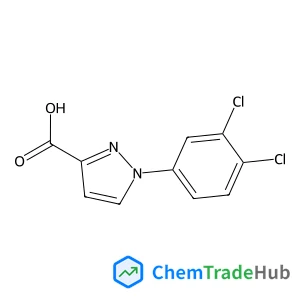
1-(3,4-Dichlorophenyl)-1H-pyrazole-3-carboxylic acid
CAS Number:
1152949-12-6
Molecular Formula:
C10H6Cl2N2O2
Emad M. Hamed, Kallum M. Koczkur, Abdelaziz Houmam
The electrochemical reduction of N,N′-dithiobisphthalimide and N,N′-thiobisphthalimide is investigated using electrochemical techniques and theoretical calculations. The results are rationalized using adequate electron transfer theories. The reduction leads to the ejection of diatomic sulfur and involves an interesting autocatalytic mechanism. This mechanism is dependent on the concentration of the initial compound and the cyclic voltammetric scan rate. The starting material is reduced both at the electrode and through homogeneous electron transfer from the produced sulfur. The initial electron transfer follows a stepwise mechanism involving the formation of the corresponding radical anion. This is supported by both the electrochemical data and the theoretical calculation results. The radical anion of the N,N′-dithiobisphthalimide dissociates through cleavage of the N–S chemical bond and not the S–S chemical bond. Application of the extension of the dissociative electron transfer theory to the dissociation of radical anions shows that the N–S chemical bond dissociates despite being stronger than the S–S chemical bond. This is due to the large difference in the oxidation potentials of the two potential anions (the phthalimidyl anion and the phthalimidyl thiyl anion). The electrochemical reduction of N,N′-thiobisphthalimide involves the intermediate formation of N,N′-dithiobisphthalimide and hence the autocatalytic process is less efficient.
Robin B. Bedford, Duncan W. Bruce, Robert M. Frost, Michael Hird
DOI: 10.1039/B507133J
Dolos Foguet-Albiol, Khalil A. Abboud, George Christou
DOI: 10.1039/B507748F
Daniel L. Reger, J. Derek Elgin, Radu F. Semeniuc, Perry J. Pellechia, Mark D. Smith
DOI: 10.1039/B504998A
Peter Nockemann, Eva Beurer, Kris Driesen, Rik Van Deun, Kristof Van Hecke, Luc Van Meervelt, Koen Binnemans
DOI: 10.1039/B506915G
Yvonne Chiang, A. Jerry Kresge, Ikenna Onyido, John P. Richard, Peter Wan, Musheng Xu
DOI: 10.1039/B506706E
Isamu Shiina, Yo-ichi Kawakita, Ryoutarou Ibuka, Kazutoshi Yokoyama, Yu-suke Yamai
DOI: 10.1039/B507401K
Makeba B. Murphy-Jolly, Lesley C. Lewis, Andrew J. M. Caffyn
DOI: 10.1039/B507752D
Olalla Nieto Faza, Carlos Silva López, Rosana Álvarez, Ángel R. de Lera
DOI: 10.1039/B506601H
Raja Kaliappan, Lakshmi S. Kaanumalle, V. Ramamurthy
DOI: 10.1039/B507517C
Waste containing N-Methoxy-N-methyl-1,3-thiazole-5-carboxamide (CAS: 898825-89-3...
N-(4-Biphenylyl)dibenzo[b,d]furan-4-amine should be stored in a tightly sealed c...
The market for 3-Acetamido-5-amino-2,4,6-triiodobenzoic acid (CAS: 1713-07-1) is...
Benzyl 2-O-acetyl-3,4,6-tri-O-benzyl-beta-D-galactopyranoside (CAS: 61820-03-9) ...
2-Ethylpiperazine dihydrochloride (CAS: 438050-52-3) is regulated under the Glob...
1,1'-[1,3-Phenylenebis(methylene)]bis(3-methyl-1H-pyrrole-2,5-dione) (CAS: 11946...
Several alternatives can be used in the synthesis of 5-Fluoro-2-(1-pyrrolidinyl)...
Proper personal protective equipment (PPE) must be worn when handling this compo...
When handling 6-Bromoimidazo[1,2-a]pyridin-8-amine, it is important to wear appr...
Alternatives to (2S,4R)-4-(4-Nitrobenzyl)pyrrolidine-2-carboxylic acid hydrochlo...

Physical Chemistry Chemical Physics (PCCP) is an international journal co-owned by 19 physical chemistry and physics societies from around the world. This journal publishes original, cutting-edge research in physical chemistry, chemical physics and biophysical chemistry. To be suitable for publication in PCCP, articles must include significant innovation and/or insight into physical chemistry; this is the most important criterion that reviewers and Editors will judge against when evaluating submissions. The journal has a broad scope and welcomes contributions spanning experiment, theory, computation and data science. Topical coverage includes spectroscopy, dynamics, kinetics, statistical mechanics, thermodynamics, electrochemistry, catalysis, surface science, quantum mechanics, quantum computing and machine learning. Interdisciplinary research areas such as polymers and soft matter, materials, nanoscience, energy, surfaces/interfaces, and biophysical chemistry are welcomed if they demonstrate significant innovation and/or insight into physical chemistry. Joined experimental/theoretical studies are particularly appreciated when complementary and based on up-to-date approaches.