












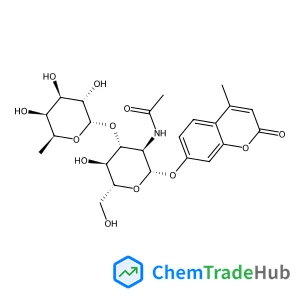
4-Methyl-2-oxo-2H-chromen-7-yl 2-acetamido-2-deoxy-3-O-(6-deoxy-alpha-L-galactopyranosyl)-beta-D-glucopyranoside
CAS Number:
383160-12-1
Molecular Formula:
C24H31NO12
Sujith Kalluri, Vanessa K. Peterson, Shi Xue Dou, Zaiping Guo
The development of cathode materials with high capacity and cycle stability is essential to emerging electric-vehicle technologies, however, of serious environmental concern is that materials with these properties developed so far contain the toxic and expensive Co. We report here the Li-rich, Co-free Li1+xMO2 (M = Li, Ni, Mn, Fe) composite cathode material, prepared via a template-free, one-step wet-chemical method followed by conventional annealing in an oxygen atmosphere. The cathode has an unprecedented level of cation mixing, where the electrochemically-active component contains four elements at the transition-metal (3a) site and 20% Ni at the active Li site (3b). We find Ni2+/Ni3+/Ni4+ to be the active redox-center of the cathode with lithiation/delithiation occurring via a solid-solution reaction where the lattice responds approximately linearly with cycling, differing to that observed for iso-structural commercial cathodes with a lower level of cation mixing. The composite cathode has ∼75% active material and delivers an initial discharge-capacity of ∼103 mA h g−1 with a reasonable capacity retention of ∼84.4% after 100 cycles. Notably, the electrochemically-active component possesses a capacity of ∼139 mA h g−1, approaching that of the commercialized LiCoO2 and Li(Ni1/3Mn1/3Co1/3)O2 materials. Importantly, our operando neutron powder-diffraction results suggest excellent structural stability of this active component, which exhibits ∼80% less change in its stacking-axis than for LiCoO2 with approximately the same capacity, a characteristic that may be exploited to enhance significantly the capacity retention of this and similar materials.
Debika Gogoi, Rajeshvari Samatbhai Karmur, Narendra Nath Ghosh
DOI: 10.1039/D3TA05104H
Tianlun Ren, Huizhen Wang, Shan Xu, Hongjie Yu, Kai Deng, Ziqiang Wang, Hongjing Wang, Liang Wang, You Xu
DOI: 10.1039/D3TA04629J
Santhoshkumar Sundaramoorthy, Amitava Choudhury, Naresh C. Osti, Alexander I. Kolesnikov, Matthew B. Stone, Yongqiang Cheng
DOI: 10.1039/D3TA04479C
DOI: 10.1039/D3NH00282A
DOI: 10.1039/D3TA05044K
Nusik Gedikoglu, Pablo Salcedo-Abraira, Nathalie Guillou, Nicolas Dupré, Christophe Payen, Philippe Poizot, Thomas Devic
DOI: 10.1039/D3TA05353A
Walter P. D. Wong, Xinyun Wang
DOI: 10.1039/D3TA04568D
Zhihao Yang, Ying Yuan, Bin Wang, Xiaojun Shen, Xiluan Wang, Tong-Qi Yuan
DOI: 10.1039/D3TA04872A
When handling lithium chloride hydrate (1:1:1) (CAS: 16712-20-2), it is importan...
4-(4H-1,2,4-Triazol-4-yl)piperidine is generally considered safe for use in phar...
Waste containing 1,3-Thiazole-2-carboxamide (CAS: 16733-85-0) should be collecte...
5-(Difluoromethyl)-2-fluorobenzonitrile (CAS: 934175-58-3) is subject to regulat...
Methyl 3-acetamido-2-thiophenecarboxylate can be synthesized by the reaction of ...
4-Isoquinolinecarbonitrile is a chemical compound with the CAS number 34846-65-6...
Store Methyl 1H-1,2,3-triazole-4-carboxylate (CAS: 877309-59-6) in a cool, dry p...
6-Bromo[1,3]thiazolo[5,4-b]pyridin-2-amine (CAS: 1160791-13-8) is subject to the...
(2S,3S)-2-Ammonio-3-(3,4-dihydroxyphenyl)-3-hydroxypropanoate (CAS: 23651-95-8) ...
7-Bromo-3-methyl-3,4-dihydroquinazolin-4-one is a solid with a crystalline form....

Physical Chemistry Chemical Physics (PCCP) is an international journal co-owned by 19 physical chemistry and physics societies from around the world. This journal publishes original, cutting-edge research in physical chemistry, chemical physics and biophysical chemistry. To be suitable for publication in PCCP, articles must include significant innovation and/or insight into physical chemistry; this is the most important criterion that reviewers and Editors will judge against when evaluating submissions. The journal has a broad scope and welcomes contributions spanning experiment, theory, computation and data science. Topical coverage includes spectroscopy, dynamics, kinetics, statistical mechanics, thermodynamics, electrochemistry, catalysis, surface science, quantum mechanics, quantum computing and machine learning. Interdisciplinary research areas such as polymers and soft matter, materials, nanoscience, energy, surfaces/interfaces, and biophysical chemistry are welcomed if they demonstrate significant innovation and/or insight into physical chemistry. Joined experimental/theoretical studies are particularly appreciated when complementary and based on up-to-date approaches.
![[(2R)-6,6-Dimethyl-2-morpholinyl]methanol hydrochloride (1:1) structure](https://static.chemtradehub.com/structs/141/1416444-88-6-e06a.webp "[(2R)-6,6-Dimethyl-2-morpholinyl]methanol hydrochloride (1:1) structure")
![Ethyl 4-[8-chloro(5,5,6,6,7-~2~H_5_)-5,6-dihydro-11H-benzo[5,6]cyclohepta[1,2-b]pyridin-11-ylidene]-1-piperidinecarboxylate structure](https://static.chemtradehub.com/structs/102/1020719-57-6-37e2.webp "Ethyl 4-[8-chloro(5,5,6,6,7-~2~H_5_)-5,6-dihydro-11H-benzo[5,6]cyclohepta[1,2-b]pyridin-11-ylidene]-1-piperidinecarboxylate structure")

![8-Bromo-6-fluoro[1,2,4]triazolo[1,5-a]pyridin-2-amine structure](https://static.chemtradehub.com/structs/125/1257705-51-3-9f4a.webp "8-Bromo-6-fluoro[1,2,4]triazolo[1,5-a]pyridin-2-amine structure")




