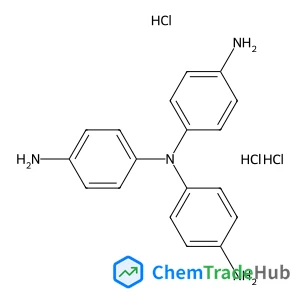
N1,N1-Bis(4-aminophenyl)benzene-1,4-diamine trihydrochloride
CAS Number:
114254-48-7
Molecular Formula:
C18H21Cl3N4
Doris Rengstl, Veronika Fischer, Werner Kunz
In this article a strategy is proposed for the design of low toxic, room temperature liquid low-melting mixtures (LMMs) which are entirely composed of natural materials. From literature it is well known that, in general, deep eutectic solvents based on choline chloride and dicarboxylic acids are LMMs, but not liquids at room temperature, with one exception: a 1 : 1 molar mixture of malonic acid and choline chloride. Therefore, the starting point of this study was the decrease of the melting point of one of the components, namely the dicarboxylic acid, which is succinic, glutaric or adipic acid. For this purpose, one of the two protons of the acidic group was exchanged by a bulky unsymmetrical choline cation. The resulting ionic liquids (ILs) were still solid at room temperature, but have a reduced melting temperature compared to the corresponding acids. In the second step, mixtures of these ILs with choline chloride were prepared. It turned out that choline glutarate–choline chloride mixtures are liquids at room temperature at compositions containing 95–98 wt% of choline glutarate. Finally, urea was added as another hydrogen bond donor. Density, conductivity and viscosity measurements were performed for all obtained mixtures. Moreover, a Walden plot was drawn which indicates that all mixtures are liquids with fully dissociated ions moving independently. Therefore, they are considered as “good” ionic liquids and, thus, for example they can be used to exchange more toxic or less biodegradable ILs in application processes. A brief outlook containing application possibilities is given. It is demonstrated that choline dodecylsulfate is readily soluble in these mixtures, forming aggregates in the LMM at temperatures exceeding 55 °C.
Patrik Västilä, Jenny Wettergren, Hans Adolfsson
DOI: 10.1039/B505516D
Hui Hong, Tim Stinear, Paul Skelton, Jonathan B. Spencer, Peter F. Leadlay
DOI: 10.1039/B506835E
Herbert W. Roesky, S. Shravan Kumar
DOI: 10.1039/B505307B
Jean-Paul Lellouche, Senthil Govindaraji, Augustine Joseph, Jyongsik Jang, Kyung Jin Lee
DOI: 10.1039/B502483H
Rongcai Huang, Kevin H. Shaughnessy
DOI: 10.1039/B509406B
Chantal Gondran, Olivier Renaudet, Pascal Dumy, Hugues Driguez, Sébastien Fort, Serge Cosnier
DOI: 10.1039/B506699A
James J. Murphy, Kotohiro Nomura
DOI: 10.1039/B506877K
Motoichi Kurisawa, Joo Eun Chung, Yi Yan Yang, Shu Jun Gao, Hiroshi Uyama
DOI: 10.1039/B506989K
Maurilio Galletta, Sebastiano Campagna, Manuel Quesada, Gilles Ulrich, Raymond Ziessel
DOI: 10.1039/B507196H
Christian Helbig, Rudolf Herrmann, Franz Mayr, Ernst-Wilhelm Scheidt, Klaus Tröster, Jan Hanss, Hans-Albrecht Krug von Nidda, Gunter Heymann, Hubert Huppertz, Wolfgang Scherer
DOI: 10.1039/B506088E
Waste containing N-Methoxy-N-methyl-1,3-thiazole-5-carboxamide (CAS: 898825-89-3...
N-(4-Biphenylyl)dibenzo[b,d]furan-4-amine should be stored in a tightly sealed c...
The market for 3-Acetamido-5-amino-2,4,6-triiodobenzoic acid (CAS: 1713-07-1) is...
Benzyl 2-O-acetyl-3,4,6-tri-O-benzyl-beta-D-galactopyranoside (CAS: 61820-03-9) ...
2-Ethylpiperazine dihydrochloride (CAS: 438050-52-3) is regulated under the Glob...
1,1'-[1,3-Phenylenebis(methylene)]bis(3-methyl-1H-pyrrole-2,5-dione) (CAS: 11946...
Several alternatives can be used in the synthesis of 5-Fluoro-2-(1-pyrrolidinyl)...
Proper personal protective equipment (PPE) must be worn when handling this compo...
When handling 6-Bromoimidazo[1,2-a]pyridin-8-amine, it is important to wear appr...
Alternatives to (2S,4R)-4-(4-Nitrobenzyl)pyrrolidine-2-carboxylic acid hydrochlo...

Physical Chemistry Chemical Physics (PCCP) is an international journal co-owned by 19 physical chemistry and physics societies from around the world. This journal publishes original, cutting-edge research in physical chemistry, chemical physics and biophysical chemistry. To be suitable for publication in PCCP, articles must include significant innovation and/or insight into physical chemistry; this is the most important criterion that reviewers and Editors will judge against when evaluating submissions. The journal has a broad scope and welcomes contributions spanning experiment, theory, computation and data science. Topical coverage includes spectroscopy, dynamics, kinetics, statistical mechanics, thermodynamics, electrochemistry, catalysis, surface science, quantum mechanics, quantum computing and machine learning. Interdisciplinary research areas such as polymers and soft matter, materials, nanoscience, energy, surfaces/interfaces, and biophysical chemistry are welcomed if they demonstrate significant innovation and/or insight into physical chemistry. Joined experimental/theoretical studies are particularly appreciated when complementary and based on up-to-date approaches.

![4-Chloro-2-{[(2-chlorophenoxy)acetyl]amino}benzoic acid structure](https://static.chemtradehub.com/structs/351/351424-20-9-9467.webp "4-Chloro-2-{[(2-chlorophenoxy)acetyl]amino}benzoic acid structure")