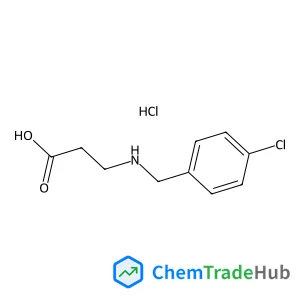
N-(4-Chlorobenzyl)-beta-alanine hydrochloride (1:1)
CAS Number:
1172479-10-5
Molecular Formula:
C10H13Cl2NO2
Youxiang Shao, Hua Hou, Baoshan Wang
The reactions of hydroperoxy radicals with hydroxymethylperoxy and methoxymethylperoxy radicals were studied using the hybrid density functional theory and the coupled-cluster theory with complete basis set extrapolation. In contrast with the unsubstituted alkylperoxy reactions, it was found that OH-substitution has a significant effect on the reaction mechanism. Several hydrogen bonding reaction precursors exist at the start of the reaction. The reaction pathways show a strongly anisotropic character. The preferred transition states are four-, five-, six-, or seven-membered cyclic structures. The predicted rate coefficients are expressed as k(T) = 8.48 × 10⁻²⁴T3.55e2164/T + 2.37 × 10⁻²⁹T4.70e3954/T cm3 molecule−1 s−1. Based on the available experimental data in the temperature range 275–333 K, the theoretical and experimental results are in agreement with a relative average deviation of only 8%. The nascent products at low and high temperatures are hydroperoxide molecules and hydroxyl radicals, respectively. A potential source has been found for the production of formic acid and new insights into the experimental observations are presented.
Yanfei Shen, Yuanjian Zhang, Qixian Zhang, Tianyan You, Ari Ivaska
DOI: 10.1039/B507688A
Martin Schüler, David O'Hagan, Alexandra M. Z. Slawin
DOI: 10.1039/B506010A
Ramsey Ida, Gang Wu
DOI: 10.1039/B505674H
Maurilio Galletta, Sebastiano Campagna, Manuel Quesada, Gilles Ulrich, Raymond Ziessel
DOI: 10.1039/B507196H
Bo Tang, Jinye Niu, Chengguang Yu, Linhai Zhuo, Jiechao Ge
DOI: 10.1039/B502978C
Liangru Yang, Alex von Zelewsky, Helen Stoeckli-Evans
DOI: 10.1039/B507769A
Sibylle Müller, Klaus Müllen
DOI: 10.1039/B509220E
Kazunori Nakashima, Tatsuo Maruyama, Noriho Kamiya, Masahiro Goto
DOI: 10.1039/B505479F
Shaofeng Yang, Roel Prins
DOI: 10.1039/B507940C
Waste containing N-Methoxy-N-methyl-1,3-thiazole-5-carboxamide (CAS: 898825-89-3...
N-(4-Biphenylyl)dibenzo[b,d]furan-4-amine should be stored in a tightly sealed c...
The market for 3-Acetamido-5-amino-2,4,6-triiodobenzoic acid (CAS: 1713-07-1) is...
Benzyl 2-O-acetyl-3,4,6-tri-O-benzyl-beta-D-galactopyranoside (CAS: 61820-03-9) ...
2-Ethylpiperazine dihydrochloride (CAS: 438050-52-3) is regulated under the Glob...
1,1'-[1,3-Phenylenebis(methylene)]bis(3-methyl-1H-pyrrole-2,5-dione) (CAS: 11946...
Several alternatives can be used in the synthesis of 5-Fluoro-2-(1-pyrrolidinyl)...
Proper personal protective equipment (PPE) must be worn when handling this compo...
When handling 6-Bromoimidazo[1,2-a]pyridin-8-amine, it is important to wear appr...
Alternatives to (2S,4R)-4-(4-Nitrobenzyl)pyrrolidine-2-carboxylic acid hydrochlo...

Physical Chemistry Chemical Physics (PCCP) is an international journal co-owned by 19 physical chemistry and physics societies from around the world. This journal publishes original, cutting-edge research in physical chemistry, chemical physics and biophysical chemistry. To be suitable for publication in PCCP, articles must include significant innovation and/or insight into physical chemistry; this is the most important criterion that reviewers and Editors will judge against when evaluating submissions. The journal has a broad scope and welcomes contributions spanning experiment, theory, computation and data science. Topical coverage includes spectroscopy, dynamics, kinetics, statistical mechanics, thermodynamics, electrochemistry, catalysis, surface science, quantum mechanics, quantum computing and machine learning. Interdisciplinary research areas such as polymers and soft matter, materials, nanoscience, energy, surfaces/interfaces, and biophysical chemistry are welcomed if they demonstrate significant innovation and/or insight into physical chemistry. Joined experimental/theoretical studies are particularly appreciated when complementary and based on up-to-date approaches.