












A double-QM/MM method for investigating donor–acceptor electron-transfer reactions in solution
Literature Information
Publication Date
2014-08-08
DOI
10.1039/C4CP02307B
Impact Factor
3.676
Authors
Jaroslav V. Burda
View Original
Abstract
We developed a double-quantum mechanical/molecular mechanical (d-QM/MM) method for investigation of full outer-sphere electron transfer (ET) processes between a donor and an acceptor (DA) in condensed matter. In the d-QM/MM method, which employs the novel concept of multiple QM regions, one can easily specify the number of electrons, spin states and appropriate exchange–correlation treatment in each QM region, which is especially important in the cases of ET involving transition metal sites. We investigated Fe2+/3+ self-exchange and Fe3+ + Ru2+ → Fe2+ + Ru3+ in aqueous solution as model reactions, and demonstrated that the d-QM/MM method gives reasonable accuracy for the redox potential, reorganization free energy and electronic coupling. In particular, the DA distance dependencies of those quantities are clearly shown at the density functional theory hybrid functional level. The present d-QM/MM method allows us to explore the intermediate DA distance region, important for long-range ET phenomena observed in electrochemistry (on the solid–liquid interfaces) and biochemistry, which cannot be dealt by the half-reaction scheme with the conventional QM/MM.
Related Literature
Methanol as a hydrate inhibitor and hydrate activator
Bjørn Kvamme, Juri Selvåg, Navid Saeidi, Tatiana Kuznetsova
2018-08-07
Paper
DOI: 10.1039/C8CP02447B
Control of triplet state generation in heavy atom-free BODIPY–anthracene dyads by media polarity and structural factors
Mikhail A. Filatov, Safakath Karuthedath, Pavel M. Polestshuk, Susan Callaghan, Keith J. Flanagan, Maxime Telitchko, Thomas Wiesner, Frédéric Laquai, Mathias O. Senge
2018-02-12
Paper
DOI: 10.1039/C7CP08472B
Structure–composition trends in multicomponent borosilicate-based glasses deduced from molecular dynamics simulations with improved B–O and P–O force fields
Baltzar Stevensson, Yang Yu, Mattias Edén
2018-02-07
Paper
DOI: 10.1039/C7CP08593A
Growth of Ni nanoclusters on irradiated graphene: a molecular dynamics study
E. E. Hernandez-Vazquez, E. M. Bringa, J. L. Moran-Lopez
2018-04-03
Paper
DOI: 10.1039/C7CP08642C
Efficient structural elucidation of microhydrated biomolecules through the interrogation of hydrogen bond networks
Yeonjoon Kim, Jaewook Kim, Kyung Yup Baek, Woo Youn Kim
2018-02-20
Paper
DOI: 10.1039/C7CP08372F
Photochemistry of glyoxylate embedded in sodium chloride clusters, a laboratory model for tropospheric sea-salt aerosols
Nina K. Bersenkowitsch, Milan Ončák, Christian van der Linde, Andreas Herburger, Martin K. Beyer
2018-02-28
Paper
DOI: 10.1039/C8CP00399H
The effect of ether-functionalisation in ionic liquids analysed by DFT calculation, infrared spectra, and Kamlet–Taft parameters
A. Tsurumaki, O. Palumbo, S. Panero, A. Paolone, M. A. Navarra
2018-02-23
Paper
DOI: 10.1039/C7CP08134K
Revealing dynamically-organized receptor ion channel clusters in live cells by a correlated electric recording and super-resolution single-molecule imaging approach
Rajeev Yadav, H. Peter Lu
2018-02-02
Paper
DOI: 10.1039/C7CP08030A
You might also like
Compound Q&A
Is 2-(2-chloroacetamido)-3-phenylpropanoic acid (CAS: 7765-11-9) safe?
2-(2-Chloroacetamido)-3-phenylpropanoic acid (CAS: 7765-11-9) is generally consi...
7765-11-92-(2-chloroacetamido...
Compound Q&A
Is 2-(Benzyloxy)-5-bromobenzoic acid (CAS: 62176-31-2) safe?
2-(Benzyloxy)-5-bromobenzoic acid can be handled safely if appropriate precautio...
62176-31-22-(Benzyloxy)-5-brom...
Compound Q&A
What is (4-Methyl-1,2,5-oxadiazol-3-yl)methanamine hydrochloride (CAS: 1159825-48-5)?
(4-Methyl-1,2,5-oxadiazol-3-yl)methanamine hydrochloride is a chemical compound ...
1159825-48-5(4-Methyl-1,2,5-oxad...
Compound Q&A
What is 2-(5-Hexylthiophen-2-yl)-4,4,5,5-tetramethyl-1,3,2-dioxaborolane (CAS: 917985-54-7)?
2-(5-Hexylthiophen-2-yl)-4,4,5,5-tetramethyl-1,3,2-dioxaborolane (CAS: 917985-54...
917985-54-72-(5-Hexylthiophen-2...
Compound Q&A
Are there alternatives to 4-(8-Methyl-9H-1,3-dioxolo[4,5-h][2,3]benzodiazepin-5-yl)benzenamine (CAS: 102771-26-6) in synthesis?
While 4-(8-Methyl-9H-1,3-dioxolo[4,5-h][2,3]benzodiazepin-5-yl)benzenamine (CAS:...
102771-26-64-(8-Methyl-9H-1,3-d...
Compound Q&A
What is the market or research trend for tert-butyl 3-hydroxy-4,5,7,8-tetrahydro-2H-pyrazolo[3,4-d]azepine-6-carboxylate (CAS: 851376-80-2)?
The market for tert-butyl 3-hydroxy-4,5,7,8-tetrahydro-2H-pyrazolo[3,4-d]azepine...
851376-80-2tert-butyl 3-hydroxy...
Compound Q&A
How should waste containing 3,5-Diamino-1H-pyrazole-4-carbonitrile (CAS: 6844-58-2) be handled?
Waste containing 3,5-Diamino-1H-pyrazole-4-carbonitrile (CAS: 6844-58-2) should ...
6844-58-23,5-Diamino-1H-pyraz...
Compound Q&A
How is (6-Fluoro-3-pyridinyl)boronic acid (CAS: 351019-18-6) typically synthesized?
(6-Fluoro-3-pyridinyl)boronic acid can be synthesized through the reaction of 6-...
351019-18-6(6-Fluoro-3-pyridiny...
Compound Q&A
What industries use Dibenzyl carbonimidoylbiscarbamate (CAS: 10065-79-9)?
Dibenzyl carbonimidoylbiscarbamate (CAS: 10065-79-9) finds applications in vario...
10065-79-9Dibenzyl carbonimido...
Compound Q&A
What is the market or research trend for (beta,beta,2,3,4,5,6-~2~H_7_)Phenylalanine (CAS: 74228-83-4)?
The market for (beta,beta,2,3,4,5,6-~2~H_7_)Phenylalanine (CAS: 74228-83-4) is g...
74228-83-4(beta,beta,2,3,4,5,6...
Source Journal
Physical Chemistry Chemical Physics

CiteScore:
5.5
Self-citation Rate:
10.3%
Articles per Year:
3036
Physical Chemistry Chemical Physics (PCCP) is an international journal co-owned by 19 physical chemistry and physics societies from around the world. This journal publishes original, cutting-edge research in physical chemistry, chemical physics and biophysical chemistry. To be suitable for publication in PCCP, articles must include significant innovation and/or insight into physical chemistry; this is the most important criterion that reviewers and Editors will judge against when evaluating submissions. The journal has a broad scope and welcomes contributions spanning experiment, theory, computation and data science. Topical coverage includes spectroscopy, dynamics, kinetics, statistical mechanics, thermodynamics, electrochemistry, catalysis, surface science, quantum mechanics, quantum computing and machine learning. Interdisciplinary research areas such as polymers and soft matter, materials, nanoscience, energy, surfaces/interfaces, and biophysical chemistry are welcomed if they demonstrate significant innovation and/or insight into physical chemistry. Joined experimental/theoretical studies are particularly appreciated when complementary and based on up-to-date approaches.
Recommended Compounds
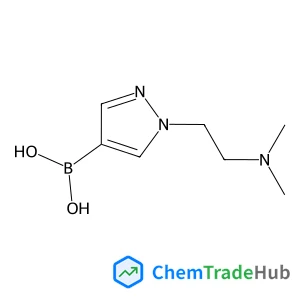
(1-(2-(Dimethylamino)ethyl)-1H-pyrazol-4-yl)boronic acid
CAS Number:
1086063-73-1
Molecular Formula:
C7H14BN3O2
![{3-[Bis(4-hydroxyphenyl)methyl]-1-[2-(dimethylamino)ethyl]-1H-indol-2-yl}[4-(2-chlorophenyl)-1-piperazinyl]methanone structure](https://static.chemtradehub.com/structs/170/170365-25-0-e4d7.webp "{3-[Bis(4-hydroxyphenyl)methyl]-1-[2-(dimethylamino)ethyl]-1H-indol-2-yl}[4-(2-chlorophenyl)-1-piperazinyl]methanone structure")
{3-[Bis(4-hydroxyphenyl)methyl]-1-[2-(dimethylamino)ethyl]-1H-indol-2-yl}[4-(2-chlorophenyl)-1-piperazinyl]methanone
CAS Number:
170365-25-0
Molecular Formula:
C36H37ClN4O3

Recommended Suppliers






Disclaimer
This page provides academic journal information for reference and research purposes only. We are not affiliated with any journal publishers and do not handle publication submissions. For publication-related inquiries, please contact the respective journal publishers directly.
If you notice any inaccuracies in the information displayed, please contact us at support@chemtradehub.com. We will promptly review and address your concerns.