












Anionic derivatives of uracil: fragmentation and reactivity
Literature Information
Publication Date
2014-07-18
DOI
10.1039/C4CP02277G
Impact Factor
3.676
Authors
Callie A. Cole, Zhe-Chen Wang
View Original
Abstract
Uracil is an essential biomolecule for terrestrial life, yet its prebiotic formation mechanisms have proven elusive for decades. Meteorites have been shown to contain uracil and the interstellar abundance of aromatic species and nitrogen-containing molecules is well established, providing support for uracil's presence in the interstellar medium (ISM). The ion chemistry of uracil may provide clues to its prebiotic synthesis and role in the origin of life. The fragmentation of biomolecules provides valuable insights into their formation. Previous research focused primarily on the fragmentation and reactivity of cations derived from uracil. In this study, we explore deprotonated uracil-5-carboxylic acid and its anionic fragments to elucidate novel reagents of uracil formation and to characterize the reactivity of uracil's anionic derivatives. The structures of these fragments are identified through theoretical calculations, further fragmentation, experimental acidity bracketing, and reactivity with several detected and potential interstellar species (SO2, OCS, CS2, NO, N2O, CO, NH3, O2, and C2H4). Fragmentation is achieved through collision induced dissociation (CID) in a commercial ion trap mass spectrometer, and all reaction rate constants are measured using a modification of this instrument. Experimental data are supported by theoretical calculations at the B3LYP/6-311++G(d,p) level of theory. Lastly, the astrochemical implications of the observed fragmentation and reaction processes are discussed.
Related Literature
Dehydroamino acids: chemical multi-tools for late-stage diversification
Jonathan W. Bogart, Albert A. Bowers
2019-02-27
Review Article
DOI: 10.1039/C8OB03155J
Late-stage C–H amination of abietane diterpenoids
Alejandro Dana, Pablo H. Di Chenna, Benjamin Darses, Fernando J. Durán, Philippe Dauban
2019-03-22
Paper
DOI: 10.1039/C9OB00272C
Unprecedented E-stereoselectivity on the sigmatropic Hurd–Claisen rearrangement of Morita–Baylis–Hillman adducts: a joint experimental–theoretical study
Vinicius Sobral Silva, Terezinha Alves Tolentino, Tiago Costa Alves Fontoura Rodrigues, Fernanda Ferrari Martins Santos, Daniel Francisco Scalabrini Machado, Wender Alves Silva, Heibbe Cristhian Benedito de Oliveira, Angelo Henrique Lira Machado
2019-04-05
Paper
DOI: 10.1039/C9OB00533A
Aminophosphonates and aminophosphonic acids with tetrasubstituted stereogenic center: diastereoselective synthesis from cyclic ketimines
Jakub Iwanejko, Anna Brol, Bartłomiej M. Szyja, Marek Daszkiewicz, Elżbieta Wojaczyńska, Tomasz K. Olszewski
2019-07-16
Paper
DOI: 10.1039/C9OB01346F
Preparation of a large-sized highly flexible carbon nanohoop
Yuta Nakagawa, Ryuta Sekiguchi, Jun Kawakami, Shunji Ito
2019-06-19
Paper
DOI: 10.1039/C9OB00763F
Improvement of the versatility of an arabinofuranosidase against galactofuranose for the synthesis of galactofuranoconjugates
Quentin Pavic, Aline Pillot, Olivier Tasseau, Laurent Legentil, Sylvain Tranchimand
2019-06-24
Paper
DOI: 10.1039/C9OB01162E
The palladium(ii)-catalyzed regioselective ortho-C–H bromination/iodination of arylacetamides with in situ generated imidic acid as the directing group: mechanistic exploration
Yogesh Jaiswal, Yogesh Kumar, Amit Kumar
2019-06-18
Paper
DOI: 10.1039/C9OB01082C
The cubane paradigm in bioactive molecule discovery: further scope, limitations and the cyclooctatetraene complement‡
Sevan D. Houston, Tyler Fahrenhorst-Jones, Hui Xing, Benjamin A. Chalmers, Melissa L. Sykes, Jeanette E. Stok, Clementina Farfan Soto, Jed M. Burns, Paul V. Bernhardt, James J. De Voss, Glen M. Boyle, Maree T. Smith, John Tsanaktsidis, G. Paul Savage, Vicky M. Avery, Craig M. Williams
2019-06-26
Paper
DOI: 10.1039/C9OB01238A
Planarized B,N-phenylated dibenzoazaborine with a carbazole substructure: electronic impact of the structural constraint
Mikinori Ando, Mika Sakai, Naoki Ando, Masato Hirai
2019-05-14
Communication
DOI: 10.1039/C9OB00934E
Synthesis and antiproliferative evaluation of new zampanolide mimics
Guanglin Chen, Manee Patanapongpibul, Ziran Jiang, James D. White, Qiao-Hong Chen
2019-03-25
Paper
DOI: 10.1039/C9OB00556K
You might also like
Compound Q&A
What are the main uses of (3.beta.)-3-Hydroxy-N,N-dimethyl-chol-5-en-24-amide (CAS: 79066-03-8)?
(3.beta.)-3-Hydroxy-N,N-dimethyl-chol-5-en-24-amide (CAS: 79066-03-8) is primari...
79066-03-8(3.beta.)-3-Hydroxy-...
Compound Q&A
What regulatory guidelines apply to 5-(aminomethyl)-2-methoxyphenol (CAS: 89702-89-6)?
5-(Aminomethyl)-2-methoxyphenol (CAS: 89702-89-6) is classified under GHS as a s...
89702-89-65-(aminomethyl)-2-me...
Compound Q&A
What is Thieno[2,3-c]pyridin-7(6H)-one (CAS: 28981-13-7)?
Thieno[2,3-c]pyridin-7(6H)-one (CAS: 28981-13-7) is a heterocyclic organic compo...
28981-13-7Thieno[2,3-c]pyridin...
Compound Q&A
Is 1-[(6-Methoxy-3-pyridinyl)methyl]-4-piperidinamine dihydrochloride (CAS: 1185311-28-7) safe?
1-[(6-Methoxy-3-pyridinyl)methyl]-4-piperidinamine dihydrochloride is generally ...
1185311-28-71-[(6-Methoxy-3-pyri...
Compound Q&A
What regulatory guidelines apply to [(2E)-3-Phenyl-2-propen-1-yl]phosphonic acid (CAS: 146404-58-2)?
[(2E)-3-Phenyl-2-propen-1-yl]phosphonic acid (CAS: 146404-58-2) is regulated und...
146404-58-2[(2E)-3-Phenyl-2-pro...
Compound Q&A
What regulatory guidelines apply to 6-Bromo-7-methoxyquinoline (CAS: 1620515-86-7)?
6-Bromo-7-methoxyquinoline (CAS: 1620515-86-7) falls under the scope of the Glob...
1620515-86-76-Bromo-7-methoxyqui...
Compound Q&A
What industries use (2R)-1-(1-Benzofuran-2-yl)-N-propyl-2-pentanamine (CAS: 260550-89-8)?
This compound is primarily used in the pharmaceutical industry for the developme...
260550-89-8(2R)-1-(1-Benzofuran...
Compound Q&A
What are the main uses of 1-Ethyl-7-[2-methyl-6-(4H-1,2,4-triazol-3-yl)-3-pyridinyl]-3,5-dihydropyrazino[2,3-b]pyrazin-2(1H)-one (CAS: 1228013-15-7)?
1-Ethyl-7-[2-methyl-6-(4H-1,2,4-triazol-3-yl)-3-pyridinyl]-3,5-dihydropyrazino[2...
1228013-15-71-Ethyl-7-[2-methyl-...
Compound Q&A
Are there alternatives to {5-(Acryloylamino)-2-[(dimethylamino)methyl]phenyl}boronic acid (CAS: 1217500-78-1) in synthesis?
Alternative reagents such as 2-[(dimethylamino)methyl]phenylboronic acid or rela...
1217500-78-1{5-(Acryloylamino)-2...
Compound Q&A
What is 3-(Piperidin-4-yloxy)pyridine (CAS: 310881-48-2)?
3-(Piperidin-4-yloxy)pyridine (CAS: 310881-48-2) is an organic compound with the...
310881-48-23-(Piperidin-4-yloxy...
Source Journal
Physical Chemistry Chemical Physics

CiteScore:
5.5
Self-citation Rate:
10.3%
Articles per Year:
3036
Physical Chemistry Chemical Physics (PCCP) is an international journal co-owned by 19 physical chemistry and physics societies from around the world. This journal publishes original, cutting-edge research in physical chemistry, chemical physics and biophysical chemistry. To be suitable for publication in PCCP, articles must include significant innovation and/or insight into physical chemistry; this is the most important criterion that reviewers and Editors will judge against when evaluating submissions. The journal has a broad scope and welcomes contributions spanning experiment, theory, computation and data science. Topical coverage includes spectroscopy, dynamics, kinetics, statistical mechanics, thermodynamics, electrochemistry, catalysis, surface science, quantum mechanics, quantum computing and machine learning. Interdisciplinary research areas such as polymers and soft matter, materials, nanoscience, energy, surfaces/interfaces, and biophysical chemistry are welcomed if they demonstrate significant innovation and/or insight into physical chemistry. Joined experimental/theoretical studies are particularly appreciated when complementary and based on up-to-date approaches.
Recommended Compounds
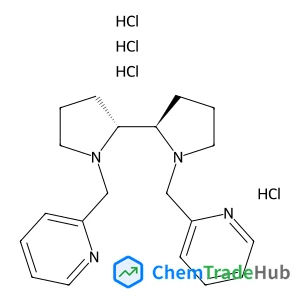
(2R,2'R)-1,1'-Bis(2-pyridinylmethyl)-2,2'-bipyrrolidine tetrahydrochloride
CAS Number:
1228077-88-0
Molecular Formula:
C20H30Cl4N4
![N-[(6-Bromo-3-pyridinyl)methyl]ethanamine structure](https://static.chemtradehub.com/structs/120/120740-05-8-ca55.webp "N-[(6-Bromo-3-pyridinyl)methyl]ethanamine structure")
Recommended Suppliers




Disclaimer
This page provides academic journal information for reference and research purposes only. We are not affiliated with any journal publishers and do not handle publication submissions. For publication-related inquiries, please contact the respective journal publishers directly.
If you notice any inaccuracies in the information displayed, please contact us at support@chemtradehub.com. We will promptly review and address your concerns.