












The atmospheric oxidation mechanism of 1,2,4-trimethylbenzene initiated by OH radicals
Literature Information
Publication Date
2014-07-14
DOI
10.1039/C4CP02027H
Impact Factor
3.676
Authors
Yun Li
View Original
Abstract
The atmospheric oxidation mechanism of 1,2,4-trimethylbenzene (1,2,4-TMB) initiated by OH radicals is investigated using quantum chemistry calculations at M06-2X and ROCBS-QB3 levels. The calculations show that the initiation of the reaction is dominated by OH addition to C1, C3 and C5 to form 1,2,4-TMB-OH adducts R1, R3, and R5 with branching ratios of 0.22, 0.19, and 0.38, respectively, using ROCBS-QB3 energies. In the troposphere, the adducts react with O2 by irreversible H-abstraction to form phenolic compounds and by reversible addition to TMB-OH-O2 peroxy radicals, which will cyclize to bicyclic radicals, similar to those in benzene, toluene, and xylenes. The bicyclic radicals can further recombine with O2 to generate bicyclic peroxy and alkoxyl radicals. The bicyclic alkoxyl radicals would break the ring directly to form 1,2-dicarbonyl products and unsaturated 1,4-dicarbonyl co-products, or undergo another cyclization to form an epoxy group, followed by the ring-breakage to form 1,2-dicarbonyl products and epoxy-1,4-dicarbonyl co-products. The predicted yields of products agree reasonably with the previous experimental measurements, while considerable discrepancies also exist for the yields of nitrates, biacetyl, 4-oxo-2-pentenal, and butenedial, etc. Our mechanism also predicts a new type of epoxy-1,4-dicarbonyl compounds with a total yield of ∼0.32. The epoxy-1,4-dicarbonyl compounds have not been suggested or reported in previous studies.
Recommended Journals
Related Literature
Chemodivergent reaction of azomethine imines and 2H-azirines for the synthesis of nitrogen-containing scaffolds
Yufeng Wu, Bing Tian, Chao Hu, Kohei Sekine, Matthias Rudolph, Frank Rominger
2019-05-10
Communication
DOI: 10.1039/C9OB00740G
The disruption of verM activates the production of gliocladiosin A and B in Clonostachys rogersoniana
Yuanyuan Pan, Xingzhong Liu, Yongsheng Che
2019-06-28
Communication
DOI: 10.1039/C9OB01102A
Correction: Enantiomeric NMR discrimination of carboxylic acids using actinomycin D as a chiral solvating agent
Liwen Bai, Pian Chen, Jiangxia Xiang, Jiarui Sun, Xinxiang Lei
2019-03-28
Correction
DOI: 10.1039/C9OB90055A
A gold-catalyzed facile intramolecular rearrangement and cyclization sequence for synthesis of 2,5-dihydrofurans
Komalla Sunil, Sridhar Balasubramanian
2019-05-14
Paper
DOI: 10.1039/C9OB00756C
Recent advances in photocatalytic manipulations of Rose Bengal in organic synthesis
Shivani Sharma, Anuj Sharma
2019-03-22
Review Article
DOI: 10.1039/C9OB00092E
Decarboxylative acylation of N-free indoles enabled by a catalytic amount of copper catalyst and liquid-assisted grinding
Jingbo Yu, Chao Zhang, Xinjie Yang, Weike Su
2019-04-06
Communication
DOI: 10.1039/C9OB00622B
Divergent synthesis of 5′,7′-difluorinated dihydroxanthene-hemicyanine fused near-infrared fluorophores
Shasha Zheng, Gu Lingyue, Michelle Jui Hsien Ong, Denis Jacquemin, Jean-Alexandre Richard, Rajavel Srinivasan
2019-04-10
Paper
DOI: 10.1039/C9OB00568D
Dehydroamino acids: chemical multi-tools for late-stage diversification
Jonathan W. Bogart, Albert A. Bowers
2019-02-27
Review Article
DOI: 10.1039/C8OB03155J
4-Aminoindoles as 1,4-bisnucleophiles for diversity-oriented synthesis of tricyclic indoles bearing 3,4-fused seven-membered rings
Shaomin Chen, Palanisamy Ravichandiran, Ahmed El-Harairy, Yves Queneau, Minghao Li
2019-05-30
Paper
DOI: 10.1039/C9OB01045A
You might also like
Compound Q&A
What are the main uses of (3.beta.)-3-Hydroxy-N,N-dimethyl-chol-5-en-24-amide (CAS: 79066-03-8)?
(3.beta.)-3-Hydroxy-N,N-dimethyl-chol-5-en-24-amide (CAS: 79066-03-8) is primari...
79066-03-8(3.beta.)-3-Hydroxy-...
Compound Q&A
What regulatory guidelines apply to 5-(aminomethyl)-2-methoxyphenol (CAS: 89702-89-6)?
5-(Aminomethyl)-2-methoxyphenol (CAS: 89702-89-6) is classified under GHS as a s...
89702-89-65-(aminomethyl)-2-me...
Compound Q&A
What is Thieno[2,3-c]pyridin-7(6H)-one (CAS: 28981-13-7)?
Thieno[2,3-c]pyridin-7(6H)-one (CAS: 28981-13-7) is a heterocyclic organic compo...
28981-13-7Thieno[2,3-c]pyridin...
Compound Q&A
Is 1-[(6-Methoxy-3-pyridinyl)methyl]-4-piperidinamine dihydrochloride (CAS: 1185311-28-7) safe?
1-[(6-Methoxy-3-pyridinyl)methyl]-4-piperidinamine dihydrochloride is generally ...
1185311-28-71-[(6-Methoxy-3-pyri...
Compound Q&A
What regulatory guidelines apply to [(2E)-3-Phenyl-2-propen-1-yl]phosphonic acid (CAS: 146404-58-2)?
[(2E)-3-Phenyl-2-propen-1-yl]phosphonic acid (CAS: 146404-58-2) is regulated und...
146404-58-2[(2E)-3-Phenyl-2-pro...
Compound Q&A
What regulatory guidelines apply to 6-Bromo-7-methoxyquinoline (CAS: 1620515-86-7)?
6-Bromo-7-methoxyquinoline (CAS: 1620515-86-7) falls under the scope of the Glob...
1620515-86-76-Bromo-7-methoxyqui...
Compound Q&A
What industries use (2R)-1-(1-Benzofuran-2-yl)-N-propyl-2-pentanamine (CAS: 260550-89-8)?
This compound is primarily used in the pharmaceutical industry for the developme...
260550-89-8(2R)-1-(1-Benzofuran...
Compound Q&A
What are the main uses of 1-Ethyl-7-[2-methyl-6-(4H-1,2,4-triazol-3-yl)-3-pyridinyl]-3,5-dihydropyrazino[2,3-b]pyrazin-2(1H)-one (CAS: 1228013-15-7)?
1-Ethyl-7-[2-methyl-6-(4H-1,2,4-triazol-3-yl)-3-pyridinyl]-3,5-dihydropyrazino[2...
1228013-15-71-Ethyl-7-[2-methyl-...
Compound Q&A
Are there alternatives to {5-(Acryloylamino)-2-[(dimethylamino)methyl]phenyl}boronic acid (CAS: 1217500-78-1) in synthesis?
Alternative reagents such as 2-[(dimethylamino)methyl]phenylboronic acid or rela...
1217500-78-1{5-(Acryloylamino)-2...
Compound Q&A
What is 3-(Piperidin-4-yloxy)pyridine (CAS: 310881-48-2)?
3-(Piperidin-4-yloxy)pyridine (CAS: 310881-48-2) is an organic compound with the...
310881-48-23-(Piperidin-4-yloxy...
Source Journal
Physical Chemistry Chemical Physics

CiteScore:
5.5
Self-citation Rate:
10.3%
Articles per Year:
3036
Physical Chemistry Chemical Physics (PCCP) is an international journal co-owned by 19 physical chemistry and physics societies from around the world. This journal publishes original, cutting-edge research in physical chemistry, chemical physics and biophysical chemistry. To be suitable for publication in PCCP, articles must include significant innovation and/or insight into physical chemistry; this is the most important criterion that reviewers and Editors will judge against when evaluating submissions. The journal has a broad scope and welcomes contributions spanning experiment, theory, computation and data science. Topical coverage includes spectroscopy, dynamics, kinetics, statistical mechanics, thermodynamics, electrochemistry, catalysis, surface science, quantum mechanics, quantum computing and machine learning. Interdisciplinary research areas such as polymers and soft matter, materials, nanoscience, energy, surfaces/interfaces, and biophysical chemistry are welcomed if they demonstrate significant innovation and/or insight into physical chemistry. Joined experimental/theoretical studies are particularly appreciated when complementary and based on up-to-date approaches.
Recommended Compounds
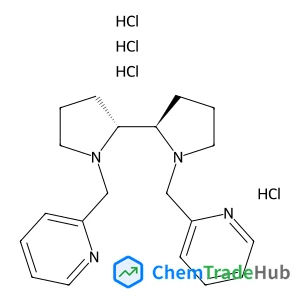
(2R,2'R)-1,1'-Bis(2-pyridinylmethyl)-2,2'-bipyrrolidine tetrahydrochloride
CAS Number:
1228077-88-0
Molecular Formula:
C20H30Cl4N4
Recommended Suppliers





Disclaimer
This page provides academic journal information for reference and research purposes only. We are not affiliated with any journal publishers and do not handle publication submissions. For publication-related inquiries, please contact the respective journal publishers directly.
If you notice any inaccuracies in the information displayed, please contact us at support@chemtradehub.com. We will promptly review and address your concerns.