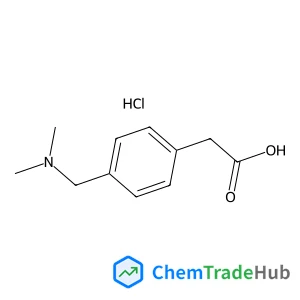
4-(Dimethylaminomethyl)phenylacetic acid hydrochloride
CAS Number:
99985-52-1
Molecular Formula:
C11H16ClNO2
Wilmer Bucheli, Kamel Arbi, Jesús Sanz, Dmitry Nuzhnyy, Stanislav Kamba, Alejandro Várez, Ricardo Jimenez
Universal dielectric response (UDR) and nearly constant loss (NCL) dispersive regimes have been investigated in fast ion conductors with perovskite and NASICON structure by using NMR and impedance spectroscopy (IS). In this study, the electrical behavior of La0.5Li0.5TiO3 (LLTO-05) perovskite and Li1.2Ti1.8Al0.2(PO4)3 (LTAP0-02) NASICON compounds was investigated. In both systems a three-dimensional network of conduction paths is present. In the Li-rich LLTO-05 sample, lithium and La are randomly distributed on A-sites of perovskites, but in LTAP0-02 Li and cation vacancies are preferentially disposed at M1 and M2 sites. In perovskite compounds, local motions produced inside unit cells are responsible for the large “near constant loss” regime detected at low temperatures, however, in the case of NASICON compounds, local motions not participating in long-range charge transport were not detected. In both analyzed systems long-range correlated motions are responsible for dc-conductivity values of ceramic grains near 10−3 S cm−1 at room temperature, indicating that low-temperature local motions, producing large NCL contribution, are not required to achieve the highest ionic conductivities.
Xiao-Juan Wang, Yan Long, Chuan-Wan Wei, Shu-Qin Gao
DOI: 10.1039/D3CP05403A
Iosif V. Leibin, Dmitry S. Bezrukov, Alexei A. Buchachenko
DOI: 10.1039/D3CP04178F
Yi Zeng, Wen Shi, Qian Peng, Yingli Niu, Zhiying Ma, Xiaoyan Zheng
DOI: 10.1039/D3CP03852A
Sergey Yu. Ketkov, Sheng-Yuan Tzeng, Elena A. Rychagova, Anton N. Lukoyanov, Wen-Bih Tzeng
DOI: 10.1039/D3CP05120J
Martin Hager, Frédéric Laquai, Yingping Zou
DOI: 10.1039/D3SE00987D
Jiali Nie, Ying Li, Dongyue Gao, Yi Fang, Jing Lin, Chengchun Tang, Zhonglu Guo
DOI: 10.1039/D3CP04718K
Robert Tirawat, Mengjin Yang, Severin N. Habisreutinger, Soňa Uličná, Ross A. Kerner, Kai Zhu, Laura T. Schelhas, Axel F. Palmstrom
DOI: 10.1039/D3SE01268A
Yongliang Zhang, Xilong Zhang, Mingjie Li, Yunfei Liu, Zhen Hu
DOI: 10.1039/D3SE00989K
Shijing Zhang, Xiaohui Feng, Zekai Xu, Yuting Li, Ping Wang, Jiating Shen, Junwei Xu, Xianglan Xu, Xiuzhong Fang, Xiang Wang
DOI: 10.1039/D3CP04104B
Zifeng Song, Haoliang Liu, Baiyi Chen, Qin Jiang, Fengxiang Sui, Kai Wu, Yonghong Cheng, Bing Xiao
DOI: 10.1039/D3CP05035A
Waste containing N-Methoxy-N-methyl-1,3-thiazole-5-carboxamide (CAS: 898825-89-3...
N-(4-Biphenylyl)dibenzo[b,d]furan-4-amine should be stored in a tightly sealed c...
The market for 3-Acetamido-5-amino-2,4,6-triiodobenzoic acid (CAS: 1713-07-1) is...
Benzyl 2-O-acetyl-3,4,6-tri-O-benzyl-beta-D-galactopyranoside (CAS: 61820-03-9) ...
2-Ethylpiperazine dihydrochloride (CAS: 438050-52-3) is regulated under the Glob...
1,1'-[1,3-Phenylenebis(methylene)]bis(3-methyl-1H-pyrrole-2,5-dione) (CAS: 11946...
Several alternatives can be used in the synthesis of 5-Fluoro-2-(1-pyrrolidinyl)...
Proper personal protective equipment (PPE) must be worn when handling this compo...
When handling 6-Bromoimidazo[1,2-a]pyridin-8-amine, it is important to wear appr...
Alternatives to (2S,4R)-4-(4-Nitrobenzyl)pyrrolidine-2-carboxylic acid hydrochlo...

Physical Chemistry Chemical Physics (PCCP) is an international journal co-owned by 19 physical chemistry and physics societies from around the world. This journal publishes original, cutting-edge research in physical chemistry, chemical physics and biophysical chemistry. To be suitable for publication in PCCP, articles must include significant innovation and/or insight into physical chemistry; this is the most important criterion that reviewers and Editors will judge against when evaluating submissions. The journal has a broad scope and welcomes contributions spanning experiment, theory, computation and data science. Topical coverage includes spectroscopy, dynamics, kinetics, statistical mechanics, thermodynamics, electrochemistry, catalysis, surface science, quantum mechanics, quantum computing and machine learning. Interdisciplinary research areas such as polymers and soft matter, materials, nanoscience, energy, surfaces/interfaces, and biophysical chemistry are welcomed if they demonstrate significant innovation and/or insight into physical chemistry. Joined experimental/theoretical studies are particularly appreciated when complementary and based on up-to-date approaches.

![[5-fluoro-2-(morpholine-4-carbonyl)phenyl]boronic acid structure](https://static.chemtradehub.com/structs/121/1217501-26-2-505c.webp "[5-fluoro-2-(morpholine-4-carbonyl)phenyl]boronic acid structure")