












Depressed transition temperature of WxV1−xO2: mechanistic insights from the X-ray absorption fine structure (XAFS) spectroscopy
Literature Information
Publication Date
2014-07-01
DOI
10.1039/C4CP01661K
Impact Factor
3.676
Authors
Lele Fan, Weifeng Huang, Shuangming Chen, Shi Chen, Feihu Chen, Chongwen Zou
View Original
Abstract
The mechanism for the decreasing critical temperature (TC) of the metal–insulator transition (MIT) in vanadium dioxide (VO2) by tungsten (W) doping is a matter of debate. Here, to clarify the correlation between W doping and TC, the electronic and geometrical structures around W and V atoms in WxV1−xO2 samples are systematically investigated by X-ray absorption fine structure (XAFS) spectroscopy. The evidence of electron doping of W6+ ions in VO2 is obtained from the reduction of V4+ to V3+ ions. This kind of electron doping has been considered to favor the MIT process. Moreover, from the XAFS results, the local rutile structure around W dopants is identified even at low doping, and acts as the structure-guided domain to facilitate the MIT in VO2. Considering the electronic band structures of WxV1−xO2 samples, the internal stresses induced by W6+ doping yield the detwisting of the nearby monoclinic VO2 lattice. This lattice detwisting will drive the downward shift of the π* electron band and a smaller separation between antibonding and bonding d∥ orbitals in the band structure of VO2, which induces the decreased band gaps of WxV1−xO2 samples. As a consequence, the potential energy barrier for phase transition is lowered and the reduced TC is observed.
Recommended Journals
Related Literature
Dinuclear zinc synergistic catalytic asymmetric phospha-Michael/Michael cascade reaction: synthesis of 1,2,3-trisubstituted indanes bearing phosphoryl groups
Bing-Kai Tao, Hua Yang, Yuan-Zhao Hua, Min-Can Wang
2019-04-03
Paper
DOI: 10.1039/C9OB00544G
Aggregation-induced emission and polymorphism/shape/size-dependent emission behaviours of fenamates for potential drug evaluation
2019-03-07
Paper
DOI: 10.1039/C9OB00338J
Decarboxylative acylation of N-free indoles enabled by a catalytic amount of copper catalyst and liquid-assisted grinding
Jingbo Yu, Chao Zhang, Xinjie Yang, Weike Su
2019-04-06
Communication
DOI: 10.1039/C9OB00622B
Use of trichloroacetonitrile as a hydrogen chloride generator for ring-opening reactions of aziridines
Yasunori Toda, Riki Matsuda, Shuto Gomyou, Hiroyuki Suga
2019-03-21
Paper
DOI: 10.1039/C9OB00602H
New geldanamycin derivatives with anti Hsp properties by mutasynthesis
Jekaterina Hermane, Simone Eichner, Lena Mancuso, Benjamin Schröder, Florenz Sasse, Carsten Zeilinger, Andreas Kirschning
2019-05-07
Paper
DOI: 10.1039/C9OB00892F
The palladium(ii)-catalyzed regioselective ortho-C–H bromination/iodination of arylacetamides with in situ generated imidic acid as the directing group: mechanistic exploration
Yogesh Jaiswal, Yogesh Kumar, Amit Kumar
2019-06-18
Paper
DOI: 10.1039/C9OB01082C
Enzymatic synthesis of N-acetyllactosamine from lactose enabled by recombinant β1,4-galactosyltransferases
Kun Huang, Fabio Parmeggiani, Helene Ledru, Kristian Hollingsworth, Jordi Mas Pons, Andrea Marchesi, Peter Both, Ashley P. Mattey, Edward Pallister, Gregory S. Bulmer, Jolanda M. van Munster, W. Bruce Turnbull, M. Carmen Galan, Sabine L. Flitsch
2019-05-30
Communication
DOI: 10.1039/C9OB01089K
Elevated reaction order of 1,3,5-tri-tert-butylbenzene bromination as evidence of a clustered polybromide transition state: a combined kinetic and computational study
Alexander M. Genaev, Vyacheslav G. Shubin, Henry S. Rzepa
2019-03-20
Paper
DOI: 10.1039/C9OB00607A
Aryne insertion into the PO bond: one-pot synthesis of quaternary phosphonium triflates
Babulal Das
2019-06-14
Paper
DOI: 10.1039/C9OB01157A
Structural characteristics requisite for the ligand-based selective detection of i-motif DNA
Sagar Satpathi, Subrahmanyam Sappati, Konoya Das
2019-05-08
Paper
DOI: 10.1039/C9OB01020C
You might also like
Compound Q&A
What are the main uses of (3.beta.)-3-Hydroxy-N,N-dimethyl-chol-5-en-24-amide (CAS: 79066-03-8)?
(3.beta.)-3-Hydroxy-N,N-dimethyl-chol-5-en-24-amide (CAS: 79066-03-8) is primari...
79066-03-8(3.beta.)-3-Hydroxy-...
Compound Q&A
What regulatory guidelines apply to 5-(aminomethyl)-2-methoxyphenol (CAS: 89702-89-6)?
5-(Aminomethyl)-2-methoxyphenol (CAS: 89702-89-6) is classified under GHS as a s...
89702-89-65-(aminomethyl)-2-me...
Compound Q&A
What is Thieno[2,3-c]pyridin-7(6H)-one (CAS: 28981-13-7)?
Thieno[2,3-c]pyridin-7(6H)-one (CAS: 28981-13-7) is a heterocyclic organic compo...
28981-13-7Thieno[2,3-c]pyridin...
Compound Q&A
Is 1-[(6-Methoxy-3-pyridinyl)methyl]-4-piperidinamine dihydrochloride (CAS: 1185311-28-7) safe?
1-[(6-Methoxy-3-pyridinyl)methyl]-4-piperidinamine dihydrochloride is generally ...
1185311-28-71-[(6-Methoxy-3-pyri...
Compound Q&A
What regulatory guidelines apply to [(2E)-3-Phenyl-2-propen-1-yl]phosphonic acid (CAS: 146404-58-2)?
[(2E)-3-Phenyl-2-propen-1-yl]phosphonic acid (CAS: 146404-58-2) is regulated und...
146404-58-2[(2E)-3-Phenyl-2-pro...
Compound Q&A
What regulatory guidelines apply to 6-Bromo-7-methoxyquinoline (CAS: 1620515-86-7)?
6-Bromo-7-methoxyquinoline (CAS: 1620515-86-7) falls under the scope of the Glob...
1620515-86-76-Bromo-7-methoxyqui...
Compound Q&A
What industries use (2R)-1-(1-Benzofuran-2-yl)-N-propyl-2-pentanamine (CAS: 260550-89-8)?
This compound is primarily used in the pharmaceutical industry for the developme...
260550-89-8(2R)-1-(1-Benzofuran...
Compound Q&A
What are the main uses of 1-Ethyl-7-[2-methyl-6-(4H-1,2,4-triazol-3-yl)-3-pyridinyl]-3,5-dihydropyrazino[2,3-b]pyrazin-2(1H)-one (CAS: 1228013-15-7)?
1-Ethyl-7-[2-methyl-6-(4H-1,2,4-triazol-3-yl)-3-pyridinyl]-3,5-dihydropyrazino[2...
1228013-15-71-Ethyl-7-[2-methyl-...
Compound Q&A
Are there alternatives to {5-(Acryloylamino)-2-[(dimethylamino)methyl]phenyl}boronic acid (CAS: 1217500-78-1) in synthesis?
Alternative reagents such as 2-[(dimethylamino)methyl]phenylboronic acid or rela...
1217500-78-1{5-(Acryloylamino)-2...
Compound Q&A
What is 3-(Piperidin-4-yloxy)pyridine (CAS: 310881-48-2)?
3-(Piperidin-4-yloxy)pyridine (CAS: 310881-48-2) is an organic compound with the...
310881-48-23-(Piperidin-4-yloxy...
Source Journal
Physical Chemistry Chemical Physics

CiteScore:
5.5
Self-citation Rate:
10.3%
Articles per Year:
3036
Physical Chemistry Chemical Physics (PCCP) is an international journal co-owned by 19 physical chemistry and physics societies from around the world. This journal publishes original, cutting-edge research in physical chemistry, chemical physics and biophysical chemistry. To be suitable for publication in PCCP, articles must include significant innovation and/or insight into physical chemistry; this is the most important criterion that reviewers and Editors will judge against when evaluating submissions. The journal has a broad scope and welcomes contributions spanning experiment, theory, computation and data science. Topical coverage includes spectroscopy, dynamics, kinetics, statistical mechanics, thermodynamics, electrochemistry, catalysis, surface science, quantum mechanics, quantum computing and machine learning. Interdisciplinary research areas such as polymers and soft matter, materials, nanoscience, energy, surfaces/interfaces, and biophysical chemistry are welcomed if they demonstrate significant innovation and/or insight into physical chemistry. Joined experimental/theoretical studies are particularly appreciated when complementary and based on up-to-date approaches.
Recommended Compounds
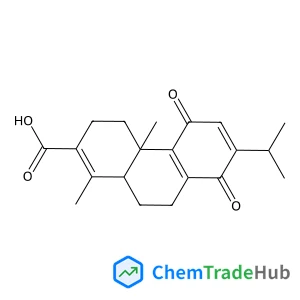
(4aS,10aS)-7-Isopropyl-1,4a-dimethyl-5,8-dioxo-3,4,4a,5,8,9,10,10a-octahydro-2-phenanthrenecarboxylic acid
CAS Number:
142950-86-5
Molecular Formula:
C20H24O4
![N-[4-(Cyanoethynyl)phenyl]-16-oxo-4,7,10,13-tetraoxa-17-azahenicos-1-yn-21-amide structure](https://static.chemtradehub.com/structs/218/2183440-36-8-68cb.webp "N-[4-(Cyanoethynyl)phenyl]-16-oxo-4,7,10,13-tetraoxa-17-azahenicos-1-yn-21-amide structure")
N-[4-(Cyanoethynyl)phenyl]-16-oxo-4,7,10,13-tetraoxa-17-azahenicos-1-yn-21-amide
CAS Number:
2183440-36-8
Molecular Formula:
C25H31N3O6
Recommended Suppliers





Disclaimer
This page provides academic journal information for reference and research purposes only. We are not affiliated with any journal publishers and do not handle publication submissions. For publication-related inquiries, please contact the respective journal publishers directly.
If you notice any inaccuracies in the information displayed, please contact us at support@chemtradehub.com. We will promptly review and address your concerns.