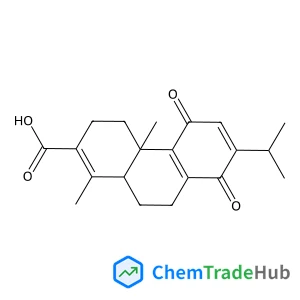
(4aS,10aS)-7-Isopropyl-1,4a-dimethyl-5,8-dioxo-3,4,4a,5,8,9,10,10a-octahydro-2-phenanthrenecarboxylic acid
CAS Number:
142950-86-5
Molecular Formula:
C20H24O4
Xuhui Sun, Junfa Zhu
Lithium/sulfur (Li/S) cells have attracted much attention due to their higher theoretical specific capacity and energy compared to those of current lithium-ion cells. However, the application of Li/S cells is still hampered by short cycle life. Sulfur–graphene oxide (S–GO) nanocomposites have shown promise as cathode materials for long-life Li/S cells because oxygen-containing functional groups on the surface of graphene oxide were successfully used as sulfur immobilizers by forming weak bonds with sulfur and polysulfides. While S–GO showed much improved cycling performance, the capacity decay still needs to be improved for commercially viable cells. In this study, we attempt to understand the capacity fading mechanism based on an ex situ study of the structural and chemical evolution of S–GO nanocomposite cathodes with various numbers of cycles using scanning electron microscopy (SEM), near edge X-ray absorption fine structure (NEXAFS) and X-ray photoelectron spectroscopy (XPS). It is found that both the surface morphologies and chemical structures of the cathode materials change considerably with increasing number of cycles. These changes are attributed to several unexpected chemical reactions of lithium with S–GO nanocomposites occurring during the discharge–charge processes with the formation of Li2CO3, Li2SO3, Li2SO4, and COSO2Li species. These reactions result in the loss of recyclable active sulfur on the surface of the electrode, and thus capacity fades while coulombic efficiency is near 100%. Moreover, the reaction products accumulate on the cathode surface, forming a compact blocking insulating layer which may make the diffusion of Li ions into/out of the cathode difficult during the discharge–charge process and thus lead to lower utilization of sulfur at higher rates. We think that these two observations are significant contributors to the capacity and rate capability degradation of the Li/S–GO cells. Therefore, for the rechargeable Li/S–GO cells, we suggest that the content of oxygen-containing functional groups on GO should be optimized and more stable functional groups need to be identified for further improvement of the cycling performance. The information we gain from this study may provide general insights into the fundamental understanding of the degradation mechanisms of other rechargeable Li/S cells using similar oxygen-containing functional groups as sulfur immobilizers.

Bioorganic & Medicinal Chemistry Letters

Journal of Chemical Sciences

Main Group Chemistry

Biocatalysis and Biotransformation

Chinese Journal of Chemistry

Critical Reviews in Solid State and Materials Sciences

Journal of the Indian Institute of Science

Acta Metallurgica Sinica-English Letters

Heteroatom Chemistry

NDT & E International
Babulal Das
DOI: 10.1039/C9OB01157A
Christopher R. Travis, Lauren E. Mazur, Emily M. Peairs, Gillian H. Gaunt, Douglas D. Young
DOI: 10.1039/C9OB00327D
Samantha L. Pilicer, Michele Mancinelli, Andrea Mazzanti, Christian Wolf
DOI: 10.1039/C9OB01265F
Paige Dickson, Thomas Kodadek
DOI: 10.1039/C9OB00581A
Shivani Sharma, Anuj Sharma
DOI: 10.1039/C9OB00092E
Yulia V. Nelyubina, Alexey Yu. Sukhorukov, Sema L. Ioffe, Andrey A. Tabolin
DOI: 10.1039/C9OB01005J
Vimal Kant Harit, Namakkal G. Ramesh
DOI: 10.1039/C9OB01010F
(3.beta.)-3-Hydroxy-N,N-dimethyl-chol-5-en-24-amide (CAS: 79066-03-8) is primari...
5-(Aminomethyl)-2-methoxyphenol (CAS: 89702-89-6) is classified under GHS as a s...
Thieno[2,3-c]pyridin-7(6H)-one (CAS: 28981-13-7) is a heterocyclic organic compo...
1-[(6-Methoxy-3-pyridinyl)methyl]-4-piperidinamine dihydrochloride is generally ...
[(2E)-3-Phenyl-2-propen-1-yl]phosphonic acid (CAS: 146404-58-2) is regulated und...
6-Bromo-7-methoxyquinoline (CAS: 1620515-86-7) falls under the scope of the Glob...
This compound is primarily used in the pharmaceutical industry for the developme...
1-Ethyl-7-[2-methyl-6-(4H-1,2,4-triazol-3-yl)-3-pyridinyl]-3,5-dihydropyrazino[2...
Alternative reagents such as 2-[(dimethylamino)methyl]phenylboronic acid or rela...
3-(Piperidin-4-yloxy)pyridine (CAS: 310881-48-2) is an organic compound with the...

Physical Chemistry Chemical Physics (PCCP) is an international journal co-owned by 19 physical chemistry and physics societies from around the world. This journal publishes original, cutting-edge research in physical chemistry, chemical physics and biophysical chemistry. To be suitable for publication in PCCP, articles must include significant innovation and/or insight into physical chemistry; this is the most important criterion that reviewers and Editors will judge against when evaluating submissions. The journal has a broad scope and welcomes contributions spanning experiment, theory, computation and data science. Topical coverage includes spectroscopy, dynamics, kinetics, statistical mechanics, thermodynamics, electrochemistry, catalysis, surface science, quantum mechanics, quantum computing and machine learning. Interdisciplinary research areas such as polymers and soft matter, materials, nanoscience, energy, surfaces/interfaces, and biophysical chemistry are welcomed if they demonstrate significant innovation and/or insight into physical chemistry. Joined experimental/theoretical studies are particularly appreciated when complementary and based on up-to-date approaches.