












An anatomy of intramolecular atomic interactions in halogen-substituted trinitromethanes
Literature Information
Publication Date
2014-07-01
DOI
10.1039/C4CP01257G
Impact Factor
3.676
Authors
Ekaterina V. Bartashevich, Ángel Martín Pendás, Vladimir G. Tsirelson
View Original
Abstract
The intramolecular interactions in substituted trinitromethanes, XC(NO2)3 (X = F, Cl, I, H) are studied and clarified by using a combination of the Quantum Theory of Atoms in Molecules (QTAIM), the non-covalent interaction analysis and the Interacting Quantum Atoms (IQA) methods. The stretching vibration modes are formed by the concerted displacements of atoms involved in the covalent bonds showing the significant multiatomic influence in substituted trinitromethanes. In agreement with that, the arrangement of the local reduced density gradient minima indicates that the electron density favors the non-covalent intramolecular interactions X⋯O and N⋯O. However, the corresponding QTAIM bond paths are not formed; instead, contacts, which we call uncompleted links in this context, are accompanied by “quasi-bonding channels” corresponding to the λ2(r) ≤ 0 regions on the sign[λ2(r)]ρ(r) contour maps. The intramolecular IQA energy contributions signal the appreciable electron exchange between the pairs of atoms associated with potential atomic interactions or the bond-path-free non-covalent links. The IQA analysis shows that the electrostatic term destabilizes FC(NO2)3 and distinctly stabilizes IC(NO2)3, whereas it is close to neutral in ClC(NO2)3. The exchange energy between the X atom and the NO2 groups, in contrast, stabilizes all the molecules.
Related Literature
Pyrrolidine ring puckering and prolyl amide bond configurations of 2-methyl-allo-hydroxyproline-based dipeptides
Gurudayal
2019-04-04
Communication
DOI: 10.1039/C9OB00150F
N-Hydroxyphthalimide/benzoquinone-catalyzed chlorination of hydrocarbon C–H bond using N-chlorosuccinimide
Zi-Hao Li, Biao-Lin Jiang, Jian-Wei Li
2019-02-26
Paper
DOI: 10.1039/C9OB00216B
Use of trichloroacetonitrile as a hydrogen chloride generator for ring-opening reactions of aziridines
Yasunori Toda, Riki Matsuda, Shuto Gomyou, Hiroyuki Suga
2019-03-21
Paper
DOI: 10.1039/C9OB00602H
A computational study on the identity of the active catalyst structure for Ru(ii) carboxylate assisted C–H activation in acetonitrile
Claire L. McMullin, Nasir A. Rajabi, James S. Hammerton
2019-06-25
Paper
DOI: 10.1039/C9OB01092K
Mechanistic investigation of superelectrophilic activation of 1,1′-bi-2-naphthols in the presence of aluminum halides
Zhongwei Zhu, Alexander M. Genaev
2019-03-27
Paper
DOI: 10.1039/C9OB00640K
Solvent-free ruthenium-catalysed triflate coupling as a convenient method for selective azole-o-C–H monoarylation
Taoufik Boubaker, Julien Roger
2019-05-22
Communication
DOI: 10.1039/C9OB00806C
Chemodivergent reaction of azomethine imines and 2H-azirines for the synthesis of nitrogen-containing scaffolds
Yufeng Wu, Bing Tian, Chao Hu, Kohei Sekine, Matthias Rudolph, Frank Rominger
2019-05-10
Communication
DOI: 10.1039/C9OB00740G
Correction: Lacto-N-tetraose synthesis by wild-type and glycosynthase variants of the β-N-hexosaminidase from Bifidobacterium bifidum
Katharina Schmölzer, Melanie Weingarten, Kai Baldenius
2019-06-04
Correction
DOI: 10.1039/C9OB90088H
Selective synthesis of (1H-benzo[d]imidazol-2-yl)(phenyl)methanone and quinoxaline from aromatic aldehyde and o-phenylenediamine
Zhenzhen Zhan, Haojie Ma, Xinfeng Cui, Pengbo Jiang, Jinghong Pu, Yixin Zhang, Guosheng Huang
2019-04-24
Paper
DOI: 10.1039/C9OB00531E
You might also like
Compound Q&A
What are the main uses of (3.beta.)-3-Hydroxy-N,N-dimethyl-chol-5-en-24-amide (CAS: 79066-03-8)?
(3.beta.)-3-Hydroxy-N,N-dimethyl-chol-5-en-24-amide (CAS: 79066-03-8) is primari...
79066-03-8(3.beta.)-3-Hydroxy-...
Compound Q&A
What regulatory guidelines apply to 5-(aminomethyl)-2-methoxyphenol (CAS: 89702-89-6)?
5-(Aminomethyl)-2-methoxyphenol (CAS: 89702-89-6) is classified under GHS as a s...
89702-89-65-(aminomethyl)-2-me...
Compound Q&A
What is Thieno[2,3-c]pyridin-7(6H)-one (CAS: 28981-13-7)?
Thieno[2,3-c]pyridin-7(6H)-one (CAS: 28981-13-7) is a heterocyclic organic compo...
28981-13-7Thieno[2,3-c]pyridin...
Compound Q&A
Is 1-[(6-Methoxy-3-pyridinyl)methyl]-4-piperidinamine dihydrochloride (CAS: 1185311-28-7) safe?
1-[(6-Methoxy-3-pyridinyl)methyl]-4-piperidinamine dihydrochloride is generally ...
1185311-28-71-[(6-Methoxy-3-pyri...
Compound Q&A
What regulatory guidelines apply to [(2E)-3-Phenyl-2-propen-1-yl]phosphonic acid (CAS: 146404-58-2)?
[(2E)-3-Phenyl-2-propen-1-yl]phosphonic acid (CAS: 146404-58-2) is regulated und...
146404-58-2[(2E)-3-Phenyl-2-pro...
Compound Q&A
What regulatory guidelines apply to 6-Bromo-7-methoxyquinoline (CAS: 1620515-86-7)?
6-Bromo-7-methoxyquinoline (CAS: 1620515-86-7) falls under the scope of the Glob...
1620515-86-76-Bromo-7-methoxyqui...
Compound Q&A
What industries use (2R)-1-(1-Benzofuran-2-yl)-N-propyl-2-pentanamine (CAS: 260550-89-8)?
This compound is primarily used in the pharmaceutical industry for the developme...
260550-89-8(2R)-1-(1-Benzofuran...
Compound Q&A
What are the main uses of 1-Ethyl-7-[2-methyl-6-(4H-1,2,4-triazol-3-yl)-3-pyridinyl]-3,5-dihydropyrazino[2,3-b]pyrazin-2(1H)-one (CAS: 1228013-15-7)?
1-Ethyl-7-[2-methyl-6-(4H-1,2,4-triazol-3-yl)-3-pyridinyl]-3,5-dihydropyrazino[2...
1228013-15-71-Ethyl-7-[2-methyl-...
Compound Q&A
Are there alternatives to {5-(Acryloylamino)-2-[(dimethylamino)methyl]phenyl}boronic acid (CAS: 1217500-78-1) in synthesis?
Alternative reagents such as 2-[(dimethylamino)methyl]phenylboronic acid or rela...
1217500-78-1{5-(Acryloylamino)-2...
Compound Q&A
What is 3-(Piperidin-4-yloxy)pyridine (CAS: 310881-48-2)?
3-(Piperidin-4-yloxy)pyridine (CAS: 310881-48-2) is an organic compound with the...
310881-48-23-(Piperidin-4-yloxy...
Source Journal
Physical Chemistry Chemical Physics

CiteScore:
5.5
Self-citation Rate:
10.3%
Articles per Year:
3036
Physical Chemistry Chemical Physics (PCCP) is an international journal co-owned by 19 physical chemistry and physics societies from around the world. This journal publishes original, cutting-edge research in physical chemistry, chemical physics and biophysical chemistry. To be suitable for publication in PCCP, articles must include significant innovation and/or insight into physical chemistry; this is the most important criterion that reviewers and Editors will judge against when evaluating submissions. The journal has a broad scope and welcomes contributions spanning experiment, theory, computation and data science. Topical coverage includes spectroscopy, dynamics, kinetics, statistical mechanics, thermodynamics, electrochemistry, catalysis, surface science, quantum mechanics, quantum computing and machine learning. Interdisciplinary research areas such as polymers and soft matter, materials, nanoscience, energy, surfaces/interfaces, and biophysical chemistry are welcomed if they demonstrate significant innovation and/or insight into physical chemistry. Joined experimental/theoretical studies are particularly appreciated when complementary and based on up-to-date approaches.
Recommended Compounds
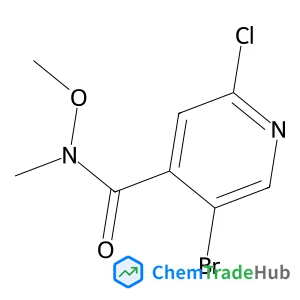
5-Bromo-2-chloro-N-methoxy-N-methylisonicotinamide
CAS Number:
1256790-08-5
Molecular Formula:
C8H8BrClN2O2
Recommended Suppliers





Disclaimer
This page provides academic journal information for reference and research purposes only. We are not affiliated with any journal publishers and do not handle publication submissions. For publication-related inquiries, please contact the respective journal publishers directly.
If you notice any inaccuracies in the information displayed, please contact us at support@chemtradehub.com. We will promptly review and address your concerns.