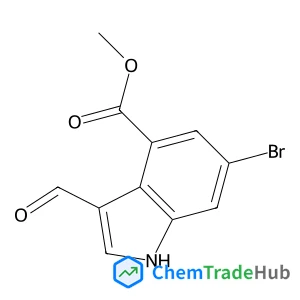
methyl 6-bromo-3-formyl-1H-indole-4-carboxylate
CAS Number:
1353636-63-1
Molecular Formula:
C11H8BrNO3
Sheng-shi Li, Chang-wen Zhang, Wei-xiao Ji, Feng Li, Pei-ji Wang, Shu-jun Hu, Shi-shen Yan, Yu-shen Liu
We performed first-principles calculations to study the adsorption characteristics of alkali, alkali-earth, group III, and 3d transition-metal (TM) adatoms on germanene. We find that the adsorption of alkali or alkali-earth adatoms on germanene has minimal effects on geometry of germanene. The significant charge transfer from alkali adatoms to germanene leads to metallization of germanene, whereas alkali-earth adatom adsorption, whose interaction is a mixture of ionic and covalent, results in semiconducting behavior with an energy gap of 17–29 meV. For group III adatoms, they also bind germanene with mixed covalent and ionic bonding character. Adsorption characteristics of the transition metals (TMs) are rather complicated, though all TM adsorptions on germanene exhibit strong covalent bonding with germanene. The main contributions to the strong bonding are from the hybridization between the TM 3d and Ge pz orbitals. Depending on the induced-TM type, the adsorbed systems can exhibit metallic, half-metallic, or semiconducting behavior. Also, the variation trends of the dipole moment and work function with the adsorption energy across the different adatoms are discussed. These findings may provide a potential avenue to design new germanene-based devices in nanoelectronics.

Advances in Colloid and Interface Science

Chemistry of Natural Compounds

Accounts of Chemical Research

Chemical Reviews

Doklady Chemistry

Journal of the American Chemical Society

Journal of the Chinese Chemical Society

Anti-Corrosion Methods and Materials

Australian Journal of Chemistry

Bulletin of the Chemical Society of Japan
R. Zhang, T. Hopson, L. A. Nagahara
DOI: 10.1039/B302681G
Brandi L. Schottel, John Bacsa, Kim R. Dunbar
DOI: 10.1039/B410811F
Alessandra Lattanzi, Patrizia Iannece, Assunta Vicinanza, Arrigo Scettri
DOI: 10.1039/B303904H
Takamitsu Fukuda, Marilyn M. Olmstead, William S. Durfee, Nagao Kobayashi
DOI: 10.1039/B301563G
Jos M. J. Paulusse, Rint P. Sijbesma
DOI: 10.1039/B301874A
(3.beta.)-3-Hydroxy-N,N-dimethyl-chol-5-en-24-amide (CAS: 79066-03-8) is primari...
5-(Aminomethyl)-2-methoxyphenol (CAS: 89702-89-6) is classified under GHS as a s...
Thieno[2,3-c]pyridin-7(6H)-one (CAS: 28981-13-7) is a heterocyclic organic compo...
1-[(6-Methoxy-3-pyridinyl)methyl]-4-piperidinamine dihydrochloride is generally ...
[(2E)-3-Phenyl-2-propen-1-yl]phosphonic acid (CAS: 146404-58-2) is regulated und...
6-Bromo-7-methoxyquinoline (CAS: 1620515-86-7) falls under the scope of the Glob...
This compound is primarily used in the pharmaceutical industry for the developme...
1-Ethyl-7-[2-methyl-6-(4H-1,2,4-triazol-3-yl)-3-pyridinyl]-3,5-dihydropyrazino[2...
Alternative reagents such as 2-[(dimethylamino)methyl]phenylboronic acid or rela...
3-(Piperidin-4-yloxy)pyridine (CAS: 310881-48-2) is an organic compound with the...

Physical Chemistry Chemical Physics (PCCP) is an international journal co-owned by 19 physical chemistry and physics societies from around the world. This journal publishes original, cutting-edge research in physical chemistry, chemical physics and biophysical chemistry. To be suitable for publication in PCCP, articles must include significant innovation and/or insight into physical chemistry; this is the most important criterion that reviewers and Editors will judge against when evaluating submissions. The journal has a broad scope and welcomes contributions spanning experiment, theory, computation and data science. Topical coverage includes spectroscopy, dynamics, kinetics, statistical mechanics, thermodynamics, electrochemistry, catalysis, surface science, quantum mechanics, quantum computing and machine learning. Interdisciplinary research areas such as polymers and soft matter, materials, nanoscience, energy, surfaces/interfaces, and biophysical chemistry are welcomed if they demonstrate significant innovation and/or insight into physical chemistry. Joined experimental/theoretical studies are particularly appreciated when complementary and based on up-to-date approaches.
![5,7-Dihydroxy-3-(4-hydroxyphenyl)-6-[(1R,6R)-3-methyl-6-prop-1-en-2-ylcyclohex-2-en-1-yl]chromen-4-one structure](https://static.chemtradehub.com/structs/191/1914963-20-4-2b05.webp "5,7-Dihydroxy-3-(4-hydroxyphenyl)-6-[(1R,6R)-3-methyl-6-prop-1-en-2-ylcyclohex-2-en-1-yl]chromen-4-one structure")