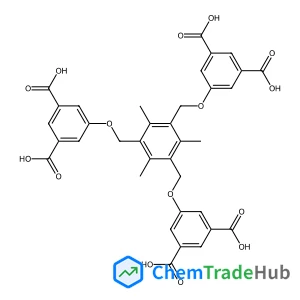
5,5',5''-(((2,4,6-Trimethylbenzene-1,3,5-triyl)tris(methylene))tris(oxy))triisophthalic acid
CAS Number:
1159974-70-5
Molecular Formula:
C36H30O15
N. Y. Dzade, A. Roldan, N. H. de Leeuw
We present density functional theory calculations with a correction for the long-range interactions (DFT-D2) of the bulk and surfaces of mackinawite (FeS), and subsequent adsorption and dissociation of NOx gases (nitrogen monoxide (NO) and nitrogen dioxide (NO2)). Our results show that these environmentally important molecules interact very weakly with the energetically most stable (001) surface, but adsorb relatively strongly onto the FeS(011), (100) and (111) surfaces, preferentially at Fe sites via charge donation from these surface species. The NOx species exhibit a variety of adsorption geometries, with the most favourable for NO being the monodentate Fe–NO configuration, whereas NO2 is calculated to form a bidentate Fe–NOO–Fe configuration. From our calculated thermochemical energy and activation energy barriers for the direct dissociation of NO and NO2 on the FeS surfaces, we show that NO prefers molecular adsorption, while dissociative adsorption, i.e. NO2 (ads) → [NO(ads) + O(ads)] is preferred over molecular adsorption for NO2 onto the mackinawite surfaces. However, the calculated high activation barriers for the further dissociation of the second N–O bond to produce either [N(ads) and 2O(ads)] or [N(ads) and O2(ads)] suggest that complete dissociation of NO2 is unlikely to occur on the mackinawite surfaces.
Hiroyuki Katayama, Hiroshi Yari, Masaki Tanaka, Fumiyuki Ozawa
DOI: 10.1039/B504436G
Takashi Jin, Fumihiko Fujii, Hiroshi Sakata, Mamoru Tamura, Masataka Kinjo
DOI: 10.1039/B506608E
Raja Kaliappan, Lakshmi S. Kaanumalle, V. Ramamurthy
DOI: 10.1039/B507517C
Sally Dixon, George J. Gordon, Richard J. Whitby
DOI: 10.1039/B508524A
Jeane Bordini, Peter C. Ford, Elia Tfouni
DOI: 10.1039/B507407J
Qin Liu, Melissa Golden, Marcetta Y. Darensbourg, Nicholas Farrell
DOI: 10.1039/B507751F
Peter B. Hitchcock, Gareth J. Rowlands, Rakesh Parmar
DOI: 10.1039/B507394D
Robin B. Bedford, Duncan W. Bruce, Robert M. Frost, Michael Hird
DOI: 10.1039/B507133J
Maurilio Galletta, Sebastiano Campagna, Manuel Quesada, Gilles Ulrich, Raymond Ziessel
DOI: 10.1039/B507196H
Waste containing N-Methoxy-N-methyl-1,3-thiazole-5-carboxamide (CAS: 898825-89-3...
N-(4-Biphenylyl)dibenzo[b,d]furan-4-amine should be stored in a tightly sealed c...
The market for 3-Acetamido-5-amino-2,4,6-triiodobenzoic acid (CAS: 1713-07-1) is...
Benzyl 2-O-acetyl-3,4,6-tri-O-benzyl-beta-D-galactopyranoside (CAS: 61820-03-9) ...
2-Ethylpiperazine dihydrochloride (CAS: 438050-52-3) is regulated under the Glob...
1,1'-[1,3-Phenylenebis(methylene)]bis(3-methyl-1H-pyrrole-2,5-dione) (CAS: 11946...
Several alternatives can be used in the synthesis of 5-Fluoro-2-(1-pyrrolidinyl)...
Proper personal protective equipment (PPE) must be worn when handling this compo...
When handling 6-Bromoimidazo[1,2-a]pyridin-8-amine, it is important to wear appr...
Alternatives to (2S,4R)-4-(4-Nitrobenzyl)pyrrolidine-2-carboxylic acid hydrochlo...

Physical Chemistry Chemical Physics (PCCP) is an international journal co-owned by 19 physical chemistry and physics societies from around the world. This journal publishes original, cutting-edge research in physical chemistry, chemical physics and biophysical chemistry. To be suitable for publication in PCCP, articles must include significant innovation and/or insight into physical chemistry; this is the most important criterion that reviewers and Editors will judge against when evaluating submissions. The journal has a broad scope and welcomes contributions spanning experiment, theory, computation and data science. Topical coverage includes spectroscopy, dynamics, kinetics, statistical mechanics, thermodynamics, electrochemistry, catalysis, surface science, quantum mechanics, quantum computing and machine learning. Interdisciplinary research areas such as polymers and soft matter, materials, nanoscience, energy, surfaces/interfaces, and biophysical chemistry are welcomed if they demonstrate significant innovation and/or insight into physical chemistry. Joined experimental/theoretical studies are particularly appreciated when complementary and based on up-to-date approaches.
![2-(7,7-Difluorobicyclo[4.1.0]hept-1-yl)ethanamine structure](https://static.chemtradehub.com/structs/209/2098065-08-6-ff24.webp "2-(7,7-Difluorobicyclo[4.1.0]hept-1-yl)ethanamine structure")