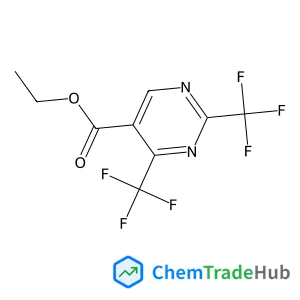
Ethyl 2,4-bis(trifluoromethyl)-5-pyrimidinecarboxylate
CAS Number:
188781-15-9
Molecular Formula:
C9H6F6N2O2
Zhe Gui, Jonathon Duay, Junkai Hu, Sang Bok Lee
A redox exchange mechanism between potassium perruthenate (KRuO4) and the functional groups of selected polymers is used here to induce RuO2 into and onto conductive polymer nanowires by simply soaking the polymer nanowire arrays in KRuO4 solution. Conductive polymer nanowire arrays of polypyrrole (PPY) and poly(3,4-ethylenedioxythiophene) (PEDOT) were studied in this work. SEM and TEM results show that the RuO2 material was distributed differently in the PPY and PEDOT nanowire matrices. Energy-dispersive X-ray spectroscopy and X-ray photoelectron spectroscopy were used to confirm the dispersion and formation of RuO2 materials in these polymer nanowires. Cyclic voltammetry and galvanostatic charge–discharge experiments were used to characterize their electrochemical performance. RuO2–polymer samples prepared with a 6 min soaking time in 10 mM KRuO4 solution show a high specific capacitance of 371 F g−1 and 500 F g−1 for PEDOT-based and PPY-based composite nanowires, respectively. This is attributed to the high exposure area of the conductive RuO2 and the good conductivity of the polymer matrix. This work demonstrates a simple method to synthesize heterogeneous polymer based-materials through the redox reaction between conductive polymers and high oxidation state transition metal oxide ions. Different heterogeneous nanocomposites were obtained depending on the polymer properties, and high energy storage performance of the metal oxides can be achieved within these heterogeneous nanostructures.
Feng Li, Ying-Ying Zhou, Ting Peng, Huo Xu, Rong-Bo Zhang, Hui Zhao, Zheng-yong Wang, Jian-Xin Lv, Zai-Sheng Wu, Zhi-Fa Shen
DOI: 10.1039/C6AN00898D
Shushu Ding, Yunxia Xu, Qi Liu, Hui Gu, Anwei Zhu, Guoyue Shi
DOI: 10.1039/C9AN02285F
Yong Xia, Jing Li, Erkang Wang
DOI: 10.1039/C6AN00675B
Joshua Jasensky, Andrew P. Boughton, Alexander Khmaladze, Jun Ding, Chi Zhang, Jason E. Swain, George W. Smith
DOI: 10.1039/C6AN00629A
Yu Du, Xiaojian Li, Xiang Ren, Huan Wang, Dan Wu, Hongmin Ma, Dawei Fan, Qin Wei
DOI: 10.1039/C9AN02288K
Sarah Esparza, Dimei Wu, Mark R. Hanudel, Barbara Gales, Isidro B. Salusky
DOI: 10.1039/C9AN02215E
Zhaoyin Wang, Jian Zhao, Zhihui Dai
DOI: 10.1039/C6AN00816J
Katharina M. Rund, Fabian Nolte, Julian Doricic, Robert Greite, Sebastian Schott, Ralf Lichtinghagen, Faikah Gueler, Nils Helge Schebb
DOI: 10.1039/C9AN01880H
Ji Eun Song, Ji Hoon Park, Ju A. La, Seyeon Park, Min Kuk Jeong, Eun Chul Cho
DOI: 10.1039/C6AN00399K
When handling lithium chloride hydrate (1:1:1) (CAS: 16712-20-2), it is importan...
4-(4H-1,2,4-Triazol-4-yl)piperidine is generally considered safe for use in phar...
Waste containing 1,3-Thiazole-2-carboxamide (CAS: 16733-85-0) should be collecte...
5-(Difluoromethyl)-2-fluorobenzonitrile (CAS: 934175-58-3) is subject to regulat...
Methyl 3-acetamido-2-thiophenecarboxylate can be synthesized by the reaction of ...
4-Isoquinolinecarbonitrile is a chemical compound with the CAS number 34846-65-6...
Store Methyl 1H-1,2,3-triazole-4-carboxylate (CAS: 877309-59-6) in a cool, dry p...
6-Bromo[1,3]thiazolo[5,4-b]pyridin-2-amine (CAS: 1160791-13-8) is subject to the...
(2S,3S)-2-Ammonio-3-(3,4-dihydroxyphenyl)-3-hydroxypropanoate (CAS: 23651-95-8) ...
7-Bromo-3-methyl-3,4-dihydroquinazolin-4-one is a solid with a crystalline form....

Physical Chemistry Chemical Physics (PCCP) is an international journal co-owned by 19 physical chemistry and physics societies from around the world. This journal publishes original, cutting-edge research in physical chemistry, chemical physics and biophysical chemistry. To be suitable for publication in PCCP, articles must include significant innovation and/or insight into physical chemistry; this is the most important criterion that reviewers and Editors will judge against when evaluating submissions. The journal has a broad scope and welcomes contributions spanning experiment, theory, computation and data science. Topical coverage includes spectroscopy, dynamics, kinetics, statistical mechanics, thermodynamics, electrochemistry, catalysis, surface science, quantum mechanics, quantum computing and machine learning. Interdisciplinary research areas such as polymers and soft matter, materials, nanoscience, energy, surfaces/interfaces, and biophysical chemistry are welcomed if they demonstrate significant innovation and/or insight into physical chemistry. Joined experimental/theoretical studies are particularly appreciated when complementary and based on up-to-date approaches.
![tert-butyl 8-benzyl-2,8-diazaspiro[4.5]decane-2-carboxylate structure](https://static.chemtradehub.com/structs/336/336191-16-3-bb55.webp "tert-butyl 8-benzyl-2,8-diazaspiro[4.5]decane-2-carboxylate structure")
![(1R,5R)-3-{[(2-Methyl-2-propanyl)oxy]carbonyl}-3-azabicyclo[3.1.0]hexane-1-carboxylic acid structure](https://static.chemtradehub.com/structs/116/1165450-63-4-bfe1.webp "(1R,5R)-3-{[(2-Methyl-2-propanyl)oxy]carbonyl}-3-azabicyclo[3.1.0]hexane-1-carboxylic acid structure")