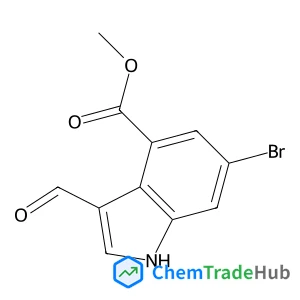
methyl 6-bromo-3-formyl-1H-indole-4-carboxylate
CAS Number:
1353636-63-1
Molecular Formula:
C11H8BrNO3
Roelof J. Kriek, Jan Rossmeisl, Samira Siahrostami, Mårten E. Björketun
Sulphur dioxide (SO2), a known industrial pollutant and pulmonary irritant, is emitted to the atmosphere in excess of 120 Mt per annum. Great strides have been taken to reduce SO2 emissions, but with the growth of specifically China, and to a lesser extent India, it is on the rise again. The electrolysis of aqueous solutions of dissolved SO2 holds huge environmental potential in that SO2 is converted to sulphuric acid (H2SO4) and at the same time hydrogen gas is produced. A further benefit or incentive is that a sulphur depolarised electrolyser (SDE) operates at an applied potential that is about one volt lower than that of a regular water electrolyser. In taking this technology forward the greatest improvement to be made is in developing a suitable electrocatalyst, which is also the ‘lowest hanging fruit’ in that very limited research and development has been conducted on the electrocatalyst for this process. In this work, density functional theory is employed to model the electro-oxidation of SO2 on single crystal planes of the 4d and 5d transition metals. Two reaction mechanisms are considered, a HSO3 intermediate pathway and a SO3 intermediate pathway. The binding energies of all intermediates are found to scale with the surface reactivity (measured as the adsorption of OH). Irrespective of the pathway water needs to be activated and reduction of SO2 to elemental sulphur must be avoided. This requirement alone calls for an electrode potential of at least 0.7–0.8 V for all the investigated transition metals and thus challenges the proclaimed goal to operate the SDE at 0.6 V. A high chemical barrier is further found to severely limit the oxidation reaction on reactive metals. A much higher catalytic activity can be obtained on precious metals but at the cost of running the reaction at high overpotentials.

Heteroatom Chemistry

Medicinal Chemistry Research

Acta Metallurgica Sinica-English Letters

Colloid Journal

Journal of Chemical Sciences

Journal of the Indian Institute of Science

Bioorganic & Medicinal Chemistry Letters

Critical Reviews in Solid State and Materials Sciences

Chinese Journal of Chemistry

Bioorganic & Medicinal Chemistry
Rajnish Budhwan, Suman Yadav, Sandip Murarka
DOI: 10.1039/C9OB00694J
DOI: 10.1039/C9OB00338J
Yi He, Danjun Wu, Zhenghua Li, Koen Robeyns, Luc Van Meervelt
DOI: 10.1039/C9OB01299K
Deepika Kathuria, Pankaj Gupta, Sumit S. Chourasiya, Subash C. Sahoo, Uwe Beifuss, Asit K. Chakraborti, Prasad V. Bharatam
DOI: 10.1039/C9OB00610A
Peiqi Zhou, Yubing Huang, Wanqing Wu, Wentao Yu, Jianxiao Li, Zhongzhi Zhu, Huanfeng Jiang
DOI: 10.1039/C9OB00377K
Kentaro Harada, Ryo Sekiya, Takeshi Maehara, Takeharu Haino
DOI: 10.1039/C9OB00388F
Zhengzhou Chu, Chengcai Xia
DOI: 10.1039/C9OB01224A
Mikinori Ando, Mika Sakai, Naoki Ando, Masato Hirai
DOI: 10.1039/C9OB00934E
Soumi Laha, Dharmendra K. Tiwari, B. Sridhar
DOI: 10.1039/C9OB00560A
(3.beta.)-3-Hydroxy-N,N-dimethyl-chol-5-en-24-amide (CAS: 79066-03-8) is primari...
5-(Aminomethyl)-2-methoxyphenol (CAS: 89702-89-6) is classified under GHS as a s...
Thieno[2,3-c]pyridin-7(6H)-one (CAS: 28981-13-7) is a heterocyclic organic compo...
1-[(6-Methoxy-3-pyridinyl)methyl]-4-piperidinamine dihydrochloride is generally ...
[(2E)-3-Phenyl-2-propen-1-yl]phosphonic acid (CAS: 146404-58-2) is regulated und...
6-Bromo-7-methoxyquinoline (CAS: 1620515-86-7) falls under the scope of the Glob...
This compound is primarily used in the pharmaceutical industry for the developme...
1-Ethyl-7-[2-methyl-6-(4H-1,2,4-triazol-3-yl)-3-pyridinyl]-3,5-dihydropyrazino[2...
Alternative reagents such as 2-[(dimethylamino)methyl]phenylboronic acid or rela...
3-(Piperidin-4-yloxy)pyridine (CAS: 310881-48-2) is an organic compound with the...

Physical Chemistry Chemical Physics (PCCP) is an international journal co-owned by 19 physical chemistry and physics societies from around the world. This journal publishes original, cutting-edge research in physical chemistry, chemical physics and biophysical chemistry. To be suitable for publication in PCCP, articles must include significant innovation and/or insight into physical chemistry; this is the most important criterion that reviewers and Editors will judge against when evaluating submissions. The journal has a broad scope and welcomes contributions spanning experiment, theory, computation and data science. Topical coverage includes spectroscopy, dynamics, kinetics, statistical mechanics, thermodynamics, electrochemistry, catalysis, surface science, quantum mechanics, quantum computing and machine learning. Interdisciplinary research areas such as polymers and soft matter, materials, nanoscience, energy, surfaces/interfaces, and biophysical chemistry are welcomed if they demonstrate significant innovation and/or insight into physical chemistry. Joined experimental/theoretical studies are particularly appreciated when complementary and based on up-to-date approaches.
amine structure](https://static.chemtradehub.com/structs/629/62924-61-2-0728.webp "[(2-chlorophenyl)methyl](ethyl)amine structure")