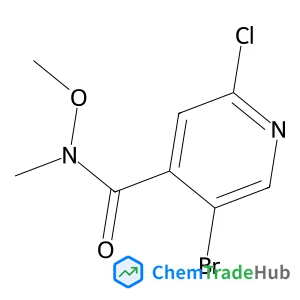
5-Bromo-2-chloro-N-methoxy-N-methylisonicotinamide
CAS Number:
1256790-08-5
Molecular Formula:
C8H8BrClN2O2
Equilibrium structures and energetics of various isomers of molecules with stoichiometry An·4O (An = Pu, Am, and Cm) are studied through electronic structure calculations at the relativistic density functional theory level in the frame of an accurate small-core pseudopotential model. In all cases, the global minima of the An·4O potential energy surfaces correspond to dioxo-superoxido-like species, [AnO2](O2). The stability of the “true” oxides AnO4 decreases from Pu to Cm, whereas the isomers with two O2 groups become relatively more stable. Correlation between the formal oxidation states and the Bader net charges of actinide atoms is discussed. Structural parameters, vibrational frequencies and charge and spin magnetization density distributions are analyzed in order to characterize the different isomers in chemical terms. Decrease of the An oxidation states along the An series is evident.

Acta Metallurgica Sinica-English Letters

Chinese Journal of Chemistry

Bioorganic & Medicinal Chemistry Letters

Herald of the Russian Academy of Sciences

NDT & E International

Medicinal Chemistry Research

Electroanalysis

Bioorganic & Medicinal Chemistry

Heteroatom Chemistry

Journal of Asian Natural Products Research
Yulia V. Nelyubina, Alexey Yu. Sukhorukov, Sema L. Ioffe, Andrey A. Tabolin
DOI: 10.1039/C9OB01005J
Jakub Iwanejko, Anna Brol, Bartłomiej M. Szyja, Marek Daszkiewicz, Elżbieta Wojaczyńska, Tomasz K. Olszewski
DOI: 10.1039/C9OB01346F
Zhengzhou Chu, Chengcai Xia
DOI: 10.1039/C9OB01224A
Mengjun Qiao, Ling Chen, Fengyi Zhou, Yali Zhang, Lingfei Zhou
DOI: 10.1039/C9OB00336C
Pauline Chaumont-Olive, Jacques Maddaluno, Anne Harrison-Marchand
DOI: 10.1039/C9OB00547A
Shivani Sharma, Anuj Sharma
DOI: 10.1039/C9OB00092E
Chun-Lan Xie, Jin-Mei Xia, Cui-Ping Xing, Zhu-Hua Luo, Zongze Shao, Xiao-Jun Yan, Shan He, Xian-Wen Yang
DOI: 10.1039/C9OB01159E
Yuta Nakagawa, Ryuta Sekiguchi, Jun Kawakami, Shunji Ito
DOI: 10.1039/C9OB00763F
(3.beta.)-3-Hydroxy-N,N-dimethyl-chol-5-en-24-amide (CAS: 79066-03-8) is primari...
5-(Aminomethyl)-2-methoxyphenol (CAS: 89702-89-6) is classified under GHS as a s...
Thieno[2,3-c]pyridin-7(6H)-one (CAS: 28981-13-7) is a heterocyclic organic compo...
1-[(6-Methoxy-3-pyridinyl)methyl]-4-piperidinamine dihydrochloride is generally ...
[(2E)-3-Phenyl-2-propen-1-yl]phosphonic acid (CAS: 146404-58-2) is regulated und...
6-Bromo-7-methoxyquinoline (CAS: 1620515-86-7) falls under the scope of the Glob...
This compound is primarily used in the pharmaceutical industry for the developme...
1-Ethyl-7-[2-methyl-6-(4H-1,2,4-triazol-3-yl)-3-pyridinyl]-3,5-dihydropyrazino[2...
Alternative reagents such as 2-[(dimethylamino)methyl]phenylboronic acid or rela...
3-(Piperidin-4-yloxy)pyridine (CAS: 310881-48-2) is an organic compound with the...

Physical Chemistry Chemical Physics (PCCP) is an international journal co-owned by 19 physical chemistry and physics societies from around the world. This journal publishes original, cutting-edge research in physical chemistry, chemical physics and biophysical chemistry. To be suitable for publication in PCCP, articles must include significant innovation and/or insight into physical chemistry; this is the most important criterion that reviewers and Editors will judge against when evaluating submissions. The journal has a broad scope and welcomes contributions spanning experiment, theory, computation and data science. Topical coverage includes spectroscopy, dynamics, kinetics, statistical mechanics, thermodynamics, electrochemistry, catalysis, surface science, quantum mechanics, quantum computing and machine learning. Interdisciplinary research areas such as polymers and soft matter, materials, nanoscience, energy, surfaces/interfaces, and biophysical chemistry are welcomed if they demonstrate significant innovation and/or insight into physical chemistry. Joined experimental/theoretical studies are particularly appreciated when complementary and based on up-to-date approaches.
amine structure](https://static.chemtradehub.com/structs/629/62924-61-2-0728.webp "[(2-chlorophenyl)methyl](ethyl)amine structure")
![N-[(6-Bromo-3-pyridinyl)methyl]ethanamine structure](https://static.chemtradehub.com/structs/120/120740-05-8-ca55.webp "N-[(6-Bromo-3-pyridinyl)methyl]ethanamine structure")