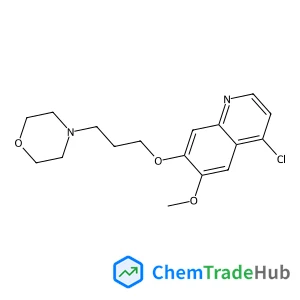
4-(3-((4-Chloro-6-methoxyquinolin-7-yl)oxy)propyl)morpholine
CAS Number:
205448-32-4
Molecular Formula:
C17H21ClN2O3
Lu-Chi Lin, Hung-Ju Yen, Chih-Jung Chen, Chia-Liang Tsai, Guey-Sheng Liou
Novel polybenzoxazines consisting of electron-donating triphenylamine derivatives and electron-withdrawing 4,4′-diphenyl sulfone moieties were successfully prepared by the thermally induced ring-opening reaction of the corresponding PB precursors and utilized for memory devices.
Aizhu Miao, Qi Fan, Yi Lu
DOI: 10.1039/C5AN00101C
Tatyana A. Kuchmenko, Dietrich A. Volmer
DOI: 10.1039/C4AN00806E
Rodolfo L. Coppo, Byron H. Farnum, Benjamin D. Sherman, Neyde Y. Murakami Iha, Thomas J. Meyer
DOI: 10.1039/C6SE00022C
Shalu Bansal, Rajiv Malhotra, Dae-Hwan Kim
DOI: 10.1039/C6SE00035E
Marion André, Jean-Nicolas Dumez
DOI: 10.1039/C5AN00653H
Yang Zhou, Xili Duan
DOI: 10.1039/D0SE00753F
Jianyu Cao, Xiaodi Jia, Mengwei Guo, Yingying Du, Juan Xu
DOI: 10.1039/C7SE00458C
Sebastián Lorca, Florencio Santos, José Abad, Yves Huttel, Antonio Urbina, Antonio J. Fernández Romero
DOI: 10.1039/D0SE00551G
Komal Patil, Pravin Babar, Dong Min Lee, Vijay Karade, Eunae Jo, Jin Hyeok Kim
DOI: 10.1039/D0SE00899K
2-(2-Chloroacetamido)-3-phenylpropanoic acid (CAS: 7765-11-9) is generally consi...
2-(Benzyloxy)-5-bromobenzoic acid can be handled safely if appropriate precautio...
(4-Methyl-1,2,5-oxadiazol-3-yl)methanamine hydrochloride is a chemical compound ...
2-(5-Hexylthiophen-2-yl)-4,4,5,5-tetramethyl-1,3,2-dioxaborolane (CAS: 917985-54...
While 4-(8-Methyl-9H-1,3-dioxolo[4,5-h][2,3]benzodiazepin-5-yl)benzenamine (CAS:...
The market for tert-butyl 3-hydroxy-4,5,7,8-tetrahydro-2H-pyrazolo[3,4-d]azepine...
Waste containing 3,5-Diamino-1H-pyrazole-4-carbonitrile (CAS: 6844-58-2) should ...
(6-Fluoro-3-pyridinyl)boronic acid can be synthesized through the reaction of 6-...
Dibenzyl carbonimidoylbiscarbamate (CAS: 10065-79-9) finds applications in vario...
The market for (beta,beta,2,3,4,5,6-~2~H_7_)Phenylalanine (CAS: 74228-83-4) is g...

ChemComm publishes urgent research which is of outstanding significance and interest to experts in the field, while also appealing to the journal’s broad chemistry readership. Our communication format is ideally suited to short, urgent studies that are of such importance that they require accelerated publication. Our scope covers all topics in chemistry, and research at the interface of chemistry and other disciplines (such as materials science, nanoscience, physics, engineering and biology) where there is a significant novelty in the chemistry aspects. Major topic areas covered include: Analytical Chemistry Catalysis Chemical Biology and medicinal chemistry Computational Chemistry and Machine Learning Energy and sustainable chemistry Environmental Chemistry Green Chemistry Inorganic Chemistry Materials Chemistry Nanoscience Organic Chemistry Physical Chemistry Polymer Chemistry Supramolecular Chemistry