











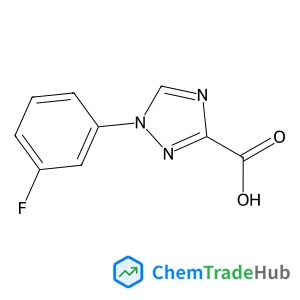
1-(3-Fluorophenyl)-1H-1,2,4-triazole-3-carboxylic acid
CAS Number:
1292369-51-7
Molecular Formula:
C9H6FN3O2
This minireview discusses universal electronic modules (generic programmable units) and their use by analytical chemists to construct inexpensive, miniature or automated devices. Recently, open-source platforms have gained considerable popularity among tech-savvy chemists because their implementation often does not require expert knowledge and investment of funds. Thus, chemistry students and researchers can easily start implementing them after a few hours of reading tutorials and trial-and-error. Single-board microcontrollers and micro-computers such as Arduino, Teensy, Raspberry Pi or BeagleBone enable collecting experimental data with high precision as well as efficient control of electric potentials and actuation of mechanical systems. They are readily programmed using high-level languages, such as C, C++, JavaScript or Python. They can also be coupled with mobile consumer electronics, including smartphones as well as teleinformatic networks. More demanding analytical tasks require fast signal processing. Field-programmable gate arrays enable efficient and inexpensive prototyping of high-performance analytical platforms, thus becoming increasingly popular among analytical chemists. This minireview discusses the advantages and drawbacks of universal electronic modules, considering their application in prototyping and manufacture of intelligent analytical instrumentation.
Hao-Ling Sun, Hongtao Shi, Fei Zhao, Limin Qi, Song Gao
DOI: 10.1039/B507240A
Jing Yang, Daniel Lévy, Wei Deng, Patrick Keller, Min-Hui Li
DOI: 10.1039/B508034G
Yvonne Chiang, A. Jerry Kresge, Ikenna Onyido, John P. Richard, Peter Wan, Musheng Xu
DOI: 10.1039/B506706E
Olalla Nieto Faza, Carlos Silva López, Rosana Álvarez, Ángel R. de Lera
DOI: 10.1039/B506601H
Peter Nockemann, Eva Beurer, Kris Driesen, Rik Van Deun, Kristof Van Hecke, Luc Van Meervelt, Koen Binnemans
DOI: 10.1039/B506915G
D. Krishna Kumar, D. Amilan Jose, Amitava Das, Parthasarathi Dastidar
DOI: 10.1039/B506941F
Jyongsik Jang, Byungkwon Lim, Moonjung Choi
DOI: 10.1039/B506265A
Dirk Jan V. C. van Steenis, Olivier R. P. David, Gino P. F. van Strijdonck, Jan H. van Maarseveen, Joost N. H. Reek
DOI: 10.1039/B507776A
Jeane Bordini, Peter C. Ford, Elia Tfouni
DOI: 10.1039/B507407J
Patrik Västilä, Jenny Wettergren, Hans Adolfsson
DOI: 10.1039/B505516D
Waste containing N-Methoxy-N-methyl-1,3-thiazole-5-carboxamide (CAS: 898825-89-3...
N-(4-Biphenylyl)dibenzo[b,d]furan-4-amine should be stored in a tightly sealed c...
The market for 3-Acetamido-5-amino-2,4,6-triiodobenzoic acid (CAS: 1713-07-1) is...
Benzyl 2-O-acetyl-3,4,6-tri-O-benzyl-beta-D-galactopyranoside (CAS: 61820-03-9) ...
2-Ethylpiperazine dihydrochloride (CAS: 438050-52-3) is regulated under the Glob...
1,1'-[1,3-Phenylenebis(methylene)]bis(3-methyl-1H-pyrrole-2,5-dione) (CAS: 11946...
Several alternatives can be used in the synthesis of 5-Fluoro-2-(1-pyrrolidinyl)...
Proper personal protective equipment (PPE) must be worn when handling this compo...
When handling 6-Bromoimidazo[1,2-a]pyridin-8-amine, it is important to wear appr...
Alternatives to (2S,4R)-4-(4-Nitrobenzyl)pyrrolidine-2-carboxylic acid hydrochlo...

Analyst publishes analytical and bioanalytical research that reports premier fundamental discoveries and inventions, and the applications of those discoveries, unconfined by traditional discipline barriers.

![tert-Butyl 6-chloro-4-oxospiro[chroman-2,4'-piperidine]-1'-carboxylate structure](https://static.chemtradehub.com/structs/101/1011482-37-3-88a5.webp "tert-Butyl 6-chloro-4-oxospiro[chroman-2,4'-piperidine]-1'-carboxylate structure")





