












An instantaneous colorimetric protein assay based on spontaneous formation of a protein corona on gold nanoparticles
Literature Information
Publication Date
2014-12-01
DOI
10.1039/C4AN01819B
Impact Factor
4.616
Authors
Yan Teck Ho, Eugenia Li Ling Yeo, James Chen Yong Kah
View Original
Abstract
Commercial protein assays used ubiquitously in laboratories typically require long incubation times due to the inherently slow protein–reagent reactions. In this study, we report a novel facile technique for the instantaneous measurement of total protein concentration by exploiting the rapid aggregation dynamics of gold nanoparticles (NPs). By adsorbing different amounts of proteins on their surface to form a protein corona, these NPs can be sterically stabilized to different degrees by aggregation, thus exhibiting a spectrum of color change which can be quantitatively characterized by UV-Vis absorption spectroscopy. We evaluated this technique on four model proteins with different structures: bovine serum albumin (BSA), normal mouse immunoglobulin G (IgG), fibrinogen (FBG) and apolipoprotein A-I (Apo-A1) using two approaches, sequential and simultaneous. We obtained an approach-dependent linear concentration range up to 80 μg mL−1 and 400 μg mL−1 for sequential and simultaneous approaches, respectively. This linear working range was wider than that of the commercial Bradford assay and comparable to the Micro BCA assay. The simultaneous approach was also able to produce a linear working range of 200 to 1000 μg mL−1 (R2 = 0.995) in human urine, while the sequential approach was non-functional in urine. Similar to Micro BCA, the NP-based protein assay was able to elicit a linear response (R2 > 0.87) for all four proteins with different structures. However, unlike Micro BCA which requires up to 120 min of incubation, we were able to obtain the read-out almost instantaneously without the need for incubation. The NP-based technique using the simultaneous approach can thus be exploited as a novel assay for instantaneous protein quantification to increase the productivity of laboratory processes.
Related Literature
Allosteric pitch length tuning of a dinuclear double helicate
Christian J. Baylies, John C. Jeffery, Tom A. Miller, Ryan Moon, Craig R. Rice, T. Riis-Johannessen
2005-07-21
Communication
DOI: 10.1039/B506199G
CdTe@Co(OH)2 (core–shell) nanoparticles: aqueous synthesis and characterization
Liang Li, Huifeng Qian, Jicun Ren
2005-07-13
Communication
DOI: 10.1039/B505791D
MCuB7O12·nH2O (M = Na, K ): A new copper borate with 14-ring channels
Tao Yang, Guobao Li, Liping You, Jing Ju, Fuhui Liao, Jianhua Lin
2005-07-26
Communication
DOI: 10.1039/B506901G
The elusive phosphorescence of pyrromethene–BF2 dyes revealed in new multicomponent species containing Ru(ii)–terpyridine subunits
Maurilio Galletta, Sebastiano Campagna, Manuel Quesada, Gilles Ulrich, Raymond Ziessel
2005-07-26
Communication
DOI: 10.1039/B507196H
PNA C–C+i-motif: superior stability of PNA TC8 tetraplexes compared to DNA TC8 tetraplexes at low pH
Nagendra K. Sharma, Krishna N. Ganesh
2005-07-13
Communication
DOI: 10.1039/B506870C
Efficient two-step synthesis of 3-halo-3-enals or 2-halo-2-alkenyl ketones from propargylic bromides via a unique cationic 1,2-aryl or proton shift in electrophilic addition reaction of 2,3-allenols with X+
Chunling Fu, Jing Li
2005-07-13
Communication
DOI: 10.1039/B508069J
Targeting of mixed sequence double-stranded DNA using pyrene-functionalized 2′-amino-α-l-LNA
Patrick J. Hrdlicka, T. Santhosh Kumar, Jesper Wengel
2005-07-21
Communication
DOI: 10.1039/B506986F
Self-repairing polymers: poly(dioxaborolane)s containing trigonal planar boron
Weijun Niu, Caroline O'Sullivan, Brett M. Rambo, Mark D. Smith, John J. Lavigne
2005-07-28
Communication
DOI: 10.1039/B504634C
You might also like
Compound Q&A
How should waste containing N-Methoxy-N-methyl-1,3-thiazole-5-carboxamide (CAS: 898825-89-3) be handled?
Waste containing N-Methoxy-N-methyl-1,3-thiazole-5-carboxamide (CAS: 898825-89-3...
898825-89-3N-Methoxy-N-methyl-1...
Compound Q&A
How should N-(4-Biphenylyl)dibenzo[b,d]furan-4-amine (CAS: 1318338-47-4) be stored?
N-(4-Biphenylyl)dibenzo[b,d]furan-4-amine should be stored in a tightly sealed c...
1318338-47-4N-(4-Biphenylyl)dibe...
Compound Q&A
What is the market or research trend for 3-Acetamido-5-amino-2,4,6-triiodobenzoic acid (CAS: 1713-07-1)?
The market for 3-Acetamido-5-amino-2,4,6-triiodobenzoic acid (CAS: 1713-07-1) is...
1713-07-13-Acetamido-5-amino-...
Compound Q&A
How should Benzyl 2-O-acetyl-3,4,6-tri-O-benzyl-beta-D-galactopyranoside (CAS: 61820-03-9) be stored?
Benzyl 2-O-acetyl-3,4,6-tri-O-benzyl-beta-D-galactopyranoside (CAS: 61820-03-9) ...
61820-03-9Benzyl 2-O-acetyl-3,...
Compound Q&A
What regulatory guidelines apply to 2-Ethylpiperazine dihydrochloride (CAS: 438050-52-3)?
2-Ethylpiperazine dihydrochloride (CAS: 438050-52-3) is regulated under the Glob...
438050-52-32-Ethylpiperazine di...
Compound Q&A
What regulatory guidelines apply to 1,1'-[1,3-Phenylenebis(methylene)]bis(3-methyl-1H-pyrrole-2,5-dione) (CAS: 119462-56-5)?
1,1'-[1,3-Phenylenebis(methylene)]bis(3-methyl-1H-pyrrole-2,5-dione) (CAS: 11946...
119462-56-51,1'-[1,3-Phenyleneb...
Compound Q&A
Are there alternatives to 5-Fluoro-2-(1-pyrrolidinyl)pyridine (CAS: 1287217-79-1) in synthesis?
Several alternatives can be used in the synthesis of 5-Fluoro-2-(1-pyrrolidinyl)...
1287217-79-15-Fluoro-2-(1-pyrrol...
Compound Q&A
What precautions should be taken when handling 1-((2R,3R,4R,5R)-5-((bis(4-methoxyphenyl)(phenyl)methoxy)methyl)-4-hydroxy-3-methoxytetrahydrofuran-2-yl)-5-methylpyrimidine-2,4(1H,3H)-dione (CAS: 153631-19-7)?
Proper personal protective equipment (PPE) must be worn when handling this compo...
153631-19-71-((2R,3R,4R,5R)-5-(...
Compound Q&A
What precautions should be taken when handling 6-Bromoimidazo[1,2-a]pyridin-8-amine (CAS: 676371-00-9)?
When handling 6-Bromoimidazo[1,2-a]pyridin-8-amine, it is important to wear appr...
676371-00-96-Bromoimidazo[1,2-a...
Compound Q&A
Are there alternatives to (2S,4R)-4-(4-Nitrobenzyl)pyrrolidine-2-carboxylic acid hydrochloride (CAS: 1049740-22-8) in synthesis?
Alternatives to (2S,4R)-4-(4-Nitrobenzyl)pyrrolidine-2-carboxylic acid hydrochlo...
1049740-22-8(2S,4R)-4-(4-Nitrobe...
Source Journal
Analyst

CiteScore:
7.8
Self-citation Rate:
5.6%
Articles per Year:
653
Analyst publishes analytical and bioanalytical research that reports premier fundamental discoveries and inventions, and the applications of those discoveries, unconfined by traditional discipline barriers.
Recommended Compounds

![2-Methylbenzo[h]quinoline structure](https://static.chemtradehub.com/structs/605/605-88-9-ac43.webp "2-Methylbenzo[h]quinoline structure")
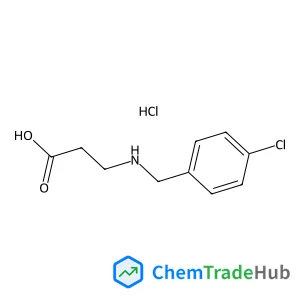
N-(4-Chlorobenzyl)-beta-alanine hydrochloride (1:1)
CAS Number:
1172479-10-5
Molecular Formula:
C10H13Cl2NO2
Recommended Suppliers







Disclaimer
This page provides academic journal information for reference and research purposes only. We are not affiliated with any journal publishers and do not handle publication submissions. For publication-related inquiries, please contact the respective journal publishers directly.
If you notice any inaccuracies in the information displayed, please contact us at support@chemtradehub.com. We will promptly review and address your concerns.