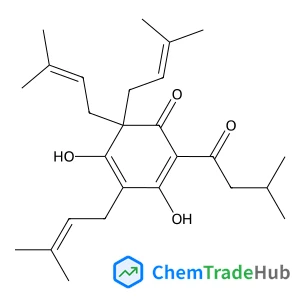
3,5-Dihydroxy-4-(3-methylbutanoyl)-2,6,6-tris(3-methyl-2-buten-1-yl)-2,4-cyclohexadien-1-one
CAS Number:
468-28-0
Molecular Formula:
C26H38O4
Nicolai Bache
Ultra-high pressure liquid chromatography (UHPLC) systems combined with state-of-the-art mass spectrometers have pushed the limit of deep proteome sequencing to new heights making it possible to identify thousands of proteins in a single LC-MS experiment within a few hours. The recently released EASY-spray technology allows one to implement nano-UHPLC with straightforwardness. In this work we initially characterized the EASY-spray containing a 50 cm column containing <2 μm particles and found that the system allowed 3000 proteins to be identified in 90 minutes. We then asked the question whether a fast and sensitive online 2D SCX-RP UHPLC-MS/MS workflow could compete with 1D long gradient analyses, using total analysis time versus proteome coverage and sample usage as benchmark parameters. The 2D LC-MS strategy consisted of the EASY-spray system that had been augmented by the addition of an SCX column. The conversion was made facile since no additional valves were required and by the use of components containing viper fittings. We benchmarked the system using a human cell lysate digest (<10 μg). The 2D SCX-RP UHPLC-MS/MS workflow allowed the identification of almost 37 000 unique peptides and 6000 proteins in a total analysis time of ∼7 hours. On the same system a 1D RP UHPLC-MS/MS workflow plateaued at only 20 000 peptides and 4400 unique proteins and required approx. 8 hours of analysis time. Furthermore, the 2D workflow could continue to increase the proteome coverage with longer analysis times, in fact with a 21 hour analysis we identified 56 600 unique peptides and >7500 proteins. We report, here, that with this fast online SCX-RP UHPLC-MS/MS workflow, the proteome coverage can be substantially extended without significantly compromising the analysis time and sample usage.
Santhia Carmel, Adhithan Pon, N. Meenakshisundaram, R. Ramesh, Arkaprava Bhattacharyya
DOI: 10.1039/C8CP01435C
Sijia S. Dong, Laura Gagliardi, Donald G. Truhlar
DOI: 10.1039/C7CP07275A
Xi Zhang, Yuan Yuan, Longrong Wang, Yanzhi Guo, Menglong Li, Chuan Li, Xuemei Pu
DOI: 10.1039/C8CP02016G
Xiqian Wang, Chenxi Liu, Yuying Jiang, Chiming Wang, Tianyu Wang, Ming Bai, Jianzhuang Jiang
DOI: 10.1039/C7CP08647D
Š. Sršeň, D. Hollas, P. Slavíček
DOI: 10.1039/C8CP00199E
E. López, D. Ascenzi, P. Tosi, J. M. Bofill, J. de Andrés, M. Albertí, J. M. Lucas, A. Aguilar
DOI: 10.1039/C7CP06911A
Dhamodaran Manikandan, S. Amirthapandian, I. S. Zhidkov, A. I. Kukharenko, S. O. Cholakh, Ramaswamy Murugan
DOI: 10.1039/C7CP07182E
Teresa Roncal-Herrero, Alejandro Fernandez-Martinez, Adriana Matamoros-Veloza, Roland Kröger
DOI: 10.1039/C8CP00540K
Milan Rambukwella, Anish Ravishanker, Alessandro Fortunelli, Mauro Stener, Amala Dass
DOI: 10.1039/C8CP01564C
When handling 2-Chloro-1,2-bis(4-methylphenyl)ethanone (CAS: 71193-32-3), it is ...
4-Ethoxy-3-(5-methyl-4-oxo-7-propyl-1,4-dihydroimidazo[5,1-f][1,2,4]triazin-2-yl...
Methyl 3-Oxo-4-Androsten-17-Carboxylate (CAS: 2681-55-2) should be stored in a c...
(R)-3-Amino-4-(3-hexylphenylamino)-4-oxobutylphosphonic acid is primarily used i...
2-Methyl-2-propanyl 3-amino-3-carbamoyl-1-azetidinecarboxylate (CAS: 1254120-14-...
There are alternative reagents that can be used in synthesis instead of (E)-4-(t...
[2-(3-Chlorophenyl)-1,3-thiazol-4-yl]methanol (CAS: 121202-20-8) is a crystallin...
The market and research trends for Methyl (2S)-[(4S)-2,2-dimethyl-1,3-dioxolan-4...
The market for 1-Bromo-2-isocyanatoethane (CAS: 42865-19-0) is driven by its use...
4-Nitro-D-phenylalanine hydrochloride (CAS: 147065-06-3) is primarily used in re...

Analyst publishes analytical and bioanalytical research that reports premier fundamental discoveries and inventions, and the applications of those discoveries, unconfined by traditional discipline barriers.
![4-[2-(Trichlorosilyl)ethyl]benzenesulfonyl chloride structure](https://static.chemtradehub.com/structs/797/79793-00-3-de16.webp "4-[2-(Trichlorosilyl)ethyl]benzenesulfonyl chloride structure")