












Multimodal optical characterisation of collagen photodegradation by femtosecond infrared laser ablation
Literature Information
Publication Date
2014-10-09
DOI
10.1039/C4AN01523A
Impact Factor
4.616
Authors
A. Manickavasagam, L. M. Hirvonen, L. N. Melita, E. Z. Chong, L. Bozec, F. Festy
View Original
Abstract
Collagen is a structural component of the human body, as a connective tissue it can become altered as a result of pathophysiological conditions. Although the collagen degradation mechanism is not fully understood, it plays an important role in ageing, disease progression and applications in therapeutic laser treatments. To fully understand the mechanism of collagen alteration, in our study photo-disruptive effects were induced in collagen I matrix by point-irradiation with a femtosecond Ti-sapphire laser under controlled laser ablation settings. This was followed by multi-modal imaging of the irradiated and surrounding areas to analyse the degradation mechanism. Our multi-modal methodology was based on second harmonic generation (SHG), scanning electron microscope (SEM), autofluorescence (AF) average intensities and the average fluorescence lifetime. This allowed us to quantitatively characterise the degraded area into four distinct zones: (1) depolymerised zone in the laser focal spot as indicated by the loss of SHG signal, (2) enhanced crosslinking zone in the inner boundary of the laser induced cavity as represented by the high fluorescence ring, (3) reduced crosslinking zone formed the outer boundary of the cavity as marked by the increased SHG signal and (4) native collagen. These identified distinct zones were in good agreement with the expected photochemical changes shown using Raman spectroscopy. In addition, imaging using polarisation-resolved SHG (p-SHG) revealed both a high degree of fibre re-orientation and a SHG change in tensor ratios around the irradiation spot. Our multi-modal optical imaging approach can provide a new methodology for defining distinct zones that can be used in a clinical setting to determine suitable thresholds for applying safe laser treatments without affecting the surrounding tissues. Furthermore this technique can be extended to address challenges observed in collagen based tissue engineering and used as a minimally invasive diagnostic tool to characterise diseased and non-diseased collagen rich tissues.
Related Literature
Singlet–triplet energy gaps and the degree of diradical character in binuclear copper molecular magnets characterized by spin-flip density functional theory
Natalie Orms, Anna I. Krylov
2018-01-22
Paper
DOI: 10.1039/C7CP07356A
Anomalous diffusion of water molecules at grain boundaries in ice Ih
Pedro Augusto Franco Pinheiro Moreira, Roberto Gomes de Aguiar Veiga, Ingrid de Almeida Ribeiro, Julian Helfferich
2018-04-30
Paper
DOI: 10.1039/C8CP00933C
Effects of CNT size on the desalination performance of an outer-wall CNT slit membrane
Elisa Y. M. Ang, Teng Yong Ng, Rongming Lin, Zishun Liu, K. R. Geethalakshmi
2018-04-19
Paper
DOI: 10.1039/C8CP01191E
Collisions of noble gas atoms with graphene and a graphene nanodome
Xin Zhang, Shiwei Cao, Zhan Li, Ning Zhang, Ximeng Chen
2018-01-30
Paper
DOI: 10.1039/C7CP07548K
Reactions of SO2 and NH3 with epoxy groups on the surface of graphite oxide powder
Wenjing Xie, Chak-Keung Chan
2018-02-09
Paper
DOI: 10.1039/C8CP00524A
Room temperature chiral reorganization of interfacial assembly of achiral double-decker phthalocyanine
Xiqian Wang, Chenxi Liu, Yuying Jiang, Chiming Wang, Tianyu Wang, Ming Bai, Jianzhuang Jiang
2018-02-14
Paper
DOI: 10.1039/C7CP08647D
A “turn-off” red-emitting fluorophore for nanomolar detection of heparin
Palash Jana, Mithun Radhakrishna, Saumyakanti Khatua, Sriram Kanvah
2018-01-24
Paper
DOI: 10.1039/C7CP06300H
Isomeric organic semiconductors containing fused-thiophene cores: molecular packing and charge transport
Pei Zhou, Yong Wu, Yanzi Xu, Ying Zhi
2018-03-23
Paper
DOI: 10.1039/C7CP08567B
Effects of 1-hexanol on C12E10 micelles: a molecular simulations and light scattering study
Sampsa Vierros, Maria Sammalkorpi
2018-01-31
Paper
DOI: 10.1039/C7CP07511A
Understanding the deformation mechanism and mechanical characteristics of cementitious mineral analogues from first principles and reactive force field molecular dynamics
Jinyang Jiang, Yiru Yan, Dongshuai Hou, Jiao Yu
2018-04-19
Paper
DOI: 10.1039/C7CP08640G
You might also like
Compound Q&A
What precautions should be taken when handling 2-Chloro-1,2-bis(4-methylphenyl)ethanone (CAS: 71193-32-3)?
When handling 2-Chloro-1,2-bis(4-methylphenyl)ethanone (CAS: 71193-32-3), it is ...
71193-32-32-Chloro-1,2-bis(4-m...
Compound Q&A
What industries use 4-Ethoxy-3-(5-methyl-4-oxo-7-propyl-1,4-dihydroimidazo[5,1-f][1,2,4]triazin-2-yl)benzenesulfonyl chloride (CAS: 224789-26-8)?
4-Ethoxy-3-(5-methyl-4-oxo-7-propyl-1,4-dihydroimidazo[5,1-f][1,2,4]triazin-2-yl...
224789-26-84-Ethoxy-3-(5-methyl...
Compound Q&A
How should Methyl 3-Oxo-4-Androsten-17-Carboxylate (CAS: 2681-55-2) be stored?
Methyl 3-Oxo-4-Androsten-17-Carboxylate (CAS: 2681-55-2) should be stored in a c...
2681-55-2Methyl 3-Oxo-4-Andro...
Compound Q&A
What are the main uses of (R)-3-Amino-4-(3-hexylphenylamino)-4-oxobutylphosphonic acid (CAS: 909725-61-7)?
(R)-3-Amino-4-(3-hexylphenylamino)-4-oxobutylphosphonic acid is primarily used i...
909725-61-7(R)-3-Amino-4-(3-hex...
Compound Q&A
What regulatory guidelines apply to 2-Methyl-2-propanyl 3-amino-3-carbamoyl-1-azetidinecarboxylate (CAS: 1254120-14-3)?
2-Methyl-2-propanyl 3-amino-3-carbamoyl-1-azetidinecarboxylate (CAS: 1254120-14-...
1254120-14-32-Methyl-2-propanyl ...
Compound Q&A
Are there alternatives to (E)-4-(tert-Butoxy)-4-oxobut-2-enoic acid (CAS: 135355-96-3) in synthesis?
There are alternative reagents that can be used in synthesis instead of (E)-4-(t...
135355-96-3(E)-4-(tert-Butoxy)-...
Compound Q&A
What are the physical and chemical properties of [2-(3-Chlorophenyl)-1,3-thiazol-4-yl]methanol (CAS: 121202-20-8)?
[2-(3-Chlorophenyl)-1,3-thiazol-4-yl]methanol (CAS: 121202-20-8) is a crystallin...
121202-20-8[2-(3-Chlorophenyl)-...
Compound Q&A
What is the market or research trend for Methyl (2S)-[(4S)-2,2-dimethyl-1,3-dioxolan-4-yl]{[(4-methylphenyl)sulfonyl]oxy}acetate (CAS: 166249-17-8)?
The market and research trends for Methyl (2S)-[(4S)-2,2-dimethyl-1,3-dioxolan-4...
166249-17-8Methyl (2S)-[(4S)-2,...
Compound Q&A
What is the market or research trend for 1-Bromo-2-isocyanatoethane (CAS: 42865-19-0)?
The market for 1-Bromo-2-isocyanatoethane (CAS: 42865-19-0) is driven by its use...
42865-19-01-Bromo-2-isocyanato...
Compound Q&A
What are the main uses of 4-Nitro-D-phenylalanine hydrochloride (CAS: 147065-06-3)?
4-Nitro-D-phenylalanine hydrochloride (CAS: 147065-06-3) is primarily used in re...
147065-06-34-Nitro-D-phenylalan...
Source Journal
Analyst

CiteScore:
7.8
Self-citation Rate:
5.6%
Articles per Year:
653
Analyst publishes analytical and bioanalytical research that reports premier fundamental discoveries and inventions, and the applications of those discoveries, unconfined by traditional discipline barriers.
Recommended Compounds
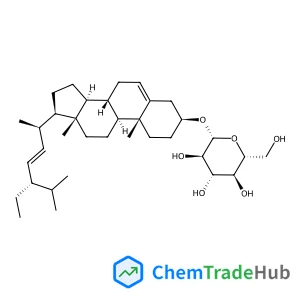
(3beta,22E)-Stigmasta-5,22-dien-3-yl beta-D-glucopyranoside
CAS Number:
19716-26-8
Molecular Formula:
C35H58O6
![4-[2-(Trichlorosilyl)ethyl]benzenesulfonyl chloride structure](https://static.chemtradehub.com/structs/797/79793-00-3-de16.webp "4-[2-(Trichlorosilyl)ethyl]benzenesulfonyl chloride structure")
4-[2-(Trichlorosilyl)ethyl]benzenesulfonyl chloride
CAS Number:
79793-00-3
Molecular Formula:
C8H8Cl4O2SSi

5,7-Dihydroxy-2-(4-hydroxyphenyl)-4-oxo-4H-chromen-3-yl 2-O-(6-deoxy-alpha-L-mannopyranosyl)-beta-D-glucopyranoside
CAS Number:
32602-81-6
Molecular Formula:
C27H30O15
Recommended Suppliers






Disclaimer
This page provides academic journal information for reference and research purposes only. We are not affiliated with any journal publishers and do not handle publication submissions. For publication-related inquiries, please contact the respective journal publishers directly.
If you notice any inaccuracies in the information displayed, please contact us at support@chemtradehub.com. We will promptly review and address your concerns.