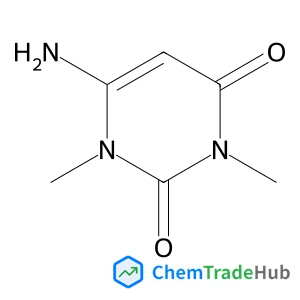
6-amino-1,3-dimethyl-1,2,3,4-tetrahydropyrimidine-2,4-dione
CAS Number:
6642-31-5
Molecular Formula:
C6H9N3O2
Wenbo Wu, Cheng Ye, Jingui Qin, Zhen Li
In this article, according to the concept of “suitable isolation group”, four new polyaryleneethynylenes containing azo-chromophore moieties derived from the same AB2-type monomer were prepared through a typical Sonogashira reaction successfully, in which different isolation groups in different size (from H to carbazole) were introduced to the periphery of the hyperbranched polymers as end-capped moieties via highly efficient “click chemistry” reaction under copper(I) catalysis. Due to the different end-capped groups, these hyperbranched polymers (P1–P4) exhibited different NLO properties accordingly, realizing the adjustment of the properties of hyperbranched polymers through the structural design. Among them, P4, with carbazole as “suitable isolation group”, demonstrated the best performance with the SHG coefficient of 113.8 pm V−1 and the onset temperatures for decays in d33 value (Tonset) of 132 °C.
Michael E. Foster, Karl Sohlberg
DOI: 10.1039/B912859J
Jyun-Lin Wu, Hsin-Fu Kuo, Ping-Tzu Chen, Hung-Jen Chen, Su-Jien Lin, Wen-Kuang Hsu
DOI: 10.1039/C0CP00890G
Alexander Gaiduk, Paul V. Ruijgrok, Mustafa Yorulmaz, Michel Orrit
DOI: 10.1039/C0CP01389G
Manh-Thuong Nguyen, Carlo A. Pignedoli, Daniele Passerone
DOI: 10.1039/C0CP00759E
Mijeong Kang, Okhil Kumar Nag, Sungu Hwang, Inhong Kim, Haesik Yang, Kwangseuk Kyhm
DOI: 10.1039/C0CP01025A
Lucia Flamigni, Dagmara Wyrostek, Roman Voloshchuk, Daniel T. Gryko
DOI: 10.1039/B916525H
Pekka Pyykkö
DOI: 10.1039/C0CP01575J
Ian P. Silverwood, Neil G. Hamilton, Christian J. Laycock, John Z. Staniforth, R. Mark Ormerod, Christopher D. Frost, Stewart F. Parker, David Lennon
DOI: 10.1039/B919977B
Sungnam Park, Jeongho Kim, Andrew M. Moran, Norbert F. Scherer
DOI: 10.1039/C0CP01252A
M. T. M Koper
DOI: 10.1039/B912091B
4-Nitrophenyl phosphate disodium salt hexahydrate is primarily used as a substra...
2-(Trifluoromethyl)-1,3-oxazole-4-carboxylic Acid (CAS: 1060816-01-4) is widely ...
2-Fluoro-4-biphenylcarboxylic acid should be stored in a cool, dry place at room...
Prednisolone-21-Carboxylic Acid is primarily used in the pharmaceutical industry...
4-(Hydrazinomethyl)-1,2,3-benzenetriol (CAS: 3614-72-0) should be stored in a co...
4-Amino-1-methyl-1H-pyrazole-5-carboxylic acid hydrochloride (CAS: 92534-70-8) i...
Dehydropachymic acid (CAS: 77012-31-8) is regulated by various agencies. It fall...
The market and research trends for 6-[(2,2-Dimethylpropanoyl)amino]nicotinic aci...
1,10-Phenanthroline-2,9-dicarbaldehyde should be stored in a cool, dry place awa...
5-Carbamoyl-11-oxo-10,11-dihydro-5H-dibenzo[b,f]azepin-10-yl acetate can be synt...

Polymer Chemistry welcomes submissions in all areas of polymer science that have a strong focus on macromolecular chemistry. Manuscripts may cover a broad range of fields, yet no direct application focus is required.
![1,1',1'',1'''-[Disulfanediylbis(carbonothioylnitrilo)]tetraethane structure](https://static.chemtradehub.com/structs/97-/97-77-8-f3e4.webp "1,1',1'',1'''-[Disulfanediylbis(carbonothioylnitrilo)]tetraethane structure")