












![Imidazo[1,2-c]pyrimidine structure](https://static.chemtradehub.com/structs/274/274-78-2-8b4c.webp "Imidazo[1,2-c]pyrimidine structure")
Alkoxide-functionalized imidazolium betaines for CO2 activation and catalytic transformation
Literature Information
Publication Date
2013-12-20
DOI
10.1039/C3GC42346H
Impact Factor
10.182
Authors
Yan-Bo Wang, Dong-Sheng Sun, Hui Zhou, Wen-Zhen Zhang, Xiao-Bing Lu
View Original
Abstract
Alkoxide-functionalized imidazolium betaines (AFIBs), including an alkoxide anion and an imidazolium cation, were synthesized by treating potassium tert-butoxide with 1-(2-hydroxyethyl)-2,3-disubstituted imidazolium bromide. The novel betaines were able to quickly capture CO2, affording carboxylate zwitterions (AFIB-CO2 adducts). In the presence of adventitious water, the transformation of the AFIB-CO2 adducts into the corresponding bicarbonate salts was observed by 1H and 13C NMR spectroscopy. The structures of the AFIB bicarbonate salts were solved using single crystal X-ray crystallography. Furthermore, the dithiocarboxylate zwitterions (AFIB-CS2 adducts), which are more stable to moisture in comparison with their CO2 adducts, were prepared by reacting CS2 with the corresponding betaines. X-Ray single crystal analysis revealed the bent geometry of the binding CS2 in the dithiocarboxylate zwitterions with a S–C–S angle of 126.6–126.9°, which indirectly confirms the structures of the AFIB-CO2 adducts in hand. These AFIB-CO2 adducts were found to function as organocatalysts for the coupling reaction of propargylic alcohols with CO2 for selectively producing valuable cyclic carbonates under mild and solvent-free reaction conditions.
Recommended Journals
Related Literature
Rapid detection of metal impurities on the surfaces of intact objects with irregular shapes using electrochemical mass spectrometry
Lili Song, Jiaquan Xu, Dacai Zhong, Konstantin Chingin, Ying Qu, Huanwen Chen
2019-03-27
Paper
DOI: 10.1039/C8AN02472C
Removing interference-based effects from the infrared transflectance spectra of thin films on metallic substrates: a fast and wave optics conform solution
Susanne Pahlow, Uwe Hübner
2018-06-04
Paper
DOI: 10.1039/C8AN00526E
A highly specific and ultrasensitive probe for the imaging of inflammation-induced endogenous hypochlorous acid
Wei Hu, Donghua Wang, Zhiqiang Mao, Zhihong Liu
2019-04-11
Paper
DOI: 10.1039/C9AN00390H
Sensitive detection of antibiotics using aptamer conformation cooperated enzyme-assisted SERS technology
Qianqian Fang, Yingying Li, Xinxing Miao, Yiqiu Zhang, Jun Yan, Tainrong Yu, Jian Liu
2019-05-10
Paper
DOI: 10.1039/C9AN00190E
A hybrid model combining wavelet transform and recursive feature elimination for running state evaluation of heat-resistant steel using laser-induced breakdown spectroscopy
Chunyi Liu, Jong H. Yoo
2019-04-05
Paper
DOI: 10.1039/C9AN00370C
T7 exo-mediated FRET-breaking combined with DSN–RNAse–TdT for the detection of microRNA with ultrahigh signal-amplification
Van Thang Nguyen, Binh Huy Le
2019-04-05
Communication
DOI: 10.1039/C9AN00303G
Inkjet-printed micro-calibration standards for ultraquantitative Raman spectral cytometry
Vernon LaLone, Maria V. Fawaz, Jomar Morales-Mercado, Márcio A. Mourão, Catherine S. Snyder, Sang Yeop Kim, Andrew P. Lieberman, Theodore J. Standiford, Krishnan Raghavendran, Kerby Shedden, Anna Schwendeman, Gus R. Rosania
2019-05-16
Paper
DOI: 10.1039/C9AN00500E
A quadruple-channel fluorescent sensor array based on label-free carbon dots for sensitive detection of tetracyclines
Dengying Long, Jingdong Peng, Huanjun Peng, Hong Xian, Shiyu Li, Xiang Wang, Jun Chen, Zhongying Zhang, Ranxi Ni
2019-04-01
Paper
DOI: 10.1039/C9AN00148D
Highly sensitive and selective light-up fluorescent probe for monitoring gallium and chromium ions in vitro and in vivo
Xiaojun He, Chenglin Wu, Yuna Qian, Yahui Li, Lilei Zhang, Feng Ding, Hong Chen
2019-05-07
Paper
DOI: 10.1039/C9AN00625G
Reaction-based fluorometric analysis of N-bromosuccinimide by oxidative deprotection of dithiane
Yu Jeong Lee, Myung Gil Choi, Tae Jung Park, Suk-Kyu Chang
2019-04-06
Paper
DOI: 10.1039/C8AN02125B
You might also like
Compound Q&A
What precautions should be taken when handling 4-Methyl-6-(trifluoromethyl)quinoline (CAS: 40716-16-3)?
When handling 4-Methyl-6-(trifluoromethyl)quinoline (CAS: 40716-16-3), safety go...
40716-16-34-Methyl-6-(trifluor...
Compound Q&A
What is 4-(3,5-Difluorophenyl)aniline (CAS: 405058-00-6)?
4-(3,5-Difluorophenyl)aniline is an aromatic organic compound with the CAS numbe...
405058-00-64-(3,5-Difluoropheny...
Compound Q&A
How is 5-{[4-(Trifluoromethyl)phenyl]sulfanyl}-1,2,3-thiadiazole-4-carboxylic acid (CAS: 338982-07-3) typically synthesized?
5-{[4-(Trifluoromethyl)phenyl]sulfanyl}-1,2,3-thiadiazole-4-carboxylic acid can ...
338982-07-35-{[4-(Trifluorometh...
Compound Q&A
What is the market or research trend for 4-Benzylaniline hydrochloride (CAS: 6317-57-3)?
The market for 4-Benzylaniline hydrochloride (CAS: 6317-57-3) is steadily growin...
6317-57-34-Benzylaniline hydr...
Compound Q&A
Is [3-(Diethylsulfamoyl)phenyl]boronic acid (CAS: 871329-58-7) safe?
[3-(Diethylsulfamoyl)phenyl]boronic acid is generally considered safe when handl...
871329-58-7[3-(Diethylsulfamoyl...
Compound Q&A
What are the main uses of 3-Bromo-2,5-dimethoxyaniline (CAS: 115929-62-9)?
3-Bromo-2,5-dimethoxyaniline is mainly used in the pharmaceutical and chemical i...
115929-62-93-Bromo-2,5-dimethox...
Compound Q&A
What regulatory guidelines apply to N-Methyl-1-(5-methyl-1H-indol-3-yl)methanamine (CAS: 915922-67-7)?
N-Methyl-1-(5-methyl-1H-indol-3-yl)methanamine (CAS: 915922-67-7) is subject to ...
915922-67-7N-Methyl-1-(5-methyl...
Compound Q&A
What industries use Carbamic acid, N-[(5S)-5,6-diamino-6-oxohexyl]-, 1,1-dimethylethyl ester (CAS: 24828-96-4)?
This compound is primarily used in the pharmaceutical industry for the synthesis...
24828-96-4Carbamic acid, N-[(5...
Compound Q&A
How should 2-Methyl-2-propanyl [(1S,3R)-3-aminocyclohexyl]carbamate (CAS: 1298101-47-9) be stored?
2-Methyl-2-propanyl [(1S,3R)-3-aminocyclohexyl]carbamate (CAS: 1298101-47-9) sho...
1298101-47-92-Methyl-2-propanyl ...
Compound Q&A
What industries use Ethyl 2-bromo-4,4,4-trifluorobutanoate (CAS: 367-33-9)?
Ethyl 2-bromo-4,4,4-trifluorobutanoate (CAS: 367-33-9) is utilized in the pharma...
367-33-9Ethyl 2-bromo-4,4,4-...
Source Journal
Green Chemistry

CiteScore:
16.1
Self-citation Rate:
7.5%
Articles per Year:
944
Green Chemistry provides a unique forum for the publication of innovative research on the development of alternative green and sustainable technologies. The scope of Green Chemistry is based on, but not limited to, the definition proposed by Anastas and Warner (Green Chemistry: Theory and Practice, P T Anastas and J C Warner, Oxford University Press, Oxford, 1998). Green chemistry is the utilisation of a set of principles that reduces or eliminates the use or generation of hazardous substances in the design, manufacture and application of chemical products. Green Chemistry is at the frontiers of this continuously-evolving interdisciplinary science and publishes research that attempts to reduce the environmental impact of the chemical enterprise by developing a technology base that is inherently non-toxic to living things and the environment. Submissions on all aspects of research relating to the endeavour are welcome. The journal publishes original and significant cutting-edge research that is likely to be of wide general appeal. To be published, work must present a significant advance in green chemistry. Papers must contain a comparison with existing methods and demonstrate advantages over those methods before publication can be considered. For more information please see this Editorial. Coverage includes the following, but is not limited to: Design (e.g. biomimicry, design for degradation/recycling/reduced toxicity…) Reagents & Feedstocks (e.g. renewables, CO2, solvents, auxiliary agents, waste utilization…) Synthesis (e.g. organic, inorganic, synthetic biology…) Catalysis (e.g. homogeneous, heterogeneous, enzyme, whole cell…) Process (e.g. process design, intensification, separations, recycling, efficiency…) Energy (e.g. renewable energy, fuels, photovoltaics, fuel cells, energy storage, energy carriers…) Applications (e.g. electronics, dyes, consumer products, coatings, pharmaceuticals, preservatives, building materials, chemicals for industry/agriculture/mining…) Impact (e.g. safety, metrics, LCA, sustainability, (eco)toxicology…) Green chemistry is, by definition, a continuously-evolving frontier. Therefore, the inclusion of a particular material or technology does not, of itself, guarantee that a paper is suitable for the journal. To be suitable, the novel advance should have the potential for reduced environmental impact relative to the state of the art. Green Chemistry does not normally deal with research associated with 'end-of-pipe' or remediation issues.
Recommended Compounds
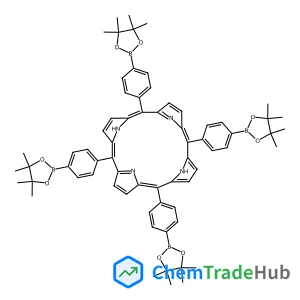
5,10,15,20-tetrakis(4-boronic acid pinacol ester phenyl) porphyrin
CAS Number:
1332748-00-1
Molecular Formula:
C68H74B4N4O8
![Methyl 3-({2'-[(E)-(hydroxyhydrazono)methyl]-4-biphenylyl}methyl)-2-oxo-2,3-dihydro-1H-benzimidazole-4-carboxylate structure](https://static.chemtradehub.com/structs/149/1499167-72-4-034a.webp "Methyl 3-({2'-[(E)-(hydroxyhydrazono)methyl]-4-biphenylyl}methyl)-2-oxo-2,3-dihydro-1H-benzimidazole-4-carboxylate structure")
Methyl 3-({2'-[(E)-(hydroxyhydrazono)methyl]-4-biphenylyl}methyl)-2-oxo-2,3-dihydro-1H-benzimidazole-4-carboxylate
CAS Number:
1499167-72-4
Molecular Formula:
C23H20N4O4
![N-{3-[Benzyl(methyl)amino]propyl}-9-chloro-5,6,7,8-tetrahydro-2-acridinecarboxamide structure](https://static.chemtradehub.com/structs/142/1426944-49-1-1e4c.webp "N-{3-[Benzyl(methyl)amino]propyl}-9-chloro-5,6,7,8-tetrahydro-2-acridinecarboxamide structure")
N-{3-[Benzyl(methyl)amino]propyl}-9-chloro-5,6,7,8-tetrahydro-2-acridinecarboxamide
CAS Number:
1426944-49-1
Molecular Formula:
C25H28ClN3O
Recommended Suppliers





Disclaimer
This page provides academic journal information for reference and research purposes only. We are not affiliated with any journal publishers and do not handle publication submissions. For publication-related inquiries, please contact the respective journal publishers directly.
If you notice any inaccuracies in the information displayed, please contact us at support@chemtradehub.com. We will promptly review and address your concerns.