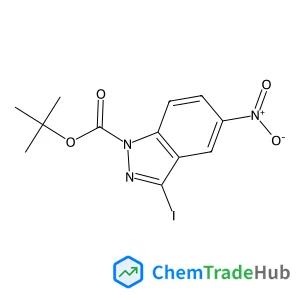
Tert-butyl 3-iodo-5-nitro-1H-indazole-1-carboxylate
CAS Number:
459133-69-8
Molecular Formula:
C12H12IN3O4
Evan A. Davey, Esteban E. Ureña-Benavides
The properties and some key applications of solvents such as (1) supercritical fluids (SCFs), (2) gas-expanded liquids (GXLs) and organic-aqueous tunable solvents (OATS), (3) water at elevated temperature (WET), and (4) switchable solvents like reversible ionic liquids (RevILs) are discussed in this review. Each system offers a unique set of properties to enable alternative strategies for varied applications. These applications range from chemical transformations, product separation, catalyst recycling, nanomaterial processing, and CO2 capture. For each application, however, the common thrust is to enable greener and sustainable solutions for chemical processes.
Wafaa Waleed Al-Qaysi, Axel Duerkop
DOI: 10.1039/C8AN00775F
Hsiao-Mei Wu, Tse-Ang Lee, Ping-Liang Ko, Wei-Hao Liao, Tung-Han Hsieh
DOI: 10.1039/C9AN00143C
Jingwei Liu, Zheng Yin
DOI: 10.1039/C9AN00377K
Merve Eryılmaz, Esra Acar Soykut, Demet Çetin, İsmail Hakkı Boyacı, Zekiye Suludere, Uğur Tamer
DOI: 10.1039/C9AN00173E
Jin-Shuai Lan, Rui-Feng Zeng, Yun Liu, Yan-Wei Xiang, Xiao-yi Jiang, Li Liu, Sai-Sai Xie, Yue Ding, Tong Zhang
DOI: 10.1039/C9AN00280D
Lili Song, Jiaquan Xu, Dacai Zhong, Konstantin Chingin, Ying Qu, Huanwen Chen
DOI: 10.1039/C8AN02472C
Dan Yuan, Yongxin Liu, Jilie Kong, Qin Chen
DOI: 10.1039/C9AN00394K
Cuiling Zhang, Dan Li, Dongwei Li, Kai Wen, Xingdong Yang, Ye Zhu
DOI: 10.1039/C9AN00427K
Shing Chung Lam, Estrella Sanz Rodriguez, Paul R. Haddad, Brett Paull
DOI: 10.1039/C9AN00329K
Hamdi Joda, Geoffrey Stone, Sylvia Daunert, Sapna Deo
DOI: 10.1039/C8AN00047F
When handling 4-Methyl-6-(trifluoromethyl)quinoline (CAS: 40716-16-3), safety go...
4-(3,5-Difluorophenyl)aniline is an aromatic organic compound with the CAS numbe...
5-{[4-(Trifluoromethyl)phenyl]sulfanyl}-1,2,3-thiadiazole-4-carboxylic acid can ...
The market for 4-Benzylaniline hydrochloride (CAS: 6317-57-3) is steadily growin...
[3-(Diethylsulfamoyl)phenyl]boronic acid is generally considered safe when handl...
3-Bromo-2,5-dimethoxyaniline is mainly used in the pharmaceutical and chemical i...
N-Methyl-1-(5-methyl-1H-indol-3-yl)methanamine (CAS: 915922-67-7) is subject to ...
This compound is primarily used in the pharmaceutical industry for the synthesis...
2-Methyl-2-propanyl [(1S,3R)-3-aminocyclohexyl]carbamate (CAS: 1298101-47-9) sho...
Ethyl 2-bromo-4,4,4-trifluorobutanoate (CAS: 367-33-9) is utilized in the pharma...

Green Chemistry provides a unique forum for the publication of innovative research on the development of alternative green and sustainable technologies. The scope of Green Chemistry is based on, but not limited to, the definition proposed by Anastas and Warner (Green Chemistry: Theory and Practice, P T Anastas and J C Warner, Oxford University Press, Oxford, 1998). Green chemistry is the utilisation of a set of principles that reduces or eliminates the use or generation of hazardous substances in the design, manufacture and application of chemical products. Green Chemistry is at the frontiers of this continuously-evolving interdisciplinary science and publishes research that attempts to reduce the environmental impact of the chemical enterprise by developing a technology base that is inherently non-toxic to living things and the environment. Submissions on all aspects of research relating to the endeavour are welcome. The journal publishes original and significant cutting-edge research that is likely to be of wide general appeal. To be published, work must present a significant advance in green chemistry. Papers must contain a comparison with existing methods and demonstrate advantages over those methods before publication can be considered. For more information please see this Editorial. Coverage includes the following, but is not limited to: Design (e.g. biomimicry, design for degradation/recycling/reduced toxicity…) Reagents & Feedstocks (e.g. renewables, CO2, solvents, auxiliary agents, waste utilization…) Synthesis (e.g. organic, inorganic, synthetic biology…) Catalysis (e.g. homogeneous, heterogeneous, enzyme, whole cell…) Process (e.g. process design, intensification, separations, recycling, efficiency…) Energy (e.g. renewable energy, fuels, photovoltaics, fuel cells, energy storage, energy carriers…) Applications (e.g. electronics, dyes, consumer products, coatings, pharmaceuticals, preservatives, building materials, chemicals for industry/agriculture/mining…) Impact (e.g. safety, metrics, LCA, sustainability, (eco)toxicology…) Green chemistry is, by definition, a continuously-evolving frontier. Therefore, the inclusion of a particular material or technology does not, of itself, guarantee that a paper is suitable for the journal. To be suitable, the novel advance should have the potential for reduced environmental impact relative to the state of the art. Green Chemistry does not normally deal with research associated with 'end-of-pipe' or remediation issues.
![Imidazo[1,2-c]pyrimidine structure](https://static.chemtradehub.com/structs/274/274-78-2-8b4c.webp "Imidazo[1,2-c]pyrimidine structure")