












Aerobic oxidation of isosorbide and isomannide employing TEMPO/laccase
Literature Information
Publication Date
2014-01-30
DOI
10.1039/C3GC41855C
Impact Factor
10.182
Authors
Johannes Gross, Katharina Tauber, Michael Fuchs, Nina G. Schmidt, Aashrita Rajagopalan, Kurt Faber, Walter M. F. Fabian, Jan Pfeffer, Thomas Haas, Wolfgang Kroutil
View Original
Abstract
The oxidation of the renewable diols isosorbide and isomannide was successfully achieved using a TEMPO/laccase system. Furthermore, various TEMPO-derivatives were tested leading to conversions of up to >99% for the oxidation of isosorbide, isomannide, indanol and a halohydrin to the corresponding ketone.
Related Literature
Photophysical properties of pyrrolocytosine, a cytosine fluorescent base analogue
Quynh L. Nguyen, Vincent A. Spata, Spiridoula Matsika
2016-05-20
Paper
DOI: 10.1039/C6CP01559J
Unravelling the optical responses of nanoplasmonic mirror-on-mirror metamaterials
Debabrata Sikdar, Shakeeb B. Hasan, Michael Urbakh, Joshua B. Edel, Alexei A. Kornyshev
2016-07-05
Paper
DOI: 10.1039/C6CP04551K
Why is the electroanalytical performance of carbon paste electrodes involving an ionic liquid binder higher than paraffinic binders? A simulation investigation
M. H. Ghatee, S. Namvar, A. R. Zolghadr, F. Moosavi
2015-07-15
Paper
DOI: 10.1039/C5CP02683K
Alkali metal ion induced cube shaped mesoporous hematite particles for improved magnetic properties and efficient degradation of water pollutants
Mouni Roy, Milan Kanti Naskar
2016-07-01
Paper
DOI: 10.1039/C6CP02442D
Near infrared absorbing near infrared emitting highly-sensitive luminescent nanothermometer based on Nd3+ to Yb3+ energy transfer
Ł. Marciniak, A. Bednarkiewicz, M. Stefanski, R. Tomala, D. Hreniak, W. Strek
2015-08-17
Paper
DOI: 10.1039/C5CP03861H
Vertical heterostructures of MoS2 and graphene nanoribbons grown by two-step chemical vapor deposition for high-gain photodetectors
Rozan Mohamad Yunus, Hiroko Endo
2015-09-01
Paper
DOI: 10.1039/C5CP03958D
Effects of substituents on fluorometric detection of cyanide anions by indolium–coumarin dyads
Masaya Nakamura, Takayuki Hirai
2015-08-27
Paper
DOI: 10.1039/C5CP03877D
Unified reaction pathways for the prebiotic formation of RNA and DNA nucleobases
Yassin Aweis Jeilani, Phoenix N. Williams, Sofia Walton, Minh Tho Nguyen
2016-05-10
Paper
DOI: 10.1039/C6CP02686A
Anomalous system-size dependence of electrolytic cells with an electrified oil–water interface
Niels Boon, René van Roij
2015-08-27
Paper
DOI: 10.1039/C5CP02945G
100 fs photo-isomerization with vibrational coherences but low quantum yield in Anabaena Sensory Rhodopsin
Alexandre Cheminal, Jérémie Léonard, So-Young Kim, Kwang-Hwan Jung, Hideki Kandori, Stefan Haacke
2015-09-03
Paper
DOI: 10.1039/C5CP04353K
You might also like
Compound Q&A
What precautions should be taken when handling 4-Methyl-6-(trifluoromethyl)quinoline (CAS: 40716-16-3)?
When handling 4-Methyl-6-(trifluoromethyl)quinoline (CAS: 40716-16-3), safety go...
40716-16-34-Methyl-6-(trifluor...
Compound Q&A
What is 4-(3,5-Difluorophenyl)aniline (CAS: 405058-00-6)?
4-(3,5-Difluorophenyl)aniline is an aromatic organic compound with the CAS numbe...
405058-00-64-(3,5-Difluoropheny...
Compound Q&A
How is 5-{[4-(Trifluoromethyl)phenyl]sulfanyl}-1,2,3-thiadiazole-4-carboxylic acid (CAS: 338982-07-3) typically synthesized?
5-{[4-(Trifluoromethyl)phenyl]sulfanyl}-1,2,3-thiadiazole-4-carboxylic acid can ...
338982-07-35-{[4-(Trifluorometh...
Compound Q&A
What is the market or research trend for 4-Benzylaniline hydrochloride (CAS: 6317-57-3)?
The market for 4-Benzylaniline hydrochloride (CAS: 6317-57-3) is steadily growin...
6317-57-34-Benzylaniline hydr...
Compound Q&A
Is [3-(Diethylsulfamoyl)phenyl]boronic acid (CAS: 871329-58-7) safe?
[3-(Diethylsulfamoyl)phenyl]boronic acid is generally considered safe when handl...
871329-58-7[3-(Diethylsulfamoyl...
Compound Q&A
What are the main uses of 3-Bromo-2,5-dimethoxyaniline (CAS: 115929-62-9)?
3-Bromo-2,5-dimethoxyaniline is mainly used in the pharmaceutical and chemical i...
115929-62-93-Bromo-2,5-dimethox...
Compound Q&A
What regulatory guidelines apply to N-Methyl-1-(5-methyl-1H-indol-3-yl)methanamine (CAS: 915922-67-7)?
N-Methyl-1-(5-methyl-1H-indol-3-yl)methanamine (CAS: 915922-67-7) is subject to ...
915922-67-7N-Methyl-1-(5-methyl...
Compound Q&A
What industries use Carbamic acid, N-[(5S)-5,6-diamino-6-oxohexyl]-, 1,1-dimethylethyl ester (CAS: 24828-96-4)?
This compound is primarily used in the pharmaceutical industry for the synthesis...
24828-96-4Carbamic acid, N-[(5...
Compound Q&A
How should 2-Methyl-2-propanyl [(1S,3R)-3-aminocyclohexyl]carbamate (CAS: 1298101-47-9) be stored?
2-Methyl-2-propanyl [(1S,3R)-3-aminocyclohexyl]carbamate (CAS: 1298101-47-9) sho...
1298101-47-92-Methyl-2-propanyl ...
Compound Q&A
What industries use Ethyl 2-bromo-4,4,4-trifluorobutanoate (CAS: 367-33-9)?
Ethyl 2-bromo-4,4,4-trifluorobutanoate (CAS: 367-33-9) is utilized in the pharma...
367-33-9Ethyl 2-bromo-4,4,4-...
Source Journal
Green Chemistry

CiteScore:
16.1
Self-citation Rate:
7.5%
Articles per Year:
944
Green Chemistry provides a unique forum for the publication of innovative research on the development of alternative green and sustainable technologies. The scope of Green Chemistry is based on, but not limited to, the definition proposed by Anastas and Warner (Green Chemistry: Theory and Practice, P T Anastas and J C Warner, Oxford University Press, Oxford, 1998). Green chemistry is the utilisation of a set of principles that reduces or eliminates the use or generation of hazardous substances in the design, manufacture and application of chemical products. Green Chemistry is at the frontiers of this continuously-evolving interdisciplinary science and publishes research that attempts to reduce the environmental impact of the chemical enterprise by developing a technology base that is inherently non-toxic to living things and the environment. Submissions on all aspects of research relating to the endeavour are welcome. The journal publishes original and significant cutting-edge research that is likely to be of wide general appeal. To be published, work must present a significant advance in green chemistry. Papers must contain a comparison with existing methods and demonstrate advantages over those methods before publication can be considered. For more information please see this Editorial. Coverage includes the following, but is not limited to: Design (e.g. biomimicry, design for degradation/recycling/reduced toxicity…) Reagents & Feedstocks (e.g. renewables, CO2, solvents, auxiliary agents, waste utilization…) Synthesis (e.g. organic, inorganic, synthetic biology…) Catalysis (e.g. homogeneous, heterogeneous, enzyme, whole cell…) Process (e.g. process design, intensification, separations, recycling, efficiency…) Energy (e.g. renewable energy, fuels, photovoltaics, fuel cells, energy storage, energy carriers…) Applications (e.g. electronics, dyes, consumer products, coatings, pharmaceuticals, preservatives, building materials, chemicals for industry/agriculture/mining…) Impact (e.g. safety, metrics, LCA, sustainability, (eco)toxicology…) Green chemistry is, by definition, a continuously-evolving frontier. Therefore, the inclusion of a particular material or technology does not, of itself, guarantee that a paper is suitable for the journal. To be suitable, the novel advance should have the potential for reduced environmental impact relative to the state of the art. Green Chemistry does not normally deal with research associated with 'end-of-pipe' or remediation issues.
Recommended Compounds
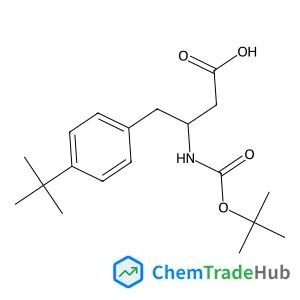
(S)-3-((tert-Butoxycarbonyl)amino)-4-(4-(tert-butyl)phenyl)butanoic acid
CAS Number:
403661-85-8
Molecular Formula:
C19H29NO4
Recommended Suppliers






Disclaimer
This page provides academic journal information for reference and research purposes only. We are not affiliated with any journal publishers and do not handle publication submissions. For publication-related inquiries, please contact the respective journal publishers directly.
If you notice any inaccuracies in the information displayed, please contact us at support@chemtradehub.com. We will promptly review and address your concerns.