












Synthesis of polyacrylonitrile copolymers as potential carbon fibre precursors in CO2
Literature Information
Publication Date
2013-11-21
DOI
10.1039/C3GC41677A
Impact Factor
10.182
Authors
Vladimir V. Bagrov, Peter S. Timashev
View Original
Abstract
Binary and ternary acrylonitrile (AN) copolymers with methyl acrylate (MA) and either itaconic acid (IA, 1) or IA derivatives (monomethyl itaconate (2), monoethyl itaconate (3), IA monoamide (4), IA mono-n-octylamide (5)) were prepared in CO2. The obtained copolymers have good morphological and molecular weight characteristics. They demonstrate broad heat evolution during thermal cyclisation according to DSC measurements; therefore, they may be used to produce carbon fibres. The polymer yield per reaction volume is 2 to 3 times higher relative to that produced in solution (in DMSO or DMF) or an aqueous suspension.
Related Literature
THz time-domain spectroscopy of mixed CO2–CH3OH interstellar ice analogs
2016-06-07
Paper
DOI: 10.1039/C6CP00632A
Double deuterated acetylacetone in neon matrices: infrared spectroscopy, photoreactivity and the tunneling process
Michèle Chevalier, Claudine Crépin
2016-06-27
Paper
DOI: 10.1039/C6CP02796B
A molecular theory for optimal blue energy extraction by electrical double layer expansion
Alejandro Gallegos, Diannan Lu, Zheng Liu, Jianzhong Wu
2015-08-19
Paper
DOI: 10.1039/C5CP03514G
First-principles analysis of the spectroscopic limited maximum efficiency of photovoltaic absorber layers for CuAu-like chalcogenides and silicon
Marnik Bercx, Nasrin Sarmadian, Rolando Saniz, Bart Partoens, Dirk Lamoen
2016-07-07
Paper
DOI: 10.1039/C6CP03468C
Nonadiabatic dynamics of floppy hydrogen bonded complexes: the case of the ionized ammonia dimer
Jan Chalabala, Petr Slavíček
2016-06-29
Paper
DOI: 10.1039/C6CP02714H
Deformation twinning and the role of amino acids and magnesium in calcite hardness from molecular simulation
A. S. Côté, R. Darkins, D. M. Duffy
2015-07-13
Paper
DOI: 10.1039/C5CP03370E
π-Ring currents in doped coronenes with nitrogen and boron: diatropic–paratropic duality
Inmaculada García Cuesta, Barnaby Pownall, Stefano Pelloni, Alfredo M. Sánchez de Merás
2015-08-26
Paper
DOI: 10.1039/C5CP03732H
Thermoelectric performance enhancement of Mg2Sn based solid solutions by band convergence and phonon scattering via Pb and Si/Ge substitution for Sn
Binghui Ge, Qing Jie, Udara Saparamadu, Weishu Liu, Zhifeng Ren
2016-07-04
Paper
DOI: 10.1039/C6CP03944H
Anomalous system-size dependence of electrolytic cells with an electrified oil–water interface
Niels Boon, René van Roij
2015-08-27
Paper
DOI: 10.1039/C5CP02945G
Phosphoryl transfer reaction catalyzed by membrane diacylglycerol kinase: a theoretical mechanism study
Yafei Jiang, Hongwei Tan, Jimin Zheng, Xichen Li, Guangju Chen, Zongchao Jia
2015-08-24
Paper
DOI: 10.1039/C5CP03342J
You might also like
Compound Q&A
What precautions should be taken when handling 4-Methyl-6-(trifluoromethyl)quinoline (CAS: 40716-16-3)?
When handling 4-Methyl-6-(trifluoromethyl)quinoline (CAS: 40716-16-3), safety go...
40716-16-34-Methyl-6-(trifluor...
Compound Q&A
What is 4-(3,5-Difluorophenyl)aniline (CAS: 405058-00-6)?
4-(3,5-Difluorophenyl)aniline is an aromatic organic compound with the CAS numbe...
405058-00-64-(3,5-Difluoropheny...
Compound Q&A
How is 5-{[4-(Trifluoromethyl)phenyl]sulfanyl}-1,2,3-thiadiazole-4-carboxylic acid (CAS: 338982-07-3) typically synthesized?
5-{[4-(Trifluoromethyl)phenyl]sulfanyl}-1,2,3-thiadiazole-4-carboxylic acid can ...
338982-07-35-{[4-(Trifluorometh...
Compound Q&A
What is the market or research trend for 4-Benzylaniline hydrochloride (CAS: 6317-57-3)?
The market for 4-Benzylaniline hydrochloride (CAS: 6317-57-3) is steadily growin...
6317-57-34-Benzylaniline hydr...
Compound Q&A
Is [3-(Diethylsulfamoyl)phenyl]boronic acid (CAS: 871329-58-7) safe?
[3-(Diethylsulfamoyl)phenyl]boronic acid is generally considered safe when handl...
871329-58-7[3-(Diethylsulfamoyl...
Compound Q&A
What are the main uses of 3-Bromo-2,5-dimethoxyaniline (CAS: 115929-62-9)?
3-Bromo-2,5-dimethoxyaniline is mainly used in the pharmaceutical and chemical i...
115929-62-93-Bromo-2,5-dimethox...
Compound Q&A
What regulatory guidelines apply to N-Methyl-1-(5-methyl-1H-indol-3-yl)methanamine (CAS: 915922-67-7)?
N-Methyl-1-(5-methyl-1H-indol-3-yl)methanamine (CAS: 915922-67-7) is subject to ...
915922-67-7N-Methyl-1-(5-methyl...
Compound Q&A
What industries use Carbamic acid, N-[(5S)-5,6-diamino-6-oxohexyl]-, 1,1-dimethylethyl ester (CAS: 24828-96-4)?
This compound is primarily used in the pharmaceutical industry for the synthesis...
24828-96-4Carbamic acid, N-[(5...
Compound Q&A
How should 2-Methyl-2-propanyl [(1S,3R)-3-aminocyclohexyl]carbamate (CAS: 1298101-47-9) be stored?
2-Methyl-2-propanyl [(1S,3R)-3-aminocyclohexyl]carbamate (CAS: 1298101-47-9) sho...
1298101-47-92-Methyl-2-propanyl ...
Compound Q&A
What industries use Ethyl 2-bromo-4,4,4-trifluorobutanoate (CAS: 367-33-9)?
Ethyl 2-bromo-4,4,4-trifluorobutanoate (CAS: 367-33-9) is utilized in the pharma...
367-33-9Ethyl 2-bromo-4,4,4-...
Source Journal
Green Chemistry

CiteScore:
16.1
Self-citation Rate:
7.5%
Articles per Year:
944
Green Chemistry provides a unique forum for the publication of innovative research on the development of alternative green and sustainable technologies. The scope of Green Chemistry is based on, but not limited to, the definition proposed by Anastas and Warner (Green Chemistry: Theory and Practice, P T Anastas and J C Warner, Oxford University Press, Oxford, 1998). Green chemistry is the utilisation of a set of principles that reduces or eliminates the use or generation of hazardous substances in the design, manufacture and application of chemical products. Green Chemistry is at the frontiers of this continuously-evolving interdisciplinary science and publishes research that attempts to reduce the environmental impact of the chemical enterprise by developing a technology base that is inherently non-toxic to living things and the environment. Submissions on all aspects of research relating to the endeavour are welcome. The journal publishes original and significant cutting-edge research that is likely to be of wide general appeal. To be published, work must present a significant advance in green chemistry. Papers must contain a comparison with existing methods and demonstrate advantages over those methods before publication can be considered. For more information please see this Editorial. Coverage includes the following, but is not limited to: Design (e.g. biomimicry, design for degradation/recycling/reduced toxicity…) Reagents & Feedstocks (e.g. renewables, CO2, solvents, auxiliary agents, waste utilization…) Synthesis (e.g. organic, inorganic, synthetic biology…) Catalysis (e.g. homogeneous, heterogeneous, enzyme, whole cell…) Process (e.g. process design, intensification, separations, recycling, efficiency…) Energy (e.g. renewable energy, fuels, photovoltaics, fuel cells, energy storage, energy carriers…) Applications (e.g. electronics, dyes, consumer products, coatings, pharmaceuticals, preservatives, building materials, chemicals for industry/agriculture/mining…) Impact (e.g. safety, metrics, LCA, sustainability, (eco)toxicology…) Green chemistry is, by definition, a continuously-evolving frontier. Therefore, the inclusion of a particular material or technology does not, of itself, guarantee that a paper is suitable for the journal. To be suitable, the novel advance should have the potential for reduced environmental impact relative to the state of the art. Green Chemistry does not normally deal with research associated with 'end-of-pipe' or remediation issues.
Recommended Compounds
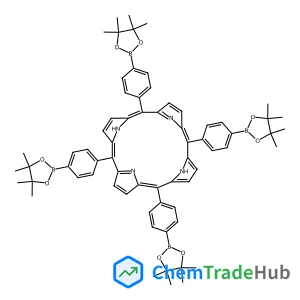
5,10,15,20-tetrakis(4-boronic acid pinacol ester phenyl) porphyrin
CAS Number:
1332748-00-1
Molecular Formula:
C68H74B4N4O8
![(4aR,5S,6R,8aS)-5-[2-(3-Furyl)ethyl]-8a-(hydroxymethyl)-5,6-dimethyl-3,4,4a,5,6,7,8,8a-octahydro-1-naphthalenecarboxylic acid structure](https://static.chemtradehub.com/structs/184/18411-75-1-d4cd.webp "(4aR,5S,6R,8aS)-5-[2-(3-Furyl)ethyl]-8a-(hydroxymethyl)-5,6-dimethyl-3,4,4a,5,6,7,8,8a-octahydro-1-naphthalenecarboxylic acid structure")
(4aR,5S,6R,8aS)-5-[2-(3-Furyl)ethyl]-8a-(hydroxymethyl)-5,6-dimethyl-3,4,4a,5,6,7,8,8a-octahydro-1-naphthalenecarboxylic acid
CAS Number:
18411-75-1
Molecular Formula:
C20H28O4
Recommended Suppliers





Disclaimer
This page provides academic journal information for reference and research purposes only. We are not affiliated with any journal publishers and do not handle publication submissions. For publication-related inquiries, please contact the respective journal publishers directly.
If you notice any inaccuracies in the information displayed, please contact us at support@chemtradehub.com. We will promptly review and address your concerns.