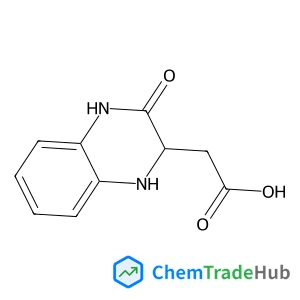
(3-Oxo-1,2,3,4-tetrahydro-2-quinoxalinyl)acetic acid
CAS Number:
136584-14-0
Molecular Formula:
C10H10N2O3
Rafael Martín-Rapún, Sonia Sayalero
A polystyrene-supported, pyrrolidine-based catalyst depicting very high activity and excellent stereoselectivity in the anti-Mannich reaction of aldehydes and ketones has been developed. The very robust, immobilized catalyst has been successfully used in the implementation of a continuous flow process with short residence times (down to 6 min) for the production of highly enantioenriched anti-type Mannich adducts at the preparative scale.

Green Chemistry

Current Pharmaceutical Biotechnology

Nature Reviews Drug Discovery

Journal of Enzyme inhibition and Medicinal Chemistry

Mini-Reviews in Medicinal Chemistry

Advanced Engineering Materials

Faraday Discussions

Physical Chemistry Chemical Physics

European Journal of Organic Chemistry

Molecular Diversity
DOI: 10.1039/D3SC04287A
Jonathan E. Tsang, David A. Nathanson
DOI: 10.1039/D3SC04424F
Daniele Mazzarella, Tommaso Bortolato, Giorgio Pelosi, Luca Dell'Amico
DOI: 10.1039/D3SC05997A
Ran Liu, Zheng Liu, Mohan Chen, Hang Xing, Penghui Zhang, Jingjing Zhang
DOI: 10.1039/D3SC04249A
Kang-Jie Bian, David Nemoto, Jr, Xiao-Wei Chen, Shih-Chieh Kao, James Hooson, Julian G. West
DOI: 10.1039/D3SC05231A
Qiuhong Cheng, Aiyou Hao, Pengyao Xing
DOI: 10.1039/D3SC05212E
Rebecca L. Spicer, Helen M. O'Connor, Yael Ben-Tal, Hang Zhou, Patrick J. Boaler, Fraser C. Milne, Euan K. Brechin, Guy. C. Lloyd-Jones, Paul J. Lusby
DOI: 10.1039/D3SC04877B
Charlie Ruffman, Krista G. Steenbergen, Anna L. Garden, Nicola Gaston
DOI: 10.1039/D3SC04416E
When handling 4-(2-Furylmethyl)thiomorpholine 1,1-dioxide (CAS: 79206-94-3), it ...
When handling 4-Chloro-N-[2-(4-morpholinyl)ethyl]benzamide (CAS: 71320-77-9), it...
Waste containing this compound (CAS: 62921-74-8) should be handled according to ...
Waste containing (S)-Methyl 2-amino-3-cyclohexylpropanoate should be collected i...
This compound can be synthesized using a multi-step process involving the conjug...
There are several alternatives to (2E)-3-(3,4-Dichlorophenyl)acrylic acid in syn...
Ethyl 6-(2-nitrophenyl)imidazo[2,1-b][1,3]thiazole-3-carboxylate (CAS: 925437-84...
Waste containing 2-(1,3-Thiazol-2-yl)ethanamine (CAS: 18453-07-1) should be coll...
Methyl 5-iodo-2-methylbenzoate can be synthesized through the iodination of meth...
5-Chloro[1,2,4]triazolo[1,5-a]pyridine is commonly synthesized via the condensat...
Green Chemistry provides a unique forum for the publication of innovative research on the development of alternative green and sustainable technologies. The scope of Green Chemistry is based on, but not limited to, the definition proposed by Anastas and Warner (Green Chemistry: Theory and Practice, P T Anastas and J C Warner, Oxford University Press, Oxford, 1998). Green chemistry is the utilisation of a set of principles that reduces or eliminates the use or generation of hazardous substances in the design, manufacture and application of chemical products. Green Chemistry is at the frontiers of this continuously-evolving interdisciplinary science and publishes research that attempts to reduce the environmental impact of the chemical enterprise by developing a technology base that is inherently non-toxic to living things and the environment. Submissions on all aspects of research relating to the endeavour are welcome. The journal publishes original and significant cutting-edge research that is likely to be of wide general appeal. To be published, work must present a significant advance in green chemistry. Papers must contain a comparison with existing methods and demonstrate advantages over those methods before publication can be considered. For more information please see this Editorial. Coverage includes the following, but is not limited to: Design (e.g. biomimicry, design for degradation/recycling/reduced toxicity…) Reagents & Feedstocks (e.g. renewables, CO2, solvents, auxiliary agents, waste utilization…) Synthesis (e.g. organic, inorganic, synthetic biology…) Catalysis (e.g. homogeneous, heterogeneous, enzyme, whole cell…) Process (e.g. process design, intensification, separations, recycling, efficiency…) Energy (e.g. renewable energy, fuels, photovoltaics, fuel cells, energy storage, energy carriers…) Applications (e.g. electronics, dyes, consumer products, coatings, pharmaceuticals, preservatives, building materials, chemicals for industry/agriculture/mining…) Impact (e.g. safety, metrics, LCA, sustainability, (eco)toxicology…) Green chemistry is, by definition, a continuously-evolving frontier. Therefore, the inclusion of a particular material or technology does not, of itself, guarantee that a paper is suitable for the journal. To be suitable, the novel advance should have the potential for reduced environmental impact relative to the state of the art. Green Chemistry does not normally deal with research associated with 'end-of-pipe' or remediation issues.
![6-Benzyl-4,5,6,7-tetrahydro-1H-pyrazolo[3,4-c]pyridin-3(2H)-one structure](https://static.chemtradehub.com/structs/909/909187-64-0-f54f.webp "6-Benzyl-4,5,6,7-tetrahydro-1H-pyrazolo[3,4-c]pyridin-3(2H)-one structure")