












Thiazolium-functionalized polystyrene monolithic microreactors for continuous-flow umpolung catalysis
Literature Information
Publication Date
2013-08-19
DOI
10.1039/C3GC41284A
Impact Factor
10.182
Authors
Olga Bortolini, Alberto Cavazzini, Paolo Dambruoso, Pier Paolo Giovannini, Lorenzo Caciolli, Alessandro Massi, Salvatore Pacifico, Daniele Ragno
View Original
Abstract
Thiazolium salt pre-catalysts have been immobilized on silica and monolithic polystyrene and their activity was tested under batch conditions in three model umpolung reactions, namely the benzoin condensation of benzaldehyde, the acyloin-type condensation of biacetyl, and the Stetter reaction of biacetyl with trans-chalcone. A prerequisite of the study has been the utilization of environmentally benign water and ethanol solvents. After having established the higher performance of polystyrene monolithic thiazolium carbene catalysts, their effectiveness has been tested under the flow regime by fabricating the corresponding monolithic microreactors (pressure-resistant stainless-steel columns). Importantly, it has been demonstrated by a brief substrate scope study that the polymeric matrix and the continuous flow regime synergistically contribute to preserve the activity of the carbene catalysts over time, thus permitting the long-term operation (up to 7 days) of the prepared monolithic reactors for the production of valuable compounds via the umpolung strategy.
Recommended Journals
Related Literature
Regioselective Zn(OAc)2-catalyzed azide–alkyne cycloaddition in water: the green click-chemistry
Maria A. Morozova, Mekhman S. Yusubov, Václav Eigner, Alexander A. Bondarev, Akio Saito, Marina E. Trusova, Pavel S. Postnikov
2017-02-08
Research Article
DOI: 10.1039/C6QO00787B
Pyrene-fused bisphenazinothiadiazoles with red to NIR electroluminescence
Diego Cortizo-Lacalle, Antonio Pertegás, Manuel Melle-Franco, Henk J. Bolink
2017-04-10
Research Article
DOI: 10.1039/C7QO00227K
Radical cation and dication of a 4H-dithieno[2,3-b:3′,2′-e][1,4]-thiazine‡
Arno Schneeweis, Andreas Neidlinger, Guido J. Reiss, Walter Frank, Katja Heinze, Thomas J. J. Müller
2017-04-04
Research Article
DOI: 10.1039/C7QO00188F
Selective deprotonation of tetra[3,4]thienylene in the presence of n-BuLi
Bingbing Li, Chunli Li, Zhiying Ma, Li Xu, Hua Wang
2017-02-06
Research Article
DOI: 10.1039/C6QO00754F
A copper-catalyzed arylation/nucleophilic addition/fragmentation/C–S bond formation cascade: synthesis of bis(arylthio)imines
Wei-Si Guo, Yuan-Chao Wang, Qian Dou, Li-Rong Wen, Ming Li
2017-01-03
Research Article
DOI: 10.1039/C6QO00739B
A theoretical study on quasi-one-dimensional open-shell singlet ladder oligomers: multi-radical nature, aromaticity and second hyperpolarizability
Kotaro Fukuda, Jun-ya Fujiyoshi, Hiroshi Matsui, Takanori Nagami, Shota Takamuku, Benoît Champagne
2017-03-06
Research Article
DOI: 10.1039/C7QO00108H
Visible light enabled γ-trifluoromethylation of Baylis–Hillman acetates: stereoselective synthesis of trisubstituted alkenes
Arvind Kumar Yadav, Anup Kumar Sharma, Krishna Nand Singh
2019-02-14
Research Article
DOI: 10.1039/C9QO00166B
Synthesis of largely π-extended naphthalenediimides via C–H activation towards highly soluble and narrow band-gap organic optoelectronic materials
Wenting Wu, Zheng Zhao, Xiaodi Yang, Xike Gao
2017-03-22
Research Article
DOI: 10.1039/C7QO00061H
Manganese-mediated reductive amidation of esters with nitroarenes
Chi Wai Cheung, Ni Shen, Shao-Peng Wang, Asim Ullah, Xile Hu, Jun-An Ma
2019-01-30
Research Article
DOI: 10.1039/C8QO01405A
Site-selective oxidative C–H sulfonylation of 8-acylaminoquinolines and anilides under metal-free conditions
Dong Li
2017-01-03
Research Article
DOI: 10.1039/C6QO00730A
You might also like
Compound Q&A
What precautions should be taken when handling 4-Methyl-6-(trifluoromethyl)quinoline (CAS: 40716-16-3)?
When handling 4-Methyl-6-(trifluoromethyl)quinoline (CAS: 40716-16-3), safety go...
40716-16-34-Methyl-6-(trifluor...
Compound Q&A
What is 4-(3,5-Difluorophenyl)aniline (CAS: 405058-00-6)?
4-(3,5-Difluorophenyl)aniline is an aromatic organic compound with the CAS numbe...
405058-00-64-(3,5-Difluoropheny...
Compound Q&A
How is 5-{[4-(Trifluoromethyl)phenyl]sulfanyl}-1,2,3-thiadiazole-4-carboxylic acid (CAS: 338982-07-3) typically synthesized?
5-{[4-(Trifluoromethyl)phenyl]sulfanyl}-1,2,3-thiadiazole-4-carboxylic acid can ...
338982-07-35-{[4-(Trifluorometh...
Compound Q&A
What is the market or research trend for 4-Benzylaniline hydrochloride (CAS: 6317-57-3)?
The market for 4-Benzylaniline hydrochloride (CAS: 6317-57-3) is steadily growin...
6317-57-34-Benzylaniline hydr...
Compound Q&A
Is [3-(Diethylsulfamoyl)phenyl]boronic acid (CAS: 871329-58-7) safe?
[3-(Diethylsulfamoyl)phenyl]boronic acid is generally considered safe when handl...
871329-58-7[3-(Diethylsulfamoyl...
Compound Q&A
What are the main uses of 3-Bromo-2,5-dimethoxyaniline (CAS: 115929-62-9)?
3-Bromo-2,5-dimethoxyaniline is mainly used in the pharmaceutical and chemical i...
115929-62-93-Bromo-2,5-dimethox...
Compound Q&A
What regulatory guidelines apply to N-Methyl-1-(5-methyl-1H-indol-3-yl)methanamine (CAS: 915922-67-7)?
N-Methyl-1-(5-methyl-1H-indol-3-yl)methanamine (CAS: 915922-67-7) is subject to ...
915922-67-7N-Methyl-1-(5-methyl...
Compound Q&A
What industries use Carbamic acid, N-[(5S)-5,6-diamino-6-oxohexyl]-, 1,1-dimethylethyl ester (CAS: 24828-96-4)?
This compound is primarily used in the pharmaceutical industry for the synthesis...
24828-96-4Carbamic acid, N-[(5...
Compound Q&A
How should 2-Methyl-2-propanyl [(1S,3R)-3-aminocyclohexyl]carbamate (CAS: 1298101-47-9) be stored?
2-Methyl-2-propanyl [(1S,3R)-3-aminocyclohexyl]carbamate (CAS: 1298101-47-9) sho...
1298101-47-92-Methyl-2-propanyl ...
Compound Q&A
What industries use Ethyl 2-bromo-4,4,4-trifluorobutanoate (CAS: 367-33-9)?
Ethyl 2-bromo-4,4,4-trifluorobutanoate (CAS: 367-33-9) is utilized in the pharma...
367-33-9Ethyl 2-bromo-4,4,4-...
Source Journal
Green Chemistry

CiteScore:
16.1
Self-citation Rate:
7.5%
Articles per Year:
944
Green Chemistry provides a unique forum for the publication of innovative research on the development of alternative green and sustainable technologies. The scope of Green Chemistry is based on, but not limited to, the definition proposed by Anastas and Warner (Green Chemistry: Theory and Practice, P T Anastas and J C Warner, Oxford University Press, Oxford, 1998). Green chemistry is the utilisation of a set of principles that reduces or eliminates the use or generation of hazardous substances in the design, manufacture and application of chemical products. Green Chemistry is at the frontiers of this continuously-evolving interdisciplinary science and publishes research that attempts to reduce the environmental impact of the chemical enterprise by developing a technology base that is inherently non-toxic to living things and the environment. Submissions on all aspects of research relating to the endeavour are welcome. The journal publishes original and significant cutting-edge research that is likely to be of wide general appeal. To be published, work must present a significant advance in green chemistry. Papers must contain a comparison with existing methods and demonstrate advantages over those methods before publication can be considered. For more information please see this Editorial. Coverage includes the following, but is not limited to: Design (e.g. biomimicry, design for degradation/recycling/reduced toxicity…) Reagents & Feedstocks (e.g. renewables, CO2, solvents, auxiliary agents, waste utilization…) Synthesis (e.g. organic, inorganic, synthetic biology…) Catalysis (e.g. homogeneous, heterogeneous, enzyme, whole cell…) Process (e.g. process design, intensification, separations, recycling, efficiency…) Energy (e.g. renewable energy, fuels, photovoltaics, fuel cells, energy storage, energy carriers…) Applications (e.g. electronics, dyes, consumer products, coatings, pharmaceuticals, preservatives, building materials, chemicals for industry/agriculture/mining…) Impact (e.g. safety, metrics, LCA, sustainability, (eco)toxicology…) Green chemistry is, by definition, a continuously-evolving frontier. Therefore, the inclusion of a particular material or technology does not, of itself, guarantee that a paper is suitable for the journal. To be suitable, the novel advance should have the potential for reduced environmental impact relative to the state of the art. Green Chemistry does not normally deal with research associated with 'end-of-pipe' or remediation issues.
Recommended Compounds
![6-Bromo-3-ethyl-3H-imidazo[4,5-b]pyridine structure](https://static.chemtradehub.com/structs/103/1033202-59-3-2a8f.webp "6-Bromo-3-ethyl-3H-imidazo[4,5-b]pyridine structure")
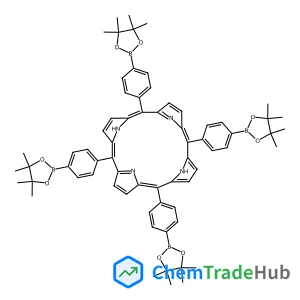
5,10,15,20-tetrakis(4-boronic acid pinacol ester phenyl) porphyrin
CAS Number:
1332748-00-1
Molecular Formula:
C68H74B4N4O8
Recommended Suppliers



Disclaimer
This page provides academic journal information for reference and research purposes only. We are not affiliated with any journal publishers and do not handle publication submissions. For publication-related inquiries, please contact the respective journal publishers directly.
If you notice any inaccuracies in the information displayed, please contact us at support@chemtradehub.com. We will promptly review and address your concerns.